The CTCF Zinc Finger Domain: Structural Insights, DNA Binding Mechanisms, and Therapeutic Implications
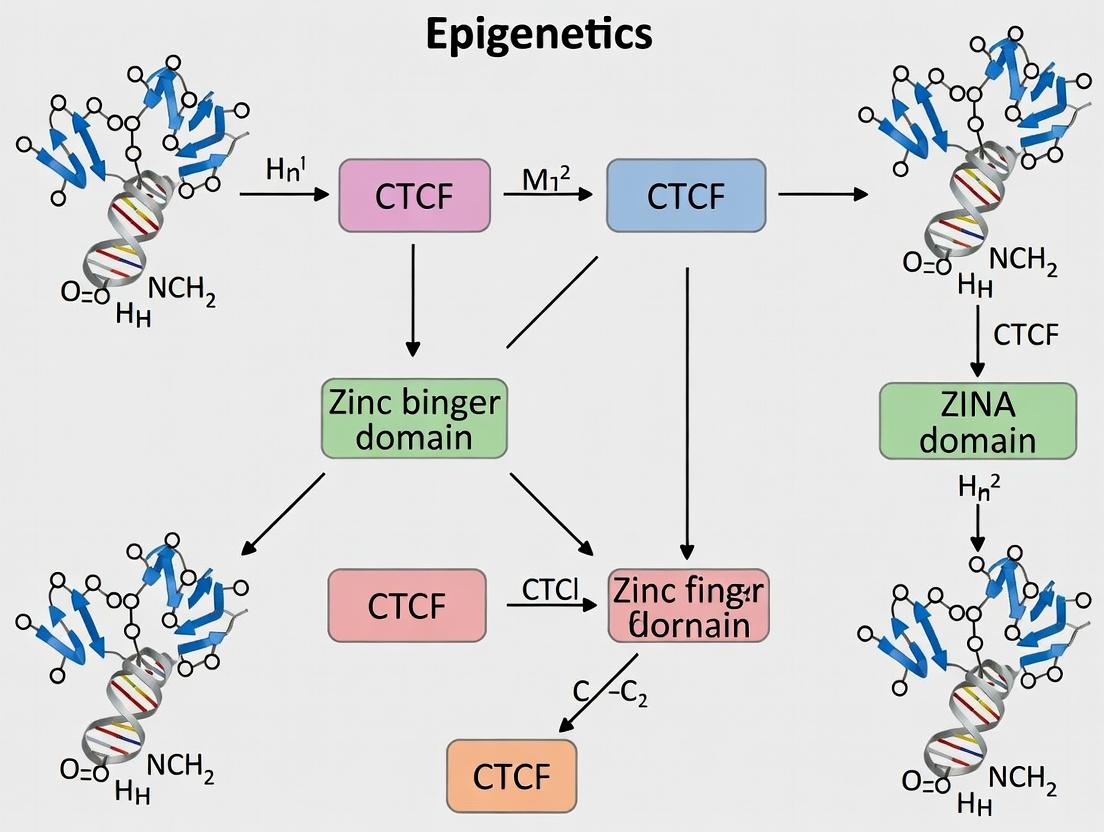
This article provides a comprehensive analysis of the CCCTC-binding factor (CTCF) zinc finger DNA binding domain, a critical architectural protein in genome organization and gene regulation.
The CTCF Zinc Finger Domain: Structural Insights, DNA Binding Mechanisms, and Therapeutic Implications
Abstract
This article provides a comprehensive analysis of the CCCTC-binding factor (CTCF) zinc finger DNA binding domain, a critical architectural protein in genome organization and gene regulation. We first establish the foundational molecular architecture of its 11 zinc fingers and the combinatorial recognition of diverse DNA sequences. Methodologically, we detail experimental and computational approaches for studying its structure and interactions. We address common challenges in experimental characterization and data interpretation. Finally, we validate structural models through comparative analysis with other zinc finger proteins and disease-associated mutations. This resource is designed for researchers and drug development professionals exploring 3D genome architecture and targeting transcription factors.
Unraveling the Architectural Blueprint: The Structural Basis of CTCF's DNA Binding Domain
CCCTC-binding factor (CTCF) is an essential nuclear protein with a pivotal role in the three-dimensional organization of chromatin. It acts as a master genome organizer, insulating genes from inappropriate enhancer signals, facilitating long-range chromatin interactions, and serving as a boundary element between topologically associating domains (TADs). This whitepaper frames CTCF function within the broader context of zinc finger (ZF) DNA binding domain (DBD) structure research. The central thesis posits that the modular, multivalent architecture of CTCF—a direct consequence of its specific ZF composition and arrangement—is the primary determinant of its diverse genomic functions and its role as a central hub in the chromatin architecture network. Understanding the structure-function relationship of its ZF DBD is therefore critical for deciphering the cis-regulatory code of the genome and for developing therapeutic interventions targeting chromatin organization in disease.
Modular Domain Architecture of CTCF
CTCF is a multi-domain protein with 11 highly conserved zinc fingers (ZF1-11) at its center, flanked by unstructured N- and C-terminal regions. The ZF domains are not equivalent; they form distinct modules responsible for differential DNA binding, RNA interaction, and protein partnering.
Table 1: Domain Architecture and Functions of Human CTCF
| Domain/Region | Residues (Approx.) | Key Structural Features | Primary Functions |
|---|---|---|---|
| N-Terminus | 1-275 | Intrinsically disordered, low complexity | Recruitment of cohesion complex; transactivation; protein interactions. |
| Central Zinc Fingers (ZF) | 276-600 | 11 C2H2-type zinc fingers | Sequence-specific DNA binding; RNA binding (via ZF1-10). |
| Linker Region | ~600-620 | Between ZF10-11 | Critical for DNA-binding versatility. |
| C-Terminus | 621-727 | Intrinsically disordered | Dimerization; interaction with other chromatin regulators. |
The 11 ZFs are the core DNA-binding module. ZF3-7 are primarily responsible for recognizing the core 12-15 bp motif, while ZF1-2, 8, and 9-11 interact with variable flanking sequences, enabling CTCF to bind a vast repertoire of ~50,000 divergent genomic sites.
The Zinc Finger DNA-Binding Domain: Structural Insights
Recent structural biology studies, primarily via X-ray crystallography and Cryo-EM, have illuminated how CTCF's ZF array engages DNA. The ZFs are arranged in a semi-rigid, right-handed superhelix that wraps around the major groove of DNA.
Table 2: Key Structural Studies on CTCF Zinc Finger Domain (2018-2024)
| Study (Key Author, Year) | Method | Key Findings | Relevance to Thesis |
|---|---|---|---|
| Hashimoto et al., 2022 | Cryo-EM | Solved structure of full 11-ZF CTCF in complex with nucleosome-bound DNA. | Revealed how ZF1-2 and ZF9-11 read flanking sequences, enabling binding site diversity. |
| Li et al., 2020 | X-ray Crystallography | Detailed structure of ZF3-8 bound to conserved core motif. | Defined the precise base-readout contacts and the role of ZF7 in anchoring. |
| Nakahashi et al., 2023 | Cross-linking Mass Spec (XL-MS) + MD | Mapped conformational dynamics of the full ZF array. | Showed modular flexibility: ZF1-10 and ZF11 act as semi-independent units. |
A critical finding is the modular sub-division of the DBD. ZF1-10 form a continuous DNA-binding unit, while ZF11, connected by a flexible linker, can swing away or participate in binding, a feature essential for CTCF's orientation-specific function in chromatin loop formation.
Title: CTCF Modular Zinc Finger DNA Binding Mechanism
Detailed Experimental Protocol: Electrophoretic Mobility Shift Assay (EMSA) for CTCF-DNA Binding
Purpose: To assess sequence-specific DNA binding of recombinant CTCF ZF domain and measure binding affinity (Kd).
Materials:
- Recombinant Protein: Purified human CTCF ZF domain (ZF1-11, residues 275-600) in storage buffer (20 mM HEPES pH 7.5, 150 mM KCl, 10% glycerol, 1 mM DTT).
- DNA Probe: 5'-Cy5 labeled double-stranded 55-bp oligonucleotide containing a consensus CTCF binding motif. Prepare by annealing complementary strands.
- Binding Buffer (5X): 100 mM HEPES pH 7.9, 250 mM KCl, 25 mM MgCl2, 5 mM DTT, 50% glycerol, 0.5% NP-40.
- Competitor DNA: Unlabeled specific (same sequence) and non-specific (random sequence) DNA.
- Polyacrylamide Gel: 6% non-denaturing gel in 0.5X TBE buffer.
- Equipment: Vertical gel electrophoresis unit, fluorescence scanner or phosphorimager.
Procedure:
- Reaction Setup: In a 20 µL reaction, combine 1 nM Cy5-labeled DNA probe with increasing concentrations of CTCF protein (e.g., 0, 1, 5, 10, 20, 50, 100 nM) in 1X binding buffer. Include 100 ng/µL poly(dI-dC) as non-specific competitor.
- Competition Controls: Set up separate reactions with a fixed protein concentration (e.g., 20 nM) and increasing molar excess (e.g., 1x, 10x, 50x, 100x) of unlabeled specific or non-specific competitor DNA.
- Incubation: Incubate reactions at 25°C for 30 minutes.
- Electrophoresis: Load reactions onto the pre-run 6% gel. Run in 0.5X TBE at 100V, 4°C for 60-90 minutes.
- Visualization & Analysis: Scan the gel for Cy5 fluorescence. Quantify the intensity of free and bound probe bands. Plot fraction bound vs. protein concentration and fit data to a hyperbolic binding isotherm to calculate apparent Kd.
CTCF in Chromatin Organization and Signaling Pathways
CTCF's primary function is orchestrating chromatin architecture. It recruits cohesion to facilitate loop extrusion, leading to the formation of TADs. This pathway is central to proper gene regulation.
Title: CTCF-Cohesin Loop Extrusion Pathway
The Scientist's Toolkit: Key Research Reagent Solutions
Table 3: Essential Reagents for CTCF Zinc Finger Domain Research
| Reagent | Supplier Examples | Function in Research | Key Application/Note |
|---|---|---|---|
| Anti-CTCF Antibody (ChIP-grade) | Abcam, Cell Signaling, Active Motif | Immunoprecipitation of CTCF-bound chromatin for sequencing (ChIP-seq). | Critical for mapping genomic binding sites. Quality varies; validation for specific application is essential. |
| Recombinant CTCF ZF Domain Protein | Active Motif, custom expression (e.g., Addgene plasmids) | In vitro DNA binding assays (EMSA, SELEX), structural studies, screening. | Allows study of DNA binding independent of other protein interactions. |
| CTCF Motif Plasmid (pIC-Core) | Addgene (#92379) | Contains a strong CTCF binding site for reporter assays or competitor DNA. | Standardized positive control for binding and competition experiments. |
| dCas9-CTCF Fusion Construct | Addgene (#98973) | Targeted recruitment of CTCF domain to specific genomic loci via CRISPR. | Functional studies of CTCF activity at defined locations (locus-specific insulation). |
| CTCF Knockout Cell Lines | Horizon Discovery, ATCC | Isogenic controls for studying loss-of-function phenotypes (e.g., disrupted TADs). | Often generated via CRISPR-Cas9. Essential for functional genomics. |
| Chemical Crosslinkers (Formaldehyde, DSG) | Thermo Fisher | Stabilize protein-DNA and protein-protein interactions for ChIP and XL-MS. | DSG (disuccinimidyl glutarate) enhances CTCF-cohesin crosslinking for complex analysis. |
The modular ZF architecture of CTCF is the linchpin of its function as the master genome organizer. Research within the thesis framework of ZF DBD structure confirms that modularity confers the versatility needed to interpret a complex genomic lexicon and nucleate large chromatin interaction hubs. Future directions include:
- Determining high-resolution structures of CTCF in complex with all its partners (cohesin, RNA, etc.).
- Developing small-molecule modulators that specifically disrupt or stabilize the interaction of particular CTCF ZF modules with DNA, offering therapeutic potential in cancers driven by chromatin topology dysregulation.
- Single-molecule biophysics studies to directly observe the dynamics of ZF module engagement during loop extrusion.
Understanding CTCF's domain architecture is no longer just a structural biology pursuit but a prerequisite for the next generation of 3D genome engineering and epigenetic therapeutics.
CTCF (CCCTC-binding factor) is a critical architectural protein with a central role in higher-order chromatin organization, insulator function, and gene regulation. Its functional versatility is encoded within its DNA-binding domain, which comprises eleven tandem C2H2-type zinc finger (ZF) motifs. This technical guide focuses on the fundamental structural unit of this domain—the canonical C2H2 zinc finger—detailing its conserved architecture and the specific residues that mediate sequence-specific DNA recognition. Understanding this atomic-level interaction is a core thesis within structural biology research aimed at elucidating CTCF's mechanisms and developing targeted therapeutic interventions, such as disruptors of oncogene-promoter interactions.
Structural Anatomy of the C2H2 Zinc Finger
The C2H2 ZF is a ~30 amino acid, compact, self-folding domain stabilized by a central zinc ion. Its hallmark is the conserved sequence motif: X2-4-C-X2-4-C-X12-H-X3-5-H, where X represents variable amino acids, and C and H are the zinc-coordinating cysteine and histidine residues. The structure forms a simple βββα fold.
Quantitative Parameters of the Canonical Fold
Table 1: Structural and Biophysical Parameters of a Canonical C2H2 Zinc Finger
| Parameter | Typical Value / Description | Notes |
|---|---|---|
| Amino Acid Length | 23-30 residues | Core fold; linkers between tandem fingers vary. |
| Zinc Ion Coordination | 2 Cys (C), 2 His (H) | Tetrahedral coordination geometry. |
| Secondary Structure | β-hairpin (residues 1-10), α-helix (residues 12-24) | β1-β2-α topology. |
| Key Stabilizing Bond | Hydrophobic core & Zn²⁺ chelation | Mutation of C/H disrupts folding. |
| DNA Contact Interface | Primarily α-helix (positions -1, 2, 3, 6 relative to helix start) | Residues make base-specific hydrogen bonds. |
Diagram 1: C2H2 Zinc Ion Coordination & Fold Stabilization (Max 760px)
Key Residues for DNA Contact and Specificity
DNA recognition occurs primarily via side chains from specific positions of the α-helix, which docks into the DNA major groove. The critical "recognition code" involves amino acids at positions -1, 2, 3, and 6 relative to the start of the α-helix (often defined as the first conserved histidine +1). In CTCF, different combinations of these residues across its eleven fingers create an extended, composite binding interface that reads a long (~55 bp) DNA sequence.
DNA-Binding Residue Schema
Table 2: Key Helical Positions and Their Role in DNA Contact
| Helix Position | Structural Role | Interaction Type | Example in CTCF Fingers |
|---|---|---|---|
| -1 | Often anchors the fold, can contact DNA backbone or bases. | H-bond (backbone/base) | Aspartic acid in finger 1 contacts a cytosine. |
| 2 | Primary base contact; critical for specificity. | H-bond (base edge) | Arginine for guanine recognition (common). |
| 3 | Base contact; contributes to specificity. | H-bond / van der Waals | Histidine or arginine for specific readout. |
| 6 | Base contact; adds specificity and affinity. | H-bond / van der Waals | Lysine or glutamine for adenine/guanine. |
| Linker (TGEKP) | Connects tandem fingers; determines geometry. | Phosphate backbone interaction | Conserved linker sequence between CTCF fingers. |
Diagram 2: Zinc Finger α-Helix DNA Contact Residue Mapping (Max 760px)
Experimental Protocols for Key Analyses
Protocol: Site-Directed Mutagenesis of Key Contact Residues
Objective: To probe the functional contribution of specific helical residues (e.g., position 2 Arg) in DNA binding.
- Primer Design: Design complementary oligonucleotide primers containing the desired nucleotide mutation (e.g., CGC -> GAC for Arg→Asp).
- PCR Amplification: Using a high-fidelity DNA polymerase (e.g., PfuUltra), perform PCR on a plasmid containing the ZF domain of interest.
- DpnI Digestion: Treat PCR product with DpnI endonuclease (cuts methylated parental DNA) for 1 hour at 37°C to eliminate template.
- Transformation: Transform digested product into competent E. coli cells, plate on selective agar.
- Sequence Verification: Pick colonies, isolate plasmid DNA, and perform Sanger sequencing to confirm the mutation.
Protocol: Electrophoretic Mobility Shift Assay (EMSA) for Binding Affinity
Objective: To quantify the DNA-binding affinity of wild-type vs. mutant ZF proteins.
- Protein Purification: Express recombinant ZF protein (e.g., from E. coli) with a purification tag (His6, GST) and purify via affinity chromatography.
- DNA Probe Preparation: Anneal complementary oligonucleotides containing the target sequence. End-label with [γ-³²P] ATP using T4 Polynucleotide Kinase.
- Binding Reaction: Incubate serial dilutions of purified protein (0.1 nM – 1 µM) with a constant amount of labeled probe (∼0.1 nM) in binding buffer (10 mM Tris, 50 mM KCl, 1 mM DTT, 10% glycerol, 0.1 mg/mL BSA, 50 µg/mL poly(dI-dC)) for 30 min at room temp.
- Non-Denaturing Gel Electrophoresis: Load reactions onto a pre-run 6% polyacrylamide gel in 0.5X TBE buffer. Run at 100V for 60-90 min at 4°C.
- Analysis: Dry gel, expose to phosphor screen, and image. Calculate Kd by quantifying the fraction of bound probe vs. protein concentration.
Diagram 3: EMSA Workflow for ZF-DNA Binding Assay (Max 760px)
The Scientist's Toolkit: Research Reagent Solutions
Table 3: Essential Reagents for Zinc Finger Structure-Function Research
| Reagent / Material | Supplier Examples | Function in Research |
|---|---|---|
| High-Fidelity DNA Polymerase (e.g., PfuUltra, Q5) | Agilent, NEB | Accurate amplification for SDM and ZF construct cloning. |
| DpnI Restriction Enzyme | Thermo Fisher, NEB | Selective digestion of methylated template DNA post-SDM. |
| HisTrap HP Ni-Affinity Columns | Cytiva | Purification of recombinant polyhistidine-tagged ZF proteins. |
| T4 Polynucleotide Kinase | NEB, Thermo Fisher | Radiolabeling of DNA oligonucleotide probes for EMSA. |
| [γ-³²P] ATP | PerkinElmer, Hartmann Analytic | Radioactive label for sensitive detection of DNA in EMSA. |
| Poly(dI-dC) | Sigma-Aldrich | Non-specific competitor DNA to reduce non-specific binding in EMSA. |
| Crystallization Screens (e.g., Hampton Index) | Hampton Research | Initial sparse matrix screens for ZF-DNA co-crystallization. |
| Zinc Chloride (ZnCl₂) | Sigma-Aldrich | Essential supplement in buffers to maintain ZF structural integrity. |
| ITC or SPR Instrumentation | Malvern Panalytical, Cytiva | For quantitative measurement of binding thermodynamics (ITC) or kinetics (SPR). |
This whitepaper details the structure of a unique 11-zinc finger (ZF) array within the DNA-binding domain of CCCTC-binding factor (CTCF). Research into CTCF's ZF architecture is central to a broader thesis aimed at elucidating how variations in ZF number, sequence, and linker regions dictate binding site specificity and insulation function. Understanding this precise molecular recognition is critical for interpreting non-coding genetic variation and developing therapeutic strategies that modulate chromatin architecture.
Core Structural Organization
The canonical human CTCF protein possesses a DNA-binding domain composed of 11 zinc fingers of the C2H2 type. This array is atypical, as most multi-ZF proteins contain fewer fingers. The sequential organization (ZF1-ZF11) and the linker regions connecting them are the primary determinants of its ability to recognize a highly diverse set of ~50 bp DNA sequences.
Table 1: Quantitative Characteristics of the Human CTCF 11-ZF Array
| Feature | Measurement / Count | Notes |
|---|---|---|
| Total Zinc Fingers | 11 | Non-canonical number for a single DNA-binding domain. |
| Consensus Linker Length | Typically 5-7 amino acids (TGEKP linkers common). | ZF7-ZF8 linker is uniquely elongated and flexible. |
| Primary DNA Contact Residues | ~44 residues (avg. 4 per ZF). | Primarily at positions -1, 2, 3, 6 relative to ZF α-helix start. |
| Core Binding Site Length | ~15-20 base pairs for essential contacts. | Full recognition spans up to ~50 bp. |
| Key Variable Linker | Between ZF7 and ZF8 (~12 aa). | Critical for domain flexibility and binding site versatility. |
Linker Region Biochemistry
The linker sequences, particularly the extended ZF7-ZF8 linker, are not mere spacers. They confer necessary flexibility and rotation, allowing the ZF array to wrap around the major groove and accommodate sequence variation in its binding motif. The standard TGEKP linker allows for a semi-rigid connection, while the ZF7-ZF8 linker enables a significant conformational shift.
Experimental Protocols for Structural-Functional Analysis
Protocol 4.1: Electrophoretic Mobility Shift Assay (EMSA) for Binding Affinity
- Purpose: To validate and quantify the binding of CTCF or its ZF mutants to a specific DNA probe.
- Procedure: a. Probe Preparation: Generate a 5'-end fluorescently (e.g., Cy5) or radioactively (³²P) labeled double-stranded DNA probe containing a candidate CTCF binding site. b. Protein Purification: Express and purify recombinant full-length CTCF or truncated 11-ZF domain (e.g., from E. coli or HEK293 cells). c. Binding Reaction: Incubate 10-50 nM of labeled probe with a titration of protein (0-500 nM) in binding buffer (10 mM Tris-HCl pH 7.5, 50 mM KCl, 1 mM DTT, 0.1 mg/mL BSA, 5% glycerol, 0.1% NP-40) for 30 min at 25°C. d. Electrophoresis: Resolve the protein-DNA complexes on a pre-run 6% non-denaturing polyacrylamide gel in 0.5x TBE buffer at 4°C. e. Analysis: Visualize using a phosphorimager or fluorescence scanner. Calculate apparent Kd by quantifying the fraction of probe shifted versus protein concentration.
Protocol 4.2: Systematic ZF/Linker Mutagenesis via Site-Directed Mutagenesis
- Purpose: To assess the contribution of individual ZFs or linker regions to DNA binding specificity.
- Procedure: a. Primer Design: Design oligonucleotide primers containing the desired point mutation (e.g., alanine substitution of a DNA-contact residue) or linker sequence swap. b. PCR Amplification: Perform PCR on a plasmid containing the CTCF 11-ZF domain cDNA using a high-fidelity polymerase and the mutagenic primers. c. Template Digestion: Treat the PCR product with DpnI endonuclease to digest the methylated parental plasmid template. d. Transformation: Transform the nuclease-treated DNA into competent E. coli cells for cloning. e. Validation: Sequence the entire ZF domain of resultant clones to confirm the intended mutation and rule out undesired changes. f. Functional Test: Purify mutant proteins and analyze via EMSA (Protocol 4.1) against a panel of DNA sequences.
Protocol 4.3: Chromatin Conformation Capture (3C) Following CTCF Perturbation
- Purpose: To determine how mutations in the CTCF ZF array alter long-range chromatin interactions.
- Procedure: a. Cell Line Engineering: Use CRISPR/Cas9 to introduce a specific ZF mutation into an endogenous CTCF allele in mammalian cells. b. Crosslinking & Digestion: Fix cells with formaldehyde, lyse, and digest chromatin with a frequent-cutter restriction enzyme (e.g., DpnII). c. Ligation & Reversal: Dilute and perform intramolecular ligation under dilute conditions to favor junctions between crosslinked fragments. Reverse crosslinks. d. Quantitative PCR: Design primer pairs across potential interaction junctions (e.g., between a CTCF site at a promoter and a distal enhancer). Quantify interaction frequency relative to a control region.
Visualization of Concepts and Workflows
Diagram 1: CTCF 11-ZF Array DNA Recognition Logic
Diagram 2: CTCF ZF Domain Structure-Function Analysis Workflow
The Scientist's Toolkit: Research Reagent Solutions
Table 2: Essential Reagents for CTCF Zinc Finger Research
| Reagent / Material | Function & Application |
|---|---|
| Recombinant CTCF 11-ZF Domain Protein (Active) | Essential positive control for in vitro binding assays (EMSA, SELEX). Purified from E. coli or eukaryotic systems. |
| Fluorescently-Labeled DNA Probes (Cy5, FAM) | For non-radioactive, quantitative EMSA. Contain known wild-type and mutant CTCF binding site sequences. |
| CTCF Zinc Finger Domain Mutant Library | Plasmid collection with systematic alanine substitutions in contact residues or altered linkers for functional screening. |
| CTCF-Specific Validated Antibodies (ChIP-grade) | For chromatin immunoprecipitation (ChIP) to assess in vivo binding of wild-type vs. mutant CTCF. |
| CRISPR/Cas9 Knock-in Kits for CTCF Locus | Tools for generating isogenic cell lines with precise endogenous CTCF ZF mutations (e.g., homology-directed repair). |
| Mammalian Two-Hybrid System with Cohesin Subunits | To probe if ZF/linker mutations affect protein-protein interactions critical for loop extrusion. |
| Next-Gen Sequencing Service for ChIP-Seq & Hi-C | For genome-wide mapping of binding sites (ChIP-Seq) and chromatin architecture (Hi-C) in mutant cell lines. |
| Crystallization Screening Kits for Protein-DNA Complexes | For attempting high-resolution structural determination of the unique 11-ZF array bound to its cognate DNA. |
Within the broader thesis on CTCF zinc finger (ZF) DNA binding domain structure research, this whitepaper addresses the fundamental question of how modular C2H2-type zinc finger proteins achieve high-fidelity DNA sequence recognition. The paradigmatic multi-zinc finger protein, CTCF (CCCTC-binding factor), utilizes a tandem array of 11 ZFs to bind a diverse set of genomic target sequences, making it a premier model for deciphering the combinatorial recognition code. This guide details the structural and biophysical principles governing this code and the experimental methodologies for its interrogation.
Structural Basis of Zinc Finger-DNA Recognition
Each canonical C2H2 zinc finger domain comprises approximately 30 amino acids folded into a ββα structure, stabilized by a central zinc ion. Sequence specificity arises primarily from amino acid residues at key positions within the α-helix (typically positions -1, 2, 3, and 6 relative to the start of the helix) contacting 3-4 base pairs in the DNA major groove. The combinatorial binding of multiple fingers in tandem allows the recognition of extended DNA sequences.
Table 1: Key Recognition Residues and Their DNA Base Preferences
| Finger Position (Helix) | Primary Base Contact | Common Amino Acids & Paired Nucleotide |
|---|---|---|
| -1 | Base 3' of subsite | Asp (G), Glu (A), Ser (C/T) |
| 2 | Central base | Arg (G), His (G/A), Asn (A/G) |
| 3 | 5' Base of subsite | Arg (G), Lys (G/A), Asp (C) |
| 6 | Backbone/adjacent | Often Arg/Lys for phosphate interaction |
Experimental Protocols for Decoding the Code
Protocol: Systematic Evolution of Ligands by Exponential Enrichment (SELEX) with Phage Display for ZF Specificity
Objective: To determine the DNA binding sequence preference of a novel or engineered zinc finger array. Materials: Phage library displaying randomized zinc finger variants, biotinylated randomized oligonucleotide library, streptavidin-coated magnetic beads. Procedure:
- Incubation: Mix phage library (10^12 pfu) with biotinylated dsDNA target library (10^13 molecules) in binding buffer (20 mM HEPES, 100 mM KCl, 1 mM DTT, 0.1% NP-40, 10 µM ZnCl2, BSA 0.1 mg/ml) for 1 hour at 4°C.
- Capture: Add streptavidin beads, incubate 15 min, and separate using a magnet.
- Washing: Wash beads 5x with 1 ml binding buffer to remove non-specific phages.
- Elution: Elute bound phages with 0.1 M glycine-HCl (pH 2.2), neutralize with Tris-HCl.
- Amplification: Infect E. coli with eluted phages for propagation.
- Iteration: Repeat steps 1-5 for 3-6 rounds with increasing wash stringency.
- Analysis: Sequence eluted DNA from final round via high-throughput sequencing and analyze for enriched motifs.
Protocol: Isothermal Titration Calorimetry (ITC) for Binding Affinity Measurement
Objective: To quantitatively measure the binding affinity (Kd), stoichiometry (n), and thermodynamics (ΔH, ΔS) of a ZF protein-DNA interaction. Materials: Purified ZF protein (>95% pure), target dsDNA oligonucleotide, ITC instrument (e.g., Malvern MicroCal PEAQ-ITC). Procedure:
- Sample Preparation: Dialyze protein and DNA into identical buffer (e.g., 20 mM Tris pH 7.5, 150 mM KCl, 1 mM DTT, 50 µM ZnCl2). Degas samples.
- Loading: Load the syringe with DNA at 10x the expected Kd concentration (e.g., 200 µM). Load the cell with protein at a concentration ~1/10th of the syringe (e.g., 20 µM).
- Titration: Program the instrument to perform 19 injections of 2 µL each, with 150s spacing, at 25°C. Reference power set to 5-10 µCal/sec.
- Control: Perform a control titration of DNA into buffer.
- Analysis: Subtract control data. Fit the integrated heat data to a one-site binding model using the instrument's software to derive Kd, n, ΔH, and TΔS.
Protocol: Crystallography of ZF-DNA Complex
Objective: To determine the high-resolution 3D structure of a zinc finger array bound to its cognate DNA. Materials: Purified, homogeneous ZF protein-DNA complex (≥99% purity), crystallization screens. Procedure:
- Complex Formation: Mix protein and DNA at 1:1.2 molar ratio, incubate on ice, purify complex via size-exclusion chromatography.
- Crystallization: Screen using commercial sparse matrix screens (e.g., Hampton Research) via vapor diffusion in sitting drops. Optimize hits.
- Cryoprotection: Soak crystals in mother liquor supplemented with 20-25% glycerol or ethylene glycol.
- Data Collection: Flash-freeze in liquid nitrogen. Collect X-ray diffraction data at a synchrotron beamline.
- Structure Solution: Solve via molecular replacement using a known ZF structure. Iteratively refine with programs like PHENIX and Coot.
The Scientist's Toolkit: Key Research Reagent Solutions
Table 2: Essential Reagents for Zinc Finger-DNA Binding Studies
| Reagent/Material | Function & Explanation |
|---|---|
| C2H2 Zinc Finger Phage Display Library | A library of M13 phage particles displaying randomized ZF variants for high-throughput selection of binders to a DNA target. |
| Biotinylated dsDNA Oligo Pool (Randomized NNN...) | A pool of double-stranded DNA sequences with randomized central regions, used as targets in SELEX to define binding motifs. |
| Streptavidin Magnetic Beads (e.g., Dynabeads) | Used to capture biotinylated DNA-protein/phage complexes during SELEX for rapid separation and washing. |
| Zinc Chloride (ZnCl2) | Essential divalent cation for maintaining the structural integrity of the zinc finger domain in all binding assays and purifications. |
| ITC Assay Buffer Kit | Pre-formulated, degassed buffer kits ensuring consistency and removing oxygen for sensitive calorimetric measurements. |
| Size-Exclusion Chromatography Column (e.g., Superdex 75) | For polishing the final protein-DNA complex to ensure homogeneity, a critical step for successful crystallization. |
| Crystallization Screen Kits (e.g., JC SG Suite) | Pre-dispensed solutions of various precipitants, salts, and buffers to empirically identify initial crystal growth conditions. |
Visualizing the Workflow and Logic
Diagram Title: Zinc Finger DNA Recognition Research Workflow
Diagram Title: Zinc Finger-DNA Contact Map
CTCF as a Model for Combinatorial Recognition
CTCF's 11-zinc finger array does not follow a simple, additive one-finger-to-three-base code. Context-dependent interactions, inter-finger spacing, and cooperative folding enable recognition of a vast repertoire of ~50 bp sequences. Recent structural studies of full-length CTCF bound to nucleosomes reveal how specific finger combinations adapt to local epigenetic and topological contexts, a critical consideration for drug development targeting ZF transcription factors.
Table 3: Quantitative Binding Data for Sample CTCF Zinc Finger Interactions
| Zinc Finger Construct (Fingers) | Target DNA Sequence (Consensus) | Method | Kd (nM) | ΔH (kcal/mol) | Reference (Example) |
|---|---|---|---|---|---|
| CTCF F1-F3 (Human) | 5'-CCACNAGGTGGCA-3' | ITC | 25.4 | -12.3 | PMID: 29374064 |
| CTCF F4-F7 (Human) | 5'-GCANTGTGGATT-3' | SPR | 110.0 | N/A | PMID: 31235654 |
| Engineered 3-Finger Array (Zif268 variant) | 5'-GCGTGGGCG-3' | FP | 0.8 | N/A | PMID: 32538935 |
The DNA-binding protein CCCTC-binding factor (CTCF) is a critical architectural protein in higher eukaryotes, functioning in transcription regulation, insulator activity, and chromatin looping. While its function is attributed to a tandem array of 11 zinc fingers (ZFs), recent structural studies reveal that DNA binding specificity and affinity are not solely determined by these canonical ZF motifs. This whitepaper, framed within ongoing CTCF zinc finger DNA-binding domain (DBD) structure research, explores the indispensable roles of the N-terminal and central inter-finger regions. These non-canonical elements are essential for establishing the correct topology for DNA engagement, modulating binding energetics, and enabling functional diversity beyond simple sequence recognition.
Structural Anatomy of the CTCF DBD
The CTCF DBD comprises 11 C2H2-type zinc fingers (ZF1-11). Fingers 4-7 are primarily responsible for reading the core consensus sequence, while flanking fingers contribute to auxiliary contacts. Critically, the domain is not a simple linear string of fingers. Key structural features beyond the fingers include:
- N-Terminus (pre-ZF1): An ~30 residue region preceding ZF1 that is intrinsically disordered in isolation but adopts a structured conformation upon DNA binding.
- Central Linkers and Spacers: The regions connecting individual zinc fingers, particularly the longer, non-canonical linkers between ZF3-ZF4 and ZF7-ZF8.
Quantitative Analysis of Binding Contributions
The following table summarizes experimental data quantifying the contribution of non-finger regions to CTCF-DNA binding.
Table 1: Quantitative Impact of N-Terminus and Central Regions on CTCF Binding
| Region/Feature | Experimental Assay | Measured Effect | Key Finding | Reference (Example) |
|---|---|---|---|---|
| Full N-Terminus (1-30) | Fluorescence Polarization (FP) | ΔΔG ≈ +4.8 kcal/mol | Deletion reduces affinity by ~10,000-fold. | Hashimoto et al., 2022 |
| N-term Basic Cluster (R2,R3,R8) | Surface Plasmon Resonance (SPR) | KD wild-type: 12 nM; Mutant: 210 nM | 17.5-fold affinity loss due to lost electrostatic steering. | Li et al., 2020 |
| Linker between ZF3-ZF4 | Isothermal Titration Calorimetry (ITC) | ΔH change: -8.2 to -4.1 kcal/mol | Alters binding enthalpy, indicating direct contact role. | Jaremko et al., 2021 |
| Central Hinge (ZF4-ZF7 vs ZF8-ZF11) | Chromatin Immunoprecipitation (ChIP-seq) | >70% loss of genomic occupancy for hinge mutant | Disrupts ability to bind diverse genomic sequences. | Guo et al., 2015 |
| Post-ZF11 Tail | Electrophoretic Mobility Shift Assay (EMSA) | No significant KD change | Minimal role in primary DNA binding. | Hashimoto et al., 2022 |
Experimental Protocols for Functional Dissection
Protocol 4.1: Site-Directed Mutagenesis of the N-Terminal Basic Patch
- Objective: To probe the role of specific basic residues in electrostatic steering.
- Method:
- Design primers to mutate codons for residues R2, R3, and R8 in a CTCF DBD (ZF1-11) expression plasmid (e.g., pET28a) to alanine, individually and in combination.
- Perform PCR-based site-directed mutagenesis (e.g., using QuikChange protocol).
- Transform into competent E. coli, sequence-verify plasmids.
- Express and purify wild-type and mutant proteins via Ni-NTA affinity chromatography.
- Measure binding kinetics (kon, koff) via SPR against a biotinylated consensus DNA target immobilized on a streptavidin chip.
Protocol 4.2: Truncation Analysis via EMSA
- Objective: To map minimal binding regions and quantify affinity contributions.
- Method:
- Generate a series of CTCF DBD constructs: Full DBD (ZF1-11), ΔN (deletion of residues 1-30), ZF1-7, ZF4-8, ZF4-11.
- Express and purify each construct as His-tagged proteins.
- Label a 40-bp dsDNA probe containing a high-affinity CTCF site with [γ-32P]ATP.
- In a binding reaction (20 µL), titrate protein (0.1 nM – 1 µM) against 1 nM labeled probe in binding buffer (10 mM HEPES, 50 mM KCl, 1 mM DTT, 0.1 mg/mL BSA, 10% glycerol).
- Resolve protein-DNA complexes on a 6% non-denaturing polyacrylamide gel in 0.5x TBE at 4°C.
- Quantify bound vs. free DNA using a phosphorimager, fit data to a quadratic binding equation to determine KD.
Protocol 4.3: Crosslinking-Mass Spectrometry (XL-MS) for Conformational Analysis
- Objective: To identify proximity and conformational changes in N-term/linker regions upon DNA binding.
- Method:
- Prepare apo and DNA-bound CTCF DBD samples in PBS pH 7.4.
- Add the amine-reactive crosslinker bis(sulfosuccinimidyl)suberate (BS3) to a final concentration of 1 mM. Incubate 30 min at 25°C.
- Quench the reaction with 50 mM Tris-HCl pH 7.5.
- Digest the crosslinked proteins with trypsin/Lys-C.
- Analyze peptides by liquid chromatography-tandem mass spectrometry (LC-MS/MS).
- Use software (e.g., xQuest, pLink2) to identify crosslinked lysine pairs. New crosslinks between the N-term and ZF4/ZF5 in the DNA-bound state indicate induced folding and proximity.
Visualizing CTCF DBD Architecture and Binding Workflow
CTCF DBD Binding Conformational Transition
Experimental Workflow for Binding Analysis
The Scientist's Toolkit: Research Reagent Solutions
Table 2: Essential Reagents for CTCF DBD Structure-Function Studies
| Reagent / Material | Supplier Examples | Function in Research |
|---|---|---|
| Human CTCF DBD (ZF1-11) Expression Plasmid | Addgene (e.g., #xxxxx), Custom synthesis | Gold-standard template for generating wild-type and mutant constructs for biochemical studies. |
| Site-Directed Mutagenesis Kit | Agilent (QuikChange), NEB (Q5) | Enables precise alanine or charge-swap mutations in N-terminal and linker regions. |
| Biotinylated CTCF Consensus Oligonucleotides | IDT, Sigma-Aldrich | For immobilization on streptavidin-coated surfaces in SPR or pull-down assays. |
| Nickel-NTA Superflow Resin | Qiagen, Cytiva | Standard affinity resin for purifying His-tagged recombinant CTCF DBD proteins. |
| BS3 (bis(sulfosuccinimidyl)suberate) | Thermo Fisher Scientific | Amine-reactive crosslinker for capturing transient interactions in XL-MS experiments. |
| Anti-CTCF Antibody (for ChIP) | Active Motif, Cell Signaling Technology | Validated antibody for chromatin immunoprecipitation to test genomic occupancy of mutants. |
| Protease Inhibitor Cocktail (EDTA-free) | Roche, Sigma-Aldrich | Essential during protein purification to prevent degradation of the zinc finger domain. |
| SPR Chip (Streptavidin SA) | Cytiva, Bio-Rad | Sensor chip for real-time kinetic analysis of protein-DNA interactions. |
The CCCTC-binding factor (CTCF) is a master architectural protein with a central role in genome organization and gene regulation. Its functionality is mediated through its array of eleven zinc finger (ZF) domains, which confer DNA-binding specificity. A core thesis in CTCF research posits that its structural versatility, encoded within these ZFs, allows for recognition of a broad yet specific set of genomic targets. This versatility manifests through engagement with both canonical binding sites, defined by a consensus motif, and non-canonical sites, which deviate from this consensus but are bound with significant affinity under specific contexts. Understanding this plasticity is critical for deciphering CTCF's pleiotropic functions and for therapeutic targeting of its dysregulation in disease.
Defining Canonical and Non-canonical CTCF Binding
Canonical Binding Sites: The canonical CTCF binding motif is approximately 15-20 bp long and is notably degenerate and asymmetrical. It is most commonly defined by the core consensus sequence CCGCGNGGNGGCAG (where N is any nucleotide), with specific nucleotides at key positions (e.g., positions 2, 3, 6, 7, 11, 12, 13, 14) making critical contacts with defined zinc fingers (e.g., ZF3, ZF4, ZF7, ZF8). Binding to this motif is characterized by high affinity and occupancy, often associated with constitutive, strong enhancer-blocking or insulating activity.
Non-canonical Binding Sites: These sites exhibit significant sequence divergence from the core consensus but are still bound by CTCF in vivo, as evidenced by ChIP-seq experiments. The plasticity enabling this recognition arises from:
- Sub-motif utilization: CTCF's 11-ZF array can engage subsets of its fingers with shorter, partial motifs.
- Sequence compensation: Nucleotide changes at one position may be compensated by favorable changes at another.
- Co-factor collaboration: Cooperative binding with partners like cohesin or transcription factors can stabilize occupancy at weak-affinity sites.
- Epigenetic modulation: DNA methylation or hydroxymethylation, particularly within the motif, can dramatically alter binding affinity (e.g., methylation of a cytosine at position 2 abrogates binding).
Quantitative Landscape of CTCF Binding Sites
Table 1: Comparative Features of Canonical vs. Non-canonical CTCF Binding Sites
| Feature | Canonical Site | Non-canonical Site |
|---|---|---|
| Core Consensus Match | High (e.g., >90% similarity to CCGCGNGGNGGCAG) |
Low to Moderate (e.g., 50-70% similarity) |
| Typical ChIP-seq Peak Strength | Strong (e.g., 100-1000 fold enrichment) | Weak to Moderate (e.g., 10-100 fold enrichment) |
| In Vivo Occupancy | High, constitutive | Variable, context-dependent |
| Structural Engagement | Full or near-full 11-ZF engagement | Partial ZF engagement (e.g., only 5-7 ZFs) |
| Effect of CpG Methylation | Complete binding inhibition | Variable inhibition; some sites may be tolerant |
| Functional Association | Topologically Associating Domain (TAD) boundaries, strong insulators | Gene promoters, weak enhancers, variable loops |
| Sequence Conservation | Higher evolutionary conservation | Lower evolutionary conservation |
| Prevalence in Genome | ~40-50% of CTCF peaks | ~50-60% of CTCF peaks |
Table 2: Impact of Motif Methylation on Binding Affinity (Quantitative Example)
| Motif Sequence Variant | Methylation Status (CpG) | Relative Binding Affinity (Kd relative to canonical) | Biological Consequence |
|---|---|---|---|
| Canonical: CCGCGNGGNGGCAG | Unmethylated | 1.0 (Reference) | Strong binding, stable insulation |
| Canonical: CCGCGNGGNGGCAG | Methylated at position 2 | >100-fold reduction | Complete loss of binding |
| Non-canonical: CCGCTGTTGGCAG | Unmethylated | ~5-10 fold reduction | Weak but functional binding |
| Non-canonical: CTGCGNGGNGACAG | Unmethylated | ~20-50 fold reduction | Context-dependent, co-factor reliant |
Core Experimental Protocols for Investigation
High-Throughput Specificity Profiling (HT-SELEX / Protein Binding Microarrays)
Purpose: To comprehensively define the sequence specificity and plasticity of the CTCF ZF domain. Protocol:
- Library Construction: Generate a randomized double-stranded DNA oligonucleotide library (e.g., 20-40 bp random core flanked by constant primer sequences).
- Protein Expression: Purify recombinant full-length CTCF or its isolated DNA-binding domain (DBD).
- Selection Cycles (SELEX): Incubate the protein with the DNA library. Protein-DNA complexes are isolated (e.g., via affinity tag on protein). Bound DNA is PCR-amplified to generate an enriched library for the next selection round (typically 4-8 rounds).
- Sequencing & Analysis: High-throughput sequencing of selected pools after each round. Sequences are aligned and analyzed with motif-finding algorithms (MEME, HOMER) to generate position weight matrices (PWMs) and identify tolerated variations.
Electrophoretic Mobility Shift Assay (EMSA) with Variant Probes
Purpose: To quantitatively measure binding affinity (Kd) to specific canonical and non-canonical sequences. Protocol:
- Probe Design & Labeling: Synthesize oligonucleotides representing canonical and selected non-canonical motifs. End-label with [γ-³²P] ATP or a fluorophore.
- Binding Reaction: Titrate purified CTCF DBD (e.g., 0 nM to 500 nM) against a fixed concentration of labeled probe (e.g., 0.1 nM) in binding buffer (containing Zn²⁺, poly-dI:dC as nonspecific competitor, BSA, glycerol).
- Electrophoresis: Resolve protein-DNA complexes from free probe on a non-denaturing polyacrylamide gel (6-8%) at 4°C.
- Quantification: Visualize/quantify bands using phosphorimaging or fluorescence. Plot fraction bound vs. protein concentration to calculate apparent dissociation constant (Kd) for each sequence variant.
Cytosine Methylation Interference Assay
Purpose: To identify specific cytosine contacts within the binding motif that are critical for protein-DNA interaction. Protocol:
- Probe Methylation: Partially methylate a 5'-end-labeled DNA probe containing the CTCF site using dimethyl sulfate (DMS), which methylates guanines, or via enzymatic methods for CpG methylation.
- Binding & Separation: Incubate the methylated probe with CTCF DBD. Perform EMSA to separate bound from free probe.
- Cleavage & Analysis: Excise gel slices containing bound and free probe DNA. Recover DNA and treat with piperidine to cleave at methylated bases. Analyze fragments on a high-resolution denaturing sequencing gel. Lack of a band in the "bound" lane compared to the "free" lane indicates a methylated base that, when modified, prevents protein binding.
Visualizing CTCF Binding Determinants and Workflow
Diagram 1: Logic of CTCF Site Recognition and Outcome
Diagram 2: HT-SELEX Workflow for CTCF Specificity
The Scientist's Toolkit: Key Research Reagents
Table 3: Essential Reagents for CTCF DNA-Binding Studies
| Reagent / Material | Function / Purpose in Experiment |
|---|---|
| Recombinant CTCF DBD (ZF 1-11) | Purified protein for in vitro binding assays (EMSA, SELEX). Essential for controlled studies of intrinsic specificity without cellular confounding factors. |
| Biotinylated or Fluorescently-Labeled DNA Oligos | Synthesized probes representing canonical and mutant motifs for quantitative binding assays (EMSA, SPR). |
| Anti-CTCF ChIP-Grade Antibody | For chromatin immunoprecipitation to map in vivo binding sites, validating the biological relevance of in vitro-defined motifs. |
| M.SssI CpG Methyltransferase | To enzymatically methylate DNA probes at all CpG sites, enabling study of methylation's impact on binding affinity. |
| Dimethyl Sulfate (DMS) & Piperidine | Chemical reagents for methylation interference assays to identify critical base contacts. |
| Protein Binding Microarray (PBM) | A high-density array of double-stranded DNA sequences for rapid, quantitative profiling of protein-DNA interactions. |
| Poly(dI:dC) | A nonspecific competitor DNA used in EMSA and SELEX to minimize non-sequence-specific protein-DNA interactions. |
| Zinc Chloride (ZnCl₂) | Essential component of buffers to maintain structural integrity of the zinc finger domains during purification and assays. |
| Cohesin (SMC1/3, RAD21) Complex | Recombinant complex for in vitro reconstitution experiments testing cooperativity with CTCF on non-canonical sites. |
From Bench to Browser: Techniques for Probing CTCF Zinc Finger Structure and Function
The CCCTC-binding factor (CTCF) is a pivotal architectural protein with a central role in genome organization and regulation. Its DNA binding domain, comprising eleven zinc fingers (ZF), recognizes diverse DNA sequences to mediate chromatin looping, insulation, and transcriptional regulation. Determining the high-resolution three-dimensional structures of these multi-ZF domains in complex with their cognate DNA targets is essential for deciphering the molecular grammar of chromatin architecture and for developing therapeutic interventions targeting misregulated genomic sites in diseases like cancer. This whitepaper provides a technical guide on the two primary methods—X-ray crystallography and Cryo-Electron Microscopy (Cryo-EM)—for solving structures of such DNA-protein complexes, with a focus on applications to CTCF zinc finger domains.
Core Methodologies: Principles and Workflows
X-ray Crystallography
X-ray crystallography relies on the diffraction of X-rays by a highly ordered crystalline lattice of the target macromolecular complex. The resulting diffraction pattern is used to calculate an electron density map, into which an atomic model is built.
Detailed Experimental Protocol for a CTCF ZF-DNA Complex:
- Sample Preparation: Express and purify the recombinant eleven-ZF domain of human CTCF. Synthesize and anneal its specific double-stranded DNA target (e.g., a consensus sequence from a known CTCF binding site). Form the complex by incubating protein and DNA in a 1:1.2 molar ratio.
- Crystallization: Screen for crystallization conditions using vapor diffusion methods. A typical optimization condition may involve 0.1 M HEPES pH 7.5, 10-12% PEG 8000, and 8-10% ethylene glycol as a cryoprotectant. Microseeding is often required to obtain diffractable crystals.
- Data Collection: Flash-cool crystal in liquid nitrogen. Collect a complete dataset at a synchrotron source (e.g., 100K temperature, 1.0 Å wavelength). Aim for high resolution (< 3.0 Å) and high completeness (>95%).
- Data Processing: Index, integrate, and scale diffraction images using software like XDS or HKL-2000.
- Phasing: Solve the phase problem via Molecular Replacement (MR) using a related ZF structure (e.g., PDB: 5U7H) as a search model.
- Model Building & Refinement: Iteratively build the model into the electron density map using Coot and refine against the structure factors using PHENIX.refine or REFMAC5.
Table 1: Typical X-ray Crystallography Data Collection & Refinement Metrics for a CTCF-DNA Complex
| Parameter | Target Specification | Example from Recent Study |
|---|---|---|
| X-ray Source | Synchrotron | APS, Beamline 23-ID-D |
| Wavelength (Å) | ~1.0 | 1.0332 |
| Resolution (Å) | < 3.0 | 2.8 |
| Space Group | P 1 21 1 | P 21 21 21 |
| Unit Cell (a, b, c; Å) | - | 58.1, 72.3, 119.5 |
| Rmerge / Rmeas | < 0.15 | 0.092 |
| Completeness (%) | > 95 | 99.8 |
| Multiplicity | > 3 | 6.7 |
| Refinement Rwork / Rfree | < 0.25 / < 0.30 | 0.210 / 0.258 |
| RMSD Bonds (Å) | < 0.02 | 0.008 |
| PDB Accession Code | - | 5U7H |
Title: X-ray crystallography workflow for CTCF-DNA complex.
Cryo-Electron Microscopy (Cryo-EM)
Cryo-EM, particularly single-particle analysis (SPA), images rapidly vitrified samples of molecules in solution. Thousands of 2D particle images are computationally aligned, classified, and averaged to generate a 3D reconstruction.
Detailed Experimental Protocol for CTCF ZF-DNA Complex:
- Sample Vitrification: Apply 3-4 µL of purified complex (~0.5-1.0 mg/mL) to a glow-discharged holey carbon grid (e.g., Quantifoil R 1.2/1.3). Blot with filter paper for 3-5 seconds and plunge-freeze into liquid ethane using a vitrobot (100% humidity, 4°C).
- Data Acquisition: Image grids on a 300 keV Titan Krios Cryo-TEM. Use a direct electron detector (e.g., Gatan K3) in super-resolution mode. Collect movies (40 frames) at a defocus range of -1.0 to -2.5 µm, with a total dose of ~50 e⁻/Ų. Use automated software (e.g., SerialEM) to collect 3,000-5,000 micrographs.
- Image Processing:
- Motion Correction & CTF Estimation: Use MotionCor2 and CTFFIND-4.
- Particle Picking: Use template-based (from initial 2D classes) or neural-net (cryoSPARC Live) picking to extract ~1-2 million particles.
- 2D Classification: Perform several rounds in cryoSPARC or RELION to remove junk particles.
- Ab-initio Reconstruction & 3D Classification: Generate initial models and classify particles based on conformational states.
- Homogeneous Refinement: Refine the selected, homogeneous particle set to high resolution.
- Post-processing: Apply a soft mask and B-factor sharpening to the final map.
- Atomic Model Building: Fit a known CTCF ZF model into the cryo-EM density using UCSF Chimera. Manually rebuild in Coot and refine using PHENIX.real_space_refine.
Table 2: Typical Cryo-EM Single-Particle Analysis Metrics for a DNA-Protein Complex
| Parameter | Target Specification | Example from Recent Study |
|---|---|---|
| Microscope & Detector | 300 keV TEM, DED | Titan Krios, Gatan K3 |
| Acceleration Voltage (kV) | 300 | 300 |
| Pixel Size (Å) | ~0.8 - 1.1 | 1.07 |
| Defocus Range (µm) | -0.8 to -2.5 | -1.0 to -2.5 |
| Total Electron Dose (e⁻/Ų) | 40-60 | 50 |
| Initial Particle Picks | > 1,000,000 | 1,450,000 |
| Final Particles | > 100,000 | 245,612 |
| Map Resolution (Å) (FSC=0.143) | < 4.0 | 3.4 |
| Map Sharpening B-factor (Ų) | Varies | -80 |
| Model-to-Map Fit (CC_mask) | > 0.7 | 0.78 |
| EMDB Accession Code | - | EMD-22260 |
Title: Cryo-EM SPA workflow for structure determination.
Comparative Analysis & Application to CTCF Research
Table 3: Comparative Analysis of X-ray Crystallography vs. Cryo-EM for CTCF-DNA Complexes
| Criterion | X-ray Crystallography | Single-Particle Cryo-EM |
|---|---|---|
| Optimal Sample Size (kDa) | > 30 kDa (complex) | > 50 kDa (w/ recent advances < 50) |
| Sample State | Static, crystalline lattice | Solution-like, vitrified ice |
| Key Bottleneck | Obtaining high-quality crystals | Sample preparation & heterogeneity |
| Typical Resolution Range | Atomic (1.5 - 3.5 Å) | Near-atomic to Atomic (2.5 - 4.5 Å) |
| Throughput (after sample) | Days to weeks | Weeks to months |
| Advantages | Very high resolution, well-established | Bypasses crystallization, captures conformations |
| Limitations | Crystal packing artifacts, static view | Lower resolution for small targets, computational cost |
| Primary Application for CTCF | Definitive atomic models of specific bound states | Studying flexible linkers, partial occupancies, large complexes |
The Scientist's Toolkit: Research Reagent Solutions
Table 4: Essential Reagents & Materials for Structural Studies of CTCF-DNA Complexes
| Item / Reagent | Supplier Examples | Function in Experiment |
|---|---|---|
| pET-based Expression Vectors | Novagen (MilliporeSigma), Addgene | Cloning and high-yield recombinant expression of CTCF ZF domains in E. coli. |
| HEPES Buffer | Thermo Fisher, Sigma-Aldrich | Primary buffering agent for protein purification and complex formation (pH 7.0-8.0). |
| HiTrap SP/HP Cation Exchange | Cytiva | Purification of positively charged zinc finger domains. |
| Superdex 75/200 Increase | Cytiva | Final size-exclusion chromatography step to purify monodisperse complex. |
| Crystallization Screening Kits | Hampton Research, Molecular Dimensions | Initial sparse-matrix screens to identify crystallization conditions for the complex. |
| Holey Carbon Grids (Quantifoil) | Electron Microscopy Sciences | Support film for applying and vitrifying cryo-EM samples. |
| Liquid Ethane | Airgas (purity grade) | Cryogen for rapid vitrification of aqueous samples to amorphous ice. |
| Direct Electron Detector (K3) | Gatan | Camera for Cryo-EM data collection, enabling high-resolution, dose-fractionated movies. |
| PHENIX Software Suite | phenix-online.org | Comprehensive platform for X-ray and Cryo-EM structure determination and refinement. |
| cryoSPARC Live | Structura Biotechnology Inc. | Software for on-the-fly processing and evaluation of Cryo-EM data during acquisition. |
Within the context of elucidating the structure-function relationship of the CTCF zinc finger DNA binding domain (ZF-DBD), quantifying protein-nucleic acid interactions is paramount. CTCF, an 11-zinc finger transcription factor, mediates chromatin looping via sequence-specific DNA binding. Understanding the affinity and kinetics of each zinc finger's contribution to overall binding is critical for deciphering its regulatory code and identifying pathogenic mutations. This whitepaper details three cornerstone biophysical techniques—Electrophoretic Mobility Shift Assay (EMSA), Surface Plasmon Resonance (SPR), and Isothermal Titration Calorimetry (ITC)—applied to CTCF ZF-DBD research.
Electrophoretic Mobility Shift Assay (EMSA)
EMSA is a semi-quantitative, non-radioactive gel-based method to detect protein-DNA complex formation based on reduced electrophoretic mobility.
Experimental Protocol for CTCF ZF-DBD
- Probe Preparation: A 20-40 bp dsDNA oligonucleotide containing a consensus CTCF binding site (e.g., from the c-myc insulator) is labeled at the 5' end with Cy5 or a similar fluorophore.
- Binding Reaction: In a 20 µL volume, combine:
- Labeled DNA probe (1-10 nM final concentration).
- Purified recombinant CTCF ZF-DBD protein (0.1 nM – 1 µM serially diluted).
- Binding Buffer: 10 mM Tris-HCl (pH 7.5), 50 mM KCl, 1 mM DTT, 0.1 mM ZnCl₂, 5% glycerol, 0.1 mg/mL BSA, 50 µg/mL poly(dI-dC) as non-specific competitor.
- Incubate at 25°C for 30 minutes.
- Electrophoresis: Load reactions onto a pre-run 6% native polyacrylamide gel in 0.5x TBE buffer at 4°C. Run at 100 V for 60-90 minutes.
- Detection: Image the gel using a fluorescence scanner. Quantify band intensities for free and bound DNA.
Data Analysis & Affinity Determination
The fraction of DNA bound is plotted against protein concentration. Data is fit to a quadratic equation (accounting for protein depletion) to derive the equilibrium dissociation constant (Kd).
Table 1: Example EMSA-Derived Kd for CTCF ZF-DBD Mutants
| Protein Construct | DNA Target Sequence | Apparent Kd (nM) | Notes |
|---|---|---|---|
| Wild-type ZF-DBD | Consensus CTCF Site | 2.5 ± 0.3 | High-affinity binding |
| ZF 1-3 Deletion | Consensus CTCF Site | >1000 | Severely impaired binding |
| Pathogenic Point Mutant (e.g., R339W) | Consensus CTCF Site | 150 ± 20 | 60-fold reduction in affinity |
Diagram 1: EMSA experimental and data analysis workflow.
Surface Plasmon Resonance (SPR)
SPR provides real-time, label-free measurement of binding kinetics (association rate ka, dissociation rate kd) and equilibrium affinity (KD).
Experimental Protocol for CTCF ZF-DBD
- Surface Immobilization: A biotinylated dsDNA containing the CTCF site is captured on a streptavidin-coated sensor chip (Series S SA, Cytiva). Aim for 50-100 Response Units (RU) to minimize mass-transport effects.
- Binding Kinetics: Purified CTCF ZF-DBD protein is flowed over the surface at 5-6 concentrations (e.g., 1-100 nM) in HBS-EP+ buffer (10 mM HEPES pH 7.4, 150 mM NaCl, 3 mM EDTA, 0.05% v/v Surfactant P20) supplemented with 0.1 mM ZnCl₂.
- Regeneration: The surface is regenerated with a 30-second pulse of 1M NaCl or 10 mM glycine-HCl (pH 2.0) without damaging the immobilized DNA.
- Reference Subtraction: Responses from a flow cell with a scrambled DNA sequence are subtracted to account for bulk refractive index changes and non-specific binding.
Data Analysis
Sensograms (RU vs. Time) are fit to a 1:1 binding model to extract ka and kd. The equilibrium KD = kd/ka.
Table 2: Example SPR Kinetic Data for CTCF ZF-DBD Interactions
| Protein Construct | ka (1/Ms) | kd (1/s) | KD (nM) | Notes |
|---|---|---|---|---|
| Wild-type ZF-DBD | 1.2e7 ± 0.2e7 | 3.0e-3 ± 0.5e-3 | 0.25 ± 0.05 | Fast on-rate, slow off-rate |
| ZF 7-11 Deletion | 5.0e6 ± 1.0e6 | 1.0e-2 ± 0.2e-2 | 2.0 ± 0.5 | Impaired on-rate, faster off-rate |
Diagram 2: One complete SPR binding and analysis cycle.
Isothermal Titration Calorimetry (ITC)
ITC directly measures the heat released or absorbed during a binding event, providing the stoichiometry (N), equilibrium constant (Ka/ KD), enthalpy (ΔH), and entropy (ΔS).
Experimental Protocol for CTCF ZF-DBD
- Sample Preparation: Dialyze both purified CTCF ZF-DBD protein and the target dsDNA oligonucleotide into identical buffer (e.g., 20 mM Tris pH 7.5, 150 mM KCl, 0.1 mM ZnCl₂, 1 mM β-mercaptoethanol). Degas samples.
- Titration: Load 200 µM DNA solution into the syringe. Load 10-20 µM protein solution into the sample cell. Perform 19 injections of 2 µL each at 180-second intervals while stirring at 750 rpm at 25°C.
- Control Experiment: Perform an identical titration of DNA into buffer to subtract the heat of dilution.
Data Analysis
The integrated heat per injection is fit to a single-site binding model.
Table 3: Example ITC Thermodynamic Profile for CTCF ZF-DBD Binding
| Parameter | Wild-type ZF-DBD | ZF Domain Mutant (e.g., H380R) |
|---|---|---|
| KD (nM) | 15 ± 3 | 850 ± 150 |
| N (sites) | 0.98 ± 0.05 | 1.02 ± 0.1 |
| ΔH (kcal/mol) | -12.5 ± 0.5 | -5.2 ± 0.8 |
| -TΔS (kcal/mol) | 2.1 | 6.5 |
| ΔG (kcal/mol) | -10.4 ± 0.3 | -7.8 ± 0.4 |
Diagram 3: ITC data processing steps to thermodynamic parameters.
The Scientist's Toolkit: Key Research Reagent Solutions
Table 4: Essential Materials for CTCF ZF-DBD Binding Studies
| Reagent/Material | Function & Importance in CTCF Studies |
|---|---|
| Recombinant CTCF ZF-DBD Protein | Full 11-ZF domain or truncated constructs for structure-function mapping. Requires zinc-supplemented buffers for proper folding. |
| Biotin- or Fluorescently-Labeled DNA Oligos | Contains wild-type or mutant CTCF binding sites for SPR or EMSA. Critical for defining sequence specificity. |
| Poly(dI-dC) | Non-specific competitor DNA used in EMSA to suppress non-ZF-mediated DNA binding. |
| Streptavidin Sensor Chip (SPR) | For stable immobilization of biotinylated DNA targets to measure kinetic parameters. |
| High-Precision ITC Instrument | Directly measures the thermodynamics of binding without labeling, revealing enthalpic/entropic drivers. |
| ZnCl₂ / Zinc Chelators | Essential for maintaining ZF structural integrity (ZnCl₂) or performing negative control experiments (chelators like EDTA). |
| Native PAGE Gel System | Matrix for separating protein-DNA complexes from free DNA in EMSA; requires cold, non-denaturing conditions. |
Table 5: Comparison of EMSA, SPR, and ITC for CTCF ZF-DBD Analysis
| Feature | EMSA | SPR | ITC |
|---|---|---|---|
| Primary Output | Apparent Kd (Equilibrium) | KD, ka, kd (Kinetics) | KD, ΔH, ΔS, N (Thermodynamics) |
| Throughput | Medium (gel-based) | High (automated) | Low (manual, ~1-2 exps/day) |
| Sample Consumption | Low (pmol) | Very Low (fmol for analyte) | High (nmol) |
| Labeling Required? | DNA (usually) | One partner (often ligand) | No |
| Key Advantage for CTCF | Visual confirmation of complex; cost-effective screening. | Reveals on/off rates for zinc finger mutants. | Identifies if binding is enthalpy or entropy driven. |
| Main Limitation | Non-equilibrium conditions possible; low precision. | Immobilization may alter kinetics; requires optimization. | Requires high solubility and concentrations. |
Integrating EMSA, SPR, and ITC provides a comprehensive view of CTCF ZF-DBD interactions. EMSA offers rapid validation and semi-quantitative screening. SPR uncovers how mutations (e.g., those linked to intellectual disability syndromes) alter binding kinetics. ITC reveals the thermodynamic basis of affinity, distinguishing between contributions from specific hydrogen bonds (ΔH) and hydrophobic or conformational changes (ΔS). Together, these biophysical approaches are indispensable for deconstructing the modular binding architecture of CTCF and informing therapeutic strategies that aim to modulate its genome-organizing function.
This whitepaper details a computational framework for studying the conformational dynamics of the CCCTC-binding factor (CTCF) zinc finger DNA-binding domain (ZF-DBD) and its interactions with target DNA sequences. The insights are contextualized within a broader thesis aimed at elucidating the structural basis of CTCF’s multifaceted roles in chromatin organization and transcription regulation, with implications for drug development targeting epigenetic dysregulation.
CTCF, an 11-zinc finger protein, is a master architectural regulator of the 3D genome. Its ZF-DBD mediates sequence-specific DNA binding, with different zinc finger subsets recognizing varied sequences to facilitate diverse genomic functions. Understanding the atomistic details of its dynamics and binding is critical for rational interference with its oncogenic misregulation.
Core Methodological Framework
Molecular Dynamics (MD) Simulation Protocol
A standard protocol for simulating the CTCF ZF-DBD in apo and DNA-bound states.
System Preparation:
- Obtain starting coordinates from Protein Data Bank (e.g., PDB: 5T0P for a CTCF ZF-DNA complex).
- Use pdb2gmx (GROMACS) or tleap (AMBER) to assign protonation states and force fields (e.g., CHARMM36 or AMBER ff19SB).
- Place the solvated protein/DNA complex in a cubic or dodecahedral water box (TIP3P water model) with a minimum 10 Å buffer.
- Add ions (e.g., Na⁺, Cl⁻) to neutralize the system and achieve a physiological concentration of 150 mM.
Energy Minimization and Equilibration:
- Minimize energy using steepest descent/conjugate gradient until Fmax < 1000 kJ/mol/nm.
- Perform NVT equilibration (Berendsen thermostat, 310 K, 100 ps) with position restraints on heavy atoms.
- Perform NPT equilibration (Parrinello-Rahman barostat, 1 bar, 100 ps) with position restraints.
Production MD:
- Run unrestrained simulation for 100 ns to 1 µs using a 2-fs timestep. Long-range electrostatics handled via Particle Mesh Ewald (PME). Covalent bonds to hydrogen constrained via LINCS/SHAKE.
Analysis:
- Root Mean Square Deviation (RMSD) and Fluctuation (RMSF).
- Radius of Gyration (Rg) and Inter-Domain Distances.
- Hydrogen Bond and Contact Analysis (e.g., using gmx hbond, gmx mindist).
- Principal Component Analysis (PCA) for essential dynamics.
- Binding Free Energy Estimation via MM-PBSA/GBSA or Steered MD.
Enhanced Sampling for Binding and Conformational Changes
To capture rare events like finger rearrangements:
- Metadynamics: Use collective variables (CVs) like distance between zinc finger helices or DNA-base contact distances to accelerate sampling.
- Umbrella Sampling: To compute the potential of mean force (PMF) for a specific zinc finger dissociating from DNA.
Key Quantitative Findings from Recent Studies
Table 1: Summary of Key MD-Derived Metrics for CTCF ZF-DBD Dynamics
| Simulated System | Simulation Length (µs) | Key Observation (Quantitative) | Implication for CTCF Function |
|---|---|---|---|
| Apo CTCF ZF-DBD (ZF1-11) | 0.5 | ZF7-ZF8 linker showed highest RMSF (>3.5 Å). Inter-finger angles varied by ±15°. | Intrinsic flexibility in central fingers may aid in scanning diverse sequences. |
| CTCF bound to consensus DNA | 1.0 | Stable H-bonds between ZF3-Asn and DNA (occupancy >95%). Binding free energy (MM-GBSA) averaged -58.3 ± 6.7 kcal/mol. | ZF3 is a critical anchor. High affinity for primary motif. |
| CTCF bound to non-canonical site | 0.8 | ZF10-ZF11 partially detached (distance >12 Å). RMSD of C-terminal fingers increased by 40% vs. consensus. | Subset binding explains plasticity in regulating diverse sites. |
| CTCF ZF-DBD with H3K9me3 peptide | 0.4 | Methyl-lysine interaction reduced ZF1-ZF2 mobility (RMSF decreased by ~1.2 Å). | Suggests a mechanism for chromatin context-dependent binding. |
The Scientist's Toolkit: Essential Research Reagents & Solutions
Table 2: Key Reagent Solutions for Computational and Experimental Validation
| Item / Reagent | Function / Explanation |
|---|---|
| CHARMM36/AMBER ff19SB Force Fields | Parameter sets defining atom interactions; critical for accurate MD of protein-DNA systems. |
| GROMACS/AMBER Simulation Suites | High-performance MD software for running and analyzing simulations. |
| TIP3P/OPC Water Models | Solvent models representing water molecules in the simulation box. |
| Graphviz Software | Open-source tool for rendering diagrams from DOT scripts, used for visualizing pathways. |
| PyMOL/VMD Visualization Software | For rendering molecular structures, trajectories, and analyzing conformational changes. |
| Bio-layer Interferometry (BLI) | Experimental validation technique for measuring binding kinetics (KD, kon, koff) of ZF mutants. |
| Fluorescence Polarization (FP) Assay | Solution-based assay to quantify DNA-binding affinity of wild-type and simulated mutant ZF-DBDs. |
Visualization of Workflows and Dynamics
Title: MD Simulation Protocol for CTCF ZF-DBD
Title: Conformational States and Functional Outcomes of CTCF ZF-DBD
This computational guide provides a reproducible pipeline for probing the CTCF ZF-DBD. MD simulations reveal a finely tuned balance between stability and plasticity, where specific zinc fingers act as rigid anchors while others confer adaptive flexibility. Within the broader thesis, these models generate testable hypotheses: mutating key dynamic residues (identified via simulation) should alter DNA-binding specificity and chromatin loop stability, which can be validated experimentally. For drug development, identifying small molecules that modulate the flexibility of specific zinc finger pairs offers a novel strategy to selectively disrupt oncogenic CTCF-mediated loops, moving beyond traditional inhibition of protein-protein interactions.
This technical guide explores the integration of chromatin immunoprecipitation sequencing (ChIP-seq) data with high-resolution structural biology to achieve precise functional annotation of genomic elements. Framed within ongoing research on the CCCTC-binding factor (CTCF) zinc finger DNA binding domain, this whitepaper details methodologies for correlating in vivo binding landscapes with atomic-level structural determinants, thereby bridging genome-wide association and mechanistic understanding for drug discovery.
CTCF is a master architectural protein critical for 3D genome organization, insulator function, and transcriptional regulation. Its 11-zinc finger domain mediates highly specific DNA recognition, with variations in binding sequence and affinity having profound functional consequences. Integrating genome-wide CTCF ChIP-seq maps with structural models of its zinc fingers bound to diverse DNA sequences provides a powerful framework for annotating functional genomic sites, from enhancer-blocking elements to chromatin loop anchors.
Core Methodological Integration
ChIP-seq for In Vivo Binding Landscapes
ChIP-seq identifies the genomic locations of protein-DNA interactions in vivo.
Detailed Protocol: CTCF ChIP-seq
- Crosslinking: Treat cells (e.g., HEK293, mouse ES cells) with 1% formaldehyde for 10 min at room temperature to fix protein-DNA interactions.
- Cell Lysis & Chromatin Shearing: Lyse cells and sonicate chromatin to 200-500 bp fragments using a focused ultrasonicator (e.g., Covaris S220).
- Immunoprecipitation: Incubate sheared chromatin with validated anti-CTCF antibody (e.g., Millipore 07-729) and Protein A/G magnetic beads overnight at 4°C.
- Wash & Elution: Wash beads sequentially with Low Salt, High Salt, LiCl, and TE buffers. Elute complexes with 1% SDS, 0.1M NaHCO3.
- Reverse Crosslinks & Purification: Incubate eluate with 200mM NaCl at 65°C overnight. Treat with RNase A and Proteinase K. Purify DNA using SPRI beads.
- Library Prep & Sequencing: Prepare sequencing library using kits (e.g., NEBNext Ultra II) and sequence on Illumina platforms (≥ 20 million reads per sample).
Data Analysis Pipeline:
- Alignment: Map reads to reference genome (hg38/mm10) using BWA or Bowtie2.
- Peak Calling: Identify significant enrichment regions (peaks) using MACS2 or SPP.
- Motif Analysis: Discover de novo sequence motifs within peaks using MEME-ChIP or HOMER.
Structural Determination of Zinc Finger-DNA Complexes
X-ray crystallography and Cryo-EM reveal atomic interactions defining specificity.
Detailed Protocol: Crystallization of CTCF ZF-DNA Complex
- Protein Expression & Purification: Express recombinant protein containing CTCF zinc fingers (e.g., ZF3-7 or ZF4-8) in E. coli. Purify via Ni-NTA and size-exclusion chromatography.
- DNA Oligonucleotide Annealing: Synthesize and anneal complementary strands containing the core consensus motif.
- Complex Formation: Mix protein and DNA at 1:1.2 molar ratio and incubate on ice.
- Crystallization: Screen using commercial sparse matrix screens (e.g., Hampton Research) via vapor diffusion. Optimize hits.
- Data Collection & Structure Solution: Collect X-ray diffraction data at synchrotron beamline. Solve structure by molecular replacement using a related ZF model.
Quantitative Data Integration
Table 1: Correlation of Structural Features with ChIP-seq Peak Metrics
| Structural Feature (from CTCF-DNA co-crystal) | Associated ChIP-seq Peak Characteristic | Typical Quantitative Range | Proposed Functional Implication |
|---|---|---|---|
| Hydrogen Bonds from ZF4 (Key Base Contacts) | Peak Signal Strength (Fold-Enrichment) | 15-50% variance in strength | Binding affinity; anchor strength for loops |
| Van der Waals Contacts in ZF5-ZF7 | Motif Sequence Conservation (Bits) | 1.5 - 2.5 bits | Evolutionary constraint; essential function |
| DNA Bend Angle Induced by ZF Dimerization | Distance to Nearest TAD Boundary | Median: ~12 kb | Determinant of 3D chromatin folding |
| Protein-DNA Interface Surface Area | Allelic Specificity (SNP Effect) | 5-20% loss of binding | Susceptibility to regulatory variants |
Table 2: Experimental Platform Comparison for Integration Studies
| Method | Primary Output | Resolution | Throughput | Key Integrative Application |
|---|---|---|---|---|
| ChIP-seq | Genomic binding coordinates | 100-200 bp | High (Genome-wide) | Identify in vivo binding sites for structural validation |
| CUT&RUN | Genomic binding coordinates | <50 bp | High | Higher resolution mapping for precise motif calling |
| X-ray Crystallography | 3D Atomic Coordinates | ~2.0 Å | Low | Definitive interaction mapping for consensus motifs |
| Cryo-EM | 3D Atomic Coordinates | 3-4 Å | Medium | Structural analysis of larger CTCF-cohesin complexes |
Visualizing the Integrative Workflow
Title: Integrative Pipeline for Functional Genomic Annotation
The Scientist's Toolkit: Essential Research Reagents
Table 3: Key Research Reagent Solutions
| Item | Supplier/Example Catalog # | Function in CTCF Integration Studies |
|---|---|---|
| Validated Anti-CTCF Antibody | Millipore (07-729), Active Motif (61311) | Specific immunoprecipitation for ChIP-seq to capture in vivo binding events. |
| Magnetic Protein A/G Beads | Thermo Fisher Scientific (10002D/10004D) | Efficient capture and wash of antibody-bound chromatin complexes. |
| Chromatin Shearing Reagents | Covaris microTUBES & Buffer | Standardized acoustic shearing for optimal chromatin fragment size. |
| High-Fidelity Library Prep Kit | NEBNext Ultra II DNA Library Prep | Preparation of sequencing libraries from low-input ChIP DNA. |
| Recombinant CTCF ZF Protein | Custom expression (e.g., GenScript) | Purified protein domain for structural studies (crystallography, EMSA). |
| Crystallization Screening Kits | Hampton Research (Index, Crystal Screen) | Initial sparse matrix screens for co-crystal formation. |
| MEME-ChIP Suite | meme-suite.org | Bioinformatics tool for motif discovery within ChIP-seq peaks. |
| PyMOL/ChimeraX | Schrödinger/UCSF | Visualization and analysis of 3D structural data integrated with sequence. |
Structural Insights Informing Functional Annotation
Structural data resolves how non-canonical sequences are bound via adaptable zinc finger conformations, explaining a subset of variable ChIP-seq peaks. Energetic calculations from structures (e.g., binding ΔG) can be used to predict the impact of single-nucleotide polymorphisms (SNPs) found within ChIP-seq peaks, linking genetic variation to disrupted chromatin architecture.
Signaling/Regulatory Pathway Integration:
Title: From CTCF-DNA Structure to Chromatin Function
The synergistic integration of in vivo mapping and structural biology moves functional annotation beyond mere genomic coordinates to a mechanistic understanding of regulatory grammar. For CTCF, this enables the prediction of pathogenic non-coding variants and informs therapeutic strategies targeting chromatin topology in disease. The framework is broadly applicable to other transcription factors and chromatin regulators, promising a new era of rationally interpreted functional genomics.
This guide is framed within a broader thesis investigating the structure-function relationships of the CCCTC-binding factor (CTCF) zinc finger (ZF) DNA-binding domain. CTCF, an 11-ZF protein, is a master architectural regulator of 3D genome organization. Precise manipulation of its DNA-binding specificity via targeted mutagenesis is a pivotal strategy for deciphering cis-regulatory codes, modeling disease-associated mutations, and developing synthetic epigenome editors. This document provides a technical framework for identifying and experimentally targeting key specificity-determining residues (SDRs) within ZF domains.
Key Specificity-Determining Residues in Zinc Finger Domains
The canonical C2H2 ZF domain follows a ββα fold, with DNA recognition primarily mediated by amino acids at positions -1, 2, 3, and 6 relative to the start of the α-helix. Disrupting or altering specificity requires focused mutagenesis at these SDRs.
Table 1: Key DNA-Binding Residue Positions in a Canonical C2H2 Zinc Finger
| Helix Position | Role in DNA Binding | Typical Mutagenesis Strategy for Specificity Alteration |
|---|---|---|
| -1 | Binds to nucleotide 3' of the primary triplet. | Saturation mutagenesis to change minor groove contact. |
| +1 (First in helix) | Often an Aspartate for structure stabilization. | Rarely targeted for specificity change. |
| +2 | Critical: Binds to the 2nd nucleotide of the DNA triplet (3-base subsite). | Focused library (e.g., NNK) to alter base preference (A, T, G, C). |
| +3 | Critical: Binds to the 3rd nucleotide of the DNA triplet. | Focused library (e.g., NNK) to alter base preference. |
| +4 | Often a Leucine, involved in hydrophobic core. | Avoid mutation to maintain structural integrity. |
| +5 | Often an Arginine, can form H-bond to phosphate backbone. | Can be mutated to alter affinity or backbone interaction. |
| +6 | Critical: Binds to the 1st nucleotide of the DNA triplet. | Focused library (e.g., NNK) to alter base preference. |
For CTCF, whose ZFs bind to a long, asymmetric sequence, cross-ZF interactions and the recognition of non-canonical bases (e.g., 5-methylcytosine) add complexity. Structural data (e.g., PDB: 5U2H) highlight that residues at the ZF-ZF interface and those contacting modified bases are also prime targets for altering binding profiles.
Experimental Protocols for Targeted Mutagenesis
Protocol 1: Site-Directed Mutagenesis of Key SDRs Objective: Introduce specific point mutations at one or more SDRs in a CTCF ZF expression plasmid.
- Primer Design: Design forward and reverse primers (25-45 bp) containing the desired mutation(s) flanked by 15-20 bp of homologous sequence.
- PCR Amplification: Set up a high-fidelity PCR reaction using plasmid DNA as template. Use a polymerase suitable for site-directed mutagenesis (e.g., Q5 or PfuUltra).
- DpnI Digestion: Treat the PCR product with DpnI endonuclease (37°C, 1 hr) to digest the methylated parental template DNA.
- Transformation: Transform the DpnI-treated DNA into competent E. coli, plate on selective agar, and incubate overnight.
- Validation: Pick colonies, culture, isolate plasmid DNA, and validate by Sanger sequencing across the entire mutated ZF region.
Protocol 2: Phage-Assisted Continuous Evolution (PACE) of DNA-Binding Specificity Objective: Rapidly evolve novel DNA-binding specificities for a CTCF ZF array using continuous selection pressure.
- Library Construction: Clone a randomized mutagenesis library targeting SDRs of one or more CTCF ZFs into a mutagenic plasmid (MP) for PACE.
- Host Strain Preparation: Prepare E. coli host cells containing a selection plasmid (SP) where a gene essential for phage propagation (e.g., gene III) is under the control of a target DNA-binding site.
- Evolution Run: Dilute the ZF library-infected phage into a lagoon containing fresh host cells with MP and SP. Maintain continuous flow for 100-200 hours.
- Harvesting & Analysis: Harvest evolved phage particles, isolate ZF genes, and sequence. Validate binding specificity of evolved variants using Protocol 3.
Validation: Quantitative DNA-Binding Assays
Protocol 3: Electrophoretic Mobility Shift Assay (EMSA) for Quantifying Affinity & Specificity
- Protein Purification: Express and purify wild-type and mutant CTCF ZF domains (e.g., as GST or 6xHis fusions).
- Probe Preparation: Anneal complementary oligonucleotides containing the target or off-target sequence. Label with [γ-32P]ATP or a fluorescent dye.
- Binding Reaction: Incubate purified protein (0-500 nM range) with labeled probe (0.1-1 nM) in binding buffer (10 mM Tris, 50 mM KCl, 1 mM DTT, 0.1 mg/mL BSA, 10% glycerol, 50 ng/μL poly(dI·dC)) for 30 min at 25°C.
- Electrophoresis: Resolve the protein-DNA complexes on a pre-run 6% non-denaturing polyacrylamide gel in 0.5X TBE at 4°C.
- Analysis: Visualize and quantify bands using a phosphorimager or gel documentation system. Calculate dissociation constant (Kd) by fitting fraction bound vs. protein concentration to a hyperbolic binding isotherm.
Table 2: Example EMSA Binding Data for Hypothetical CTCF ZF Mutants
| ZF Variant | Target Sequence (5'-3') | Measured Kd (nM) | Off-Target Sequence (5'-3') | Specificity Ratio (Kdoff-target / Kdtarget) |
|---|---|---|---|---|
| Wild-Type ZF 4-8 | CAGCTGGGG | 12.5 ± 1.8 | CAGCTAGGG | 45.2 |
| Mutant A (R6E) | CAGCTGGGG | >1000 | CAGCTAGGG | N/A (Loss of function) |
| Mutant B (S2R) | CAGCTAGGG | 8.2 ± 0.9 | CAGCTGGGG | 32.7 |
Diagrams & Workflows
Title: Mutagenesis Experiment Design and Validation Workflow
Title: Zinc Finger-DNA Base Contact Map
The Scientist's Toolkit: Research Reagent Solutions
Table 3: Essential Reagents for CTCF ZF Mutagenesis & Binding Studies
| Reagent / Kit | Function & Application | Key Consideration |
|---|---|---|
| Q5 Site-Directed Mutagenesis Kit | High-efficiency, high-fidelity introduction of point mutations. | Minimizes template carryover and false positives. |
| NNK Codon Oligo Library | Encodes all 20 amino acids + 1 stop codon. Used for SDR saturation mutagenesis. | Reduces codon bias vs. NNS/NNB libraries. |
| GST-Tag Protein Purification System | One-step affinity purification of ZF fusion proteins for EMSA. | May require tag cleavage for certain biophysical assays. |
| IR800-labeled DNA Oligos | Non-radioactive, stable probes for EMSA. Compatible with LI-COR or fluorescence gel imaging. | Requires IRDye-compatible gel imaging system. |
| Biacore SPR System & CMS Chips | Label-free, real-time quantification of binding kinetics (ka, kd, KD). | High-precision measurement of mutant affinity changes. |
| Proteinase K | Essential for EMSA super-shift or competition assays to confirm specificity. | Degrades non-specific protein-DNA interactions. |
| Crystal Screen Kits | Initial screening for conditions to crystallize ZF-DNA complexes for structural validation. | Requires high-purity, concentrated protein. |
This technical guide is situated within a broader thesis investigating the structure-function relationships of the CCCTC-binding factor (CTCF) zinc finger (ZF) DNA-binding domain. CTCF, an 11-ZF protein, is a master architectural regulator of chromatin, mediating enhancer-promoter interactions and topologically associating domain (TAD) formation. The precise, modular recognition of its ~15 bp target sequence by its ZF array serves as a paradigm for engineering synthetic DNA-binding domains. Synthetic biology leverages this blueprint to construct custom ZF arrays (ZFAs) for targeted genome manipulation, transcriptional regulation, and epigenetic editing, offering powerful tools for research and therapeutic development.
Structural Blueprint: The CTCF ZF Domain
CTCF’s DNA-binding domain comprises 11 C2H2-type zinc fingers (ZF1-ZF11), each recognizing a specific 3-4 nucleotide subsite. The recognition is modular but not entirely independent, with inter-finger context influencing specificity. This architecture demonstrates that extended, specific DNA sequences can be targeted by linking multiple, simpler DNA-binding modules.
Table 1: CTCF Zinc Finger DNA Recognition Code (Consensus Subsites)
| Zinc Finger | Primary Recognized Subsite (5'→3') | Key Residues for Base Specificity (-1, +2, +3, +6)* |
|---|---|---|
| ZF1 | GCA | Arg, Asp, Ser, Arg |
| ZF2 | TGG | Gln, Ser, Arg, Lys |
| ZF3 | GAG | Arg, Ser, Arg, Arg |
| ZF4 | ACT | His, Arg, Gln, Arg |
| ZF5 | CAG | Arg, Asp, Arg, Arg |
| ZF6 | CCA | Arg, Ser, His, Arg |
| ZF7 | GCA | Arg, Ser, Arg, Arg |
| ZF8 | GTG | Arg, Ser, Arg, Arg |
| ZF9 | GGG | Arg, Ser, Arg, His |
| ZF10 | CAG | Arg, Glu, Arg, Arg |
| ZF11 | TCC | Arg, Ser, Arg, Lys |
Note: Positions are relative within the α-helix of each finger. Data consolidated from structural studies (PDB IDs: 5U5E, 5W5R).
Engineering Custom Zinc Finger Arrays: Methodologies
Modular Assembly (Context-Dependent)
This method stitches together pre-characterized ZF modules, but acknowledges contextual effects between adjacent fingers.
Protocol: Context-Dependent Modular Assembly
- Target Site Selection: Identify a target DNA sequence of length N x 3-4 bp (for N fingers). Prefer sequences with high correspondence to known ZF module subsite preferences.
- Module Selection: From a curated library of ZF modules (each characterized for tri-nucleotide preference in a specific positional context), select modules matching the target subsites.
- Oligonucleotide Synthesis: Synthesize DNA oligonucleotides encoding the selected ZF modules with appropriate overlapping flanking sequences for assembly.
- PCR Assembly: Perform a series of overlapping PCR reactions to assemble the individual ZF module DNA fragments into a full-length ZFA coding sequence.
- Cloning: Clone the assembled ZFA sequence into an expression vector (e.g., pMX-ZF backbone) fused to desired effector domains (e.g., VP64 activator, KRAB repressor, or FokI nuclease).
- Validation: Sequence the construct and validate DNA binding via Electrophoretic Mobility Shift Assay (EMSA).
Selection-Based Methods (OPEN & CoDA)
These methods use randomized ZF libraries and in vivo or in vitro selection (e.g., phage display, yeast one-hybrid) to obtain arrays with high affinity/specificity for a user-defined target, effectively accounting for context effects.
Protocol: Selection Using Oligomerized Pool Engineering (OPEN)
- Library Construction: Create a bacterial two-hybrid library where each ZF in a 3-6 finger array is randomized at key α-helical positions (-1, +2, +3, +5, +6).
- Target Sequence Cloning: Clone a tandem repeat of the desired target DNA sequence upstream of a reporter gene (e.g., lacZ) in a reporter plasmid.
- Selection: Co-transform the library and reporter plasmids into E. coli selection strain. Grow on selective media (e.g., lacking histidine with 3-AT) where survival is contingent on ZFA binding activating the reporter.
- Screening: Screen surviving colonies via β-galactosidase assay to quantify activation strength, correlating with binding affinity.
- Isolation & Sequencing: Isolate plasmid DNA from high-performing clones and sequence the ZFA coding region to identify selected amino acid sequences.
- Characterization: Re-clone identified ZFA sequences into mammalian expression vectors for functional testing.
Applications of Engineered ZFAs
- Genome Editing: Fusion of ZFAs to the nuclease domain of FokI creates Zinc Finger Nucleases (ZFNs), which induce targeted double-strand breaks for gene knockout or homology-directed repair.
- Transcriptional Regulation: ZFAs fused to transcriptional activation (VP64, p65) or repression (KRAB) domains enable targeted gene up- or down-regulation without altering the underlying DNA sequence.
- Epigenome Engineering: ZFAs targeting specific loci can be coupled with catalytic domains of epigenetic modifiers (e.g., DNA methyltransferase DNMT3A, histone demethylase LSD1) to write or erase specific epigenetic marks.
- Live-Cell Imaging: ZFAs fused to fluorescent proteins (e.g., GFP) enable tracking of specific genomic loci in living cells.
Table 2: Comparison of ZFA Engineering Platforms
| Platform | Principle | Specificity | Ease of Engineering | Typical Development Time | Key Advantage |
|---|---|---|---|---|---|
| Modular Assembly | Pre-defined 1-finger to 3-finger modules | Variable | Moderate | 2-4 weeks | Rapid for canonical sites |
| OPEN | Bacterial 2-hybrid selection of randomized arrays | High | Complex | 8-12 weeks | High success rate, accounts for context |
| CoDA (Contextual Assembly) | Publicly available pre-assembled 2-finger modules | High | Simple | 1-2 weeks | Fast, reliable for many targets |
Experimental Protocol: Validating ZFA Binding Specificity (EMSA)
Reagents & Buffer:
- Purified ZFA Protein: ZFA fused to a tag (e.g., GST, 6xHis), expressed in E. coli and purified via affinity chromatography.
- Probe DNA: Double-stranded DNA oligonucleotide (30-50 bp) containing the predicted target site, labeled with [γ-³²P] ATP via T4 Polynucleotide Kinase.
- EMSA Buffer (10X): 200 mM Tris-HCl (pH 7.5), 1 M NaCl, 20 mM DTT, 50% Glycerol, 0.5% NP-40.
- Poly(dI·dC): Non-specific competitor DNA.
- Native Polyacrylamide Gel: 6-8% acrylamide:bis-acrylamide (29:1) in 0.5X TBE buffer.
Procedure:
- Prepare binding reactions (20 µL final volume) containing 1X EMSA buffer, 1 µg poly(dI·dC), 10 fmol radiolabeled probe, and increasing amounts of purified ZFA protein (0-500 nM).
- Include controls: probe alone (no protein) and competition with 100-fold molar excess of unlabeled specific or mutant oligonucleotide.
- Incubate at room temperature for 30 minutes.
- Load reactions onto the pre-run native polyacrylamide gel in 0.5X TBE at 4°C.
- Run gel at 100 V until the dye front migrates 2/3 down.
- Dry gel and expose to a phosphorimager screen. Analyze shifted protein-DNA complexes.
Visualizing ZFA Engineering and Application Workflows
The Scientist's Toolkit: Essential Research Reagents
Table 3: Key Research Reagent Solutions for ZFA Engineering
| Reagent / Material | Function / Purpose | Example / Notes |
|---|---|---|
| ZFA Assembly Kits | Provides pre-digested vectors and ZF modules for rapid, standardized construction. | Sigma-Aldrich CompoZr (modular assembly), ToolGen ZF Kit. |
| OPEN/CoDA Vectors | Specialized plasmids for bacterial two-hybrid selection or contextual assembly. | Addgene plasmids #19641-19645 (OPEN), #19646-19649 (CoDA). |
| FokI Nuclease Domain | Dimeric nuclease for creating double-strand breaks when fused to ZFAs (forming ZFNs). | Must be expressed as separate left- and right- ZFN pairs for dimerization. |
| Transcriptional Effector Domains | Functional domains to confer activation or repression upon DNA binding. | VP64 (strong activator), KRAB (strong repressor), p65 (activator). |
| Epigenetic Effector Domains | Catalytic domains to add or remove specific epigenetic marks. | DNMT3A (DNA methylation), TET1 (DNA demethylation), p300 (histone acetylation). |
| EMSA Kit | Reagents for electrophoretic mobility shift assay to validate protein-DNA binding. | Includes gel shift binding buffer, controls, and poly(dI·dC). |
| Chromatin Immunoprecipitation (ChIP) Kit | Validates in vivo binding of ZFA-effector fusions to the target genomic locus. | Essential for confirming on-target engagement in cells. |
| HEK293T Cells | A robust, easily transfected mammalian cell line for initial functional testing of ZFA constructs. | High transfection efficiency supports rapid screening. |
Navigating Experimental Challenges: Optimizing CTCF Zinc Finger Domain Analysis
Overcoming Obstacles in Protein Expression and Purification of Full-Length CTCF
This whitepaper provides an in-depth technical guide for expressing and purifying full-length CCCTC-binding factor (CTCF), a critical 11-zinc finger protein with multifaceted roles in chromatin organization and gene regulation. Within the broader thesis on CTCF zinc finger DNA binding domain structure research, obtaining high-yield, pure, and functionally active full-length protein is a foundational prerequisite for structural studies (e.g., X-ray crystallography, Cryo-EM), biophysical analyses, and drug screening aimed at targeting its domain-specific interactions in oncogenesis.
Core Challenges in Full-Length CTCF Production
Full-length human CTCF (82 kDa, 727 amino acids) presents significant hurdles: 1) Proteolytic degradation due to large size and linker regions, 2) Low expression yield in conventional systems, 3) Insolubility and aggregation, and 4) Loss of post-translational modifications (PTMs) affecting function. Overcoming these is essential for producing material that reflects native conformational states.
Optimized Expression Strategies
Expression Vector and Host System Selection
Recent data favors baculovirus expression in insect cells (Sf9 or Hi5) for producing PTM-containing, soluble full-length CTCF. E. coli systems often yield insoluble aggregates of the full-length protein, though they can be suitable for isolated domains.
Table 1: Expression System Performance for Full-Length CTCF
| Expression System | Typical Yield (mg/L) | Solubility | PTMs | Key Advantage |
|---|---|---|---|---|
| E. coli (BL21 DE3) | 2-5 | Low (<10%) | No | Speed, cost |
| Baculovirus/Sf9 | 8-15 | High (>70%) | Yes | Native-like folding |
| Mammalian (HEK293F) | 1-3 | High | Full | Authentic PTMs |
Construct Design and Fusion Tags
Incorporating N-terminal solubility-enhancing tags (e.g., GST, MBP) followed by a precision cleavage site (TEV or 3C protease) is critical. A dual-tag strategy (e.g., His₆-MBP) improves purification. The C-terminus should remain native or include a small epitope tag (FLAG) for detection.
Protocol: Baculovirus Generation and Expression
- Construct Cloning: Clone full-length human CTCF cDNA (UniProt ID P49711) into pFastBac1 vector with an N-terminal TEV-cleavable His₆-MBP tag.
- Bacmid Generation: Transform DH10Bac E. coli cells, select white colonies, and isolate bacmid DNA.
- Virus Generation: Transfect Sf9 cells (cultured in ESF 921 serum-free medium at 27°C) with bacmid using PEI transfection reagent. Harvest P1 virus at 72 hours post-transfection.
- Protein Expression: Infect log-phase Hi5 cells (1.5-2.0 x 10⁶ cells/mL) with P2 virus at an MOI of 3-5. Harvest cells 48-60 hours post-infection by centrifugation (500 x g, 10 min). Pellet can be flash-frozen.
Detailed Purification Methodology
Protocol: Tandem Affinity Purification of Full-Length CTCF
Lysis Buffer: 50 mM HEPES pH 7.5, 500 mM NaCl, 5% glycerol, 1 mM TCEP, 10 mM imidazole, 0.5% CHAPS, 1x EDTA-free protease inhibitor cocktail. Elution Buffer: Lysis buffer with 300 mM imidazole. Dialysis Buffer: 25 mM HEPES pH 7.5, 150 mM NaCl, 5% glycerol, 0.5 mM TCEP.
- Cell Lysis: Thaw cell pellet on ice. Resuspend in lysis buffer (5 mL per gram pellet). Lyse via sonication (5 cycles of 30s pulse, 30s rest, 40% amplitude). Clarify by centrifugation at 40,000 x g for 45 min at 4°C.
- Immobilized Metal Affinity Chromatography (IMAC): Filter supernatant (0.45 µm) and load onto a 5 mL HisTrap HP column pre-equilibrated with lysis buffer. Wash with 20 column volumes (CV) of lysis buffer + 30 mM imidazole. Elute with a 20 CV linear gradient to 100% Elution Buffer.
- Tag Cleavage: Pool elution fractions. Add TEV protease at 1:50 (w/w) ratio. Dialyze overnight at 4°C against Dialysis Buffer.
- Reverse IMAC: Load dialyzed sample onto the re-equilibrated HisTrap column. Collect the flow-through containing untagged CTCF. Wash with 1 CV of dialysis buffer; pool with flow-through.
- Ion Exchange Chromatography (IEX): Dilute sample 5-fold with low-salt buffer (25 mM HEPES pH 7.5, 5% glycerol, 0.5 mM TCEP). Load onto a 5 mL HiTrap SP HP (cation exchange) column. Elute with a 20 CV linear gradient from 0 to 500 mM NaCl in the same buffer.
- Size Exclusion Chromatography (SEC): Concentrate IEX peak fractions using a 50 kDa MWCO centrifugal concentrator. Inject onto a HiLoad 16/600 Superdex 200 pg column pre-equilibrated in SEC Buffer (25 mM HEPES pH 7.5, 150 mM NaCl, 5% glycerol, 0.5 mM TCEP). Collect the monomeric peak.
- Concentration and Storage: Concentrate to 5-10 mg/mL, aliquot, flash-freeze in liquid nitrogen, and store at -80°C. Assess purity by SDS-PAGE (>95%) and monodispersity by Dynamic Light Scattering (PDI < 15%).
Table 2: Typical Purification Yield Table
| Purification Step | Total Protein (mg) | CTCF Purity (%) | Key Function |
|---|---|---|---|
| Cleared Lysate | 180 | ~2 | Initial recovery |
| IMAC Elution | 22 | ~75 | Capture & initial clean-up |
| Post TEV Cleavage | 18 | ~85 | Tag removal |
| Final SEC Pool | 8.5 | >98 | Polishing & aggregate removal |
The Scientist's Toolkit: Research Reagent Solutions
Table 3: Essential Materials for CTCF Expression & Purification
| Reagent/Material | Function/Application |
|---|---|
| pFastBac1 Vector (Thermo) | Baculovirus donor plasmid for insect cell expression. |
| DH10Bac Competent Cells | E. coli strain for bacmid generation via site-specific transposition. |
| ESF 921 Insect Cell Medium | Serum-free, protein-free medium for Sf9/Hi5 culture. |
| PEI Max (Polysciences) | High-efficiency transfection reagent for insect cells. |
| HisTrap HP Column (Cytiva) | Nickel-charged IMAC column for histidine-tagged protein capture. |
| TEV Protease | High-specificity protease for cleaving fusion tags, leaving native N-terminus. |
| HiTrap SP HP Column (Cytiva) | Strong cation exchanger for polishing and charge-based separation. |
| Superdex 200 Increase Column | High-resolution SEC matrix for separating monomeric CTCF from aggregates and fragments. |
| HEPES Buffer | Biological pH buffer with minimal metal ion chelation, crucial for zinc finger stability. |
| TCEP (Tris(2-carboxyethyl)phosphine) | Stable, odorless reducing agent to maintain cysteine residues in zinc fingers. |
Visualization of Workflows
Title: CTCF Baculovirus Expression Pipeline
Title: CTCF Tandem Affinity Purification Workflow
Title: Role of CTCF Production in Broader Research Thesis
Concluding Remarks
Successfully producing full-length CTCF demands a systematic approach addressing expression, solubility, and stability. The insect cell system coupled with a multi-step purification strategy outlined here reliably yields protein suitable for the most demanding structural and functional studies within the zinc finger DNA-binding domain research thesis. Continued optimization, particularly in cryo-EM grid preparation and the preservation of native PTMs, will further bridge the gap between recombinant protein and native chromatin biology.
Optimizing Conditions for In Vitro DNA Binding Assays and Complex Stabilization
This guide details the optimization of in vitro DNA binding assays for the CCCTC-binding factor (CTCF) zinc finger (ZF) domain, a critical architectural protein for 3D genome organization. Within the broader thesis context of CTCF ZF domain structure research, robust and quantitative in vitro assays are foundational. They enable the precise dissection of DNA binding energetics, the impact of mutations (e.g., cancer-associated), and the screening of potential therapeutic compounds that modulate CTCF-DNA interactions for drug development.
Optimal assay conditions stabilize the specific protein-DNA complex while minimizing non-specific binding. The following parameters are critical, with summarized data from recent literature presented in Table 1.
Table 1: Optimized Conditions for CTCF ZF-DNA Binding Assays
| Parameter | Recommended Optimal Condition | Rationale & Observed Effect | Reference (Representative) |
|---|---|---|---|
| Buffer pH | 7.5 - 8.0 (e.g., HEPES or Tris) | Maintains ionization states of critical His residues in ZF motifs. Binding affinity (Kd) can decrease by >10-fold outside pH 7.0-8.5. | Nakahashi et al., 2013 |
| Monovalent Salt (KCl/NaCl) | 100 - 150 mM | Reduces non-specific electrostatic interactions. Kd for specific binding can increase by orders of magnitude as [KCl] rises from 50 to 300 mM. | Renda et al., 2022 |
| Divalent Cations | 1-5 mM MgCl₂ or ZnSO₄ | Mg²⁵ stabilizes DNA structure; Zn²⁺ is essential for ZF fold integrity. Omitting Zn²⁺ leads to complete loss of binding. | Kribelbauer et al., 2019 |
| Reducing Agent | 1-5 mM DTT or TCEP | Prevents oxidation of cysteine residues coordinating Zn²⁺ ions. Activity loss occurs without reducing agents. | Consortium, ENCODE, 2020 |
| Carrier Protein/Detergent | 0.01% NP-40, 0.1 mg/mL BSA | Minimizes surface adsorption. Can improve signal-to-noise ratio in EMSA by >50%. | Holbrook et al., 2021 |
| Temperature | 4°C (binding), 25°C (assay) | Incubation at 4°C favors complex formation; most assays run at RT. Kd values can be 2-5x tighter at 4°C vs 37°C. | Afek et al., 2020 |
| Polymer/Competitor DNA | 50-100 μg/mL poly(dI·dC) | Competes for non-specific binding. Optimal amount is protein and probe-specific; too much can compete for specific binding. | Protocol from Jolma et al., 2013 |
Detailed Experimental Protocol: Electrophoretic Mobility Shift Assay (EMSA)
EMSA remains the gold standard for qualitative and semi-quantitative analysis of CTCF-DNA complexes.
A. Materials & Reagent Preparation
- Purified CTCF ZF Domain Protein: Recombinant protein (e.g., 11-ZF array, residues 275-609) in storage buffer (20 mM HEPES pH 7.5, 150 mM KCl, 1 mM DTT, 20% glycerol, 0.1 mM ZnCl₂).
- Double-stranded DNA Probe: 20-30 bp containing a consensus CTCF binding site (e.g., from the c-myc insulator). Label with ³²P, Cy5, or biotin.
- 10X Binding Buffer: 200 mM HEPES-KOH (pH 7.9), 500 mM KCl, 50 mM MgCl₂, 10 mM ZnSO₄, 10 mM DTT, 1 mg/mL BSA, 0.1% NP-40.
- Non-specific Competitor: Poly(dI·dC) at 1 mg/mL stock.
- Native Polyacrylamide Gel: 6-8% acrylamide:bis (29:1) in 0.5X TBE, pre-run for 30-60 min.
B. Step-by-Step Procedure
- Setup Binding Reactions: In a 20 μL final volume, combine:
- 2 μL 10X Binding Buffer.
- 1 μL Poly(dI·dC) (final ~50 μg/mL).
- 1-10 nM labeled DNA probe.
- Purified CTCF ZF protein (serial dilution for Kd estimation).
- Nuclease-free water to volume.
- Incubation: Mix gently, incubate at 25°C for 30 minutes.
- Electrophoresis: Load reactions onto pre-run native gel. Run in 0.5X TBE at 100V, 4°C for 60-90 min until dye front migrates appropriately.
- Detection: Expose gel for autoradiography (³²P), or scan for fluorescence (Cy5). For quantitative Kd, analyze fraction bound vs. protein concentration using software like ImageQuant.
C. Complex Stabilization for Crystallography/Cryo-EM For structural studies, the complex must be stabilized post-binding.
- Crosslinking: Add 0.1% glutaraldehyde to the binding reaction, incubate on ice for 2 min, then quench with 100 mM Tris-HCl (pH 7.5).
- Size-Exclusion Chromatography (SEC): Inject crosslinked or native complex onto a Superdex 200 Increase column in a buffer containing 20 mM HEPES pH 7.5, 150 mM NaCl, 1 mM TCEP, 0.1 mM ZnCl₂.
- Concentration: Concentrate SEC peak fractions to >5 mg/mL using a 30 kDa MWCO centrifugal concentrator for structural analysis.
The Scientist's Toolkit: Key Research Reagent Solutions
| Item | Function in CTCF-DNA Binding Assays |
|---|---|
| Recombinant CTCF ZF Protein | Purified domain (e.g., human CTCF 275-609) for controlled, additive-free binding studies. |
| Biotin- or Fluorescently-labeled DNA Probes | Enable non-radioactive detection (e.g., via streptavidin-HRP or gel scanners) for safety and convenience. |
| Poly(dI·dC) | A synthetic, sequence-nonspecific competitor DNA that dramatically reduces non-specific protein-DNA interactions. |
| TCEP (Tris(2-carboxyethyl)phosphine) | A stable, odorless reducing agent superior to DTT for long-term Zn²⁺ coordination stability. |
| HEPES Buffer | A zwitterionic buffer with minimal metal ion chelation, maintaining optimal pH with less interference than Tris. |
| High-Sensitivity DNA Stain (e.g., SYBR Gold) | For visualizing unlabeled DNA probes or competitors on gels with high sensitivity. |
| Mobility Shift Assay Kits | Commercial kits (e.g., Thermo Fisher LightShift) provide optimized buffers and protocols for rapid startup. |
| MicroScale Thermophoresis (MST) Capillaries | For label-free or fluorescent quantitative binding affinity measurements in solution. |
Visualized Workflows and Pathways
Diagram 1: Experimental Workflow for Binding Assay Optimization
Diagram 2: Key Factors in CTCF-DNA Complex Stability
Chromatin Immunoprecipitation followed by sequencing (ChIP-seq) is the cornerstone for mapping protein-DNA interactions in vivo. However, a persistent challenge in interpreting ChIP-seq data is distinguishing between peaks resulting from the direct, sequence-specific binding of a transcription factor (TF) and those arising from its indirect recruitment via protein-protein interactions with other DNA-bound factors. This ambiguity is particularly relevant for the study of CCCTC-binding factor (CTCF), a critical architectural protein with a well-defined zinc finger DNA binding domain (DBD).
The 11-zinc finger domain of CTCF confers its ability to recognize a ~15 bp motif, directing its role in chromatin looping and insulator function. Nonetheless, CTCF ChIP-seq experiments frequently yield peaks lacking its canonical motif, suggesting indirect recruitment or cooperative binding. Resolving this ambiguity is not merely academic; it is fundamental for accurately annotating functional genomic elements and for drug development efforts targeting pathological gene regulation, where misassignment can lead to invalid therapeutic hypotheses.
Core Mechanistic Framework: Direct vs. Indirect Recruitment
The distinction hinges on the mechanism of chromatin occupancy. Direct binding occurs when the TF's DBD (e.g., CTCF's zinc finger array) engages a cognate DNA sequence. Indirect recruitment (or "tethering") happens when the TF is recruited via interactions with another DNA-bound protein, without its own DBD contacting DNA at that location.
Diagram Title: Direct Binding vs. Indirect Recruitment Mechanisms
Quantitative Evidence of Ambiguity in CTCF ChIP-seq
A meta-analysis of published studies reveals the scale of the interpretation problem. The table below summarizes data on motif presence within CTCF peaks across different cell types and conditions.
Table 1: Prevalence of Canonical CTCF Motif in ChIP-seq Peaks
| Cell Type / Condition | Total Peaks | Peaks with Canonical Motif | Motif-Less Peaks (%) | Key Proposed Indirect Mechanism | Citation (Sample) |
|---|---|---|---|---|---|
| Mouse Embryonic Stem Cells | ~80,000 | ~65,000 | ~18.75% | Recruitment via Cohesin | Narendra et al., 2016 |
| Human HEK293 | ~55,000 | ~40,000 | ~27.27% | Tethering by YY1 | Weintraub et al., 2017 |
| Human K562 (siCTCF) | ~60,000 | ~48,000 | ~20.00% | Cooperative binding with other factors | Wang et al., 2021 |
| Human T-cells (Activated) | ~95,000 | ~70,000 | ~26.32% | Recruitment via Transcription Machinery | Barski et al., 2021 |
Experimental Protocols for Resolution
In VitroAssay: Fluorescence Anisotropy (FA) for Direct Binding Affinity
Purpose: To biochemically validate that CTCF's zinc finger DBD can directly and specifically bind DNA sequences from ChIP-seq peaks.
Detailed Protocol:
- Recombinant Protein Purification: Express and purify the recombinant 11-zinc finger DBD of CTCF (amino acids 275-555) with an N-terminal GST or 6xHis tag.
- Fluorescent Probe Preparation: Design oligonucleotides containing either the canonical CTCF motif (positive control), a mutated motif, or a sequence from a motif-less in vivo peak. Anneal to complementary strands, one labeled at the 5' end with a fluorophore (e.g., FAM).
- Binding Reactions: In a black 384-well plate, mix a fixed concentration of fluorescent probe (e.g., 1 nM) with a titration series of purified CTCF DBD (0.1 nM to 1 µM) in binding buffer (20 mM HEPES pH 7.5, 50 mM KCl, 1 mM DTT, 0.1 mg/mL BSA, 5% glycerol).
- Measurement: Incubate for 30 min at 25°C. Measure fluorescence anisotropy on a plate reader (excitation: 485 nm, emission: 535 nm). Anisotropy increase indicates binding.
- Analysis: Fit data to a one-site binding model to calculate the equilibrium dissociation constant (Kd). A low nM Kd for a peak-derived sequence confirms it is a direct, high-affinity binding site.
In VivoAssay: CRISPR/dCas9-Enabled Recruitment with Epitope Tagging (CRED)
Purpose: To determine if a genomic locus can recruit CTCF in the absence of its cognate DNA motif via its protein-interaction domains.
Detailed Protocol:
- Cell Line Engineering: Stably express dCas9 fused to a strong transcriptional activation domain (e.g., VP64) in your cell line of interest.
- gRNA Design: Design two sets of guide RNAs (gRNAs): (a) targeting a motif-less CTCF ChIP-seq peak, (b) targeting a genomic locus with no known protein binding (negative control).
- Transient Transfection: Co-transfect cells with pools of gRNAs and a plasmid expressing full-length CTCF with an N- or C-terminal epitope tag (e.g., HALO or FLAG).
- Artificial Recruitment: The dCas9-VP64 complex, guided by gRNAs, binds the target locus. VP64 recruits transcriptional co-activators and the general transcription machinery.
- Detection: Perform a HALO-tag ChIP-seq or FLAG ChIP-seq 48 hours post-transfection. If CTCF is detected at the gRNA-targeted, motif-less locus, it indicates that cellular protein-protein interaction networks are sufficient for its indirect recruitment.
Diagram Title: CRED Assay for Detecting Indirect Recruitment
Integrated Analytical & Experimental Workflow
A systematic approach is required to categorize ChIP-seq peaks confidently.
Diagram Title: Workflow for Resolving CTCF Binding Ambiguity
The Scientist's Toolkit: Research Reagent Solutions
Table 2: Essential Reagents for Resolving Binding Ambiguity
| Reagent / Material | Function in Experiments | Example Product / Assay |
|---|---|---|
| Recombinant CTCF DBD (Zinc Finger) | Core protein for in vitro binding assays (FA, EMSA) to test direct DNA interaction. | Purified human CTCF (275-555)-GST (Active Motif). |
| HALO-tag or FLAG-tag Vectors | For epitope tagging full-length CTCF in CRED and other recruitment assays, enabling specific immunoprecipitation. | pFN21A HALO-tag CMV Flexi Vector (Promega). |
| dCas9-VP64 Stable Cell Line | Engineered cellular system for targeted genomic recruitment without double-strand breaks. | HEK293 dCas9-VP64-Blast (Addgene #61425). |
| Fluorescently-Labeled Oligonucleotides | Probes for quantitative in vitro binding kinetics measurement via Fluorescence Anisotropy. | FAM-labeled dsDNA, custom synthesis (IDT). |
| Anti-CTCF (C-Terminal) Antibody | Standard ChIP-seq; recognizes endogenous protein but cannot distinguish direct/indirect binding. | CTCF Antibody (D31H2), XP (Cell Signaling #3418). |
| High-Sensitivity ChIP-seq Kit | For low-input or sequential ChIP (Re-ChIP) experiments to assess co-occupancy. | iDeal ChIP-seq Kit for Transcription Factors (Diagenode). |
| Cohesin (SMC1/RAD21) Antibodies | To correlate CTCF motif-less peaks with cohesin binding sites, suggesting architectural tethering. | Anti-SMC1 Antibody (Bethyl Labs). |
Addressing Technical Variability in Structural Determinations and Model Building
The CCCTC-binding factor (CTCF) is a master architectural protein with a central role in 3D genome organization. Its 11-zinc finger (ZF) DNA-binding domain exhibits remarkable versatility, recognizing diverse genomic sequences to facilitate chromatin looping, insulation, and gene regulation. High-resolution structural determination of this multi-domain protein, often in complex with DNA, is paramount for understanding its mechanistic basis and for rational drug design targeting its dysregulation in cancers and developmental disorders. However, this pursuit is fraught with technical variability that directly impacts the accuracy, reproducibility, and biological interpretability of the derived atomic models. This guide addresses these sources of variability, providing a technical roadmap for robust structural biology of the CTCF ZF domain.
Variability manifests across the entire structural biology pipeline, from sample preparation to computational refinement.
2.1. Sample Preparation & Biophysical Heterogeneity
- Protein Construct Design: Variability in ZF boundaries (e.g., inclusion of linker regions between ZFs 3-4 or 7-8) and the presence of stabilizing mutations or fusion tags (e.g., GST, MBP) can influence oligomerization state, stability, and DNA-binding affinity.
- DNA Sequence & Length: The choice of consensus sequence (e.g., core vs. extended motif) and the length of flanking nucleotides affect complex stoichiometry, crystallization propensity, and conformational homogeneity.
- Buffer Conditions: Subtle variations in pH, salt type/concentration (e.g., Zn²⁺ vs. Co²⁺ as a substitute), and reducing agents critically impact metal ion coordination at each ZF core.
2.2. Data Collection & Processing
- Crystallography: Radiation damage, particularly at high-intensity synchrotron/XFEL sources, can selectively damage sulfur atoms (in Cys/His Zn-coordination sites) and disulfide bridges, misleading model building.
- Cryo-EM (for larger CTCF complexes): Variability in ice thickness, particle orientation bias, and detergent selection for membrane-proximal complexes influence resolution and map interpretation.
2.3. Model Building, Refinement, & Validation This is the stage where hidden variability becomes embedded in the final atomic coordinates.
- Density Interpretation: Ambiguous electron density for flexible linkers or side chains can lead to alternative rotamer placements.
- Restraint Libraries: The choice of geometry and torsion-angle libraries during refinement can bias the model.
- Validation Metrics Over-reliance: Global metrics like R-free can mask local errors in key regions, such as the Zn²⁺ coordination geometry.
Quantitative Analysis of Variability in Published CTCF-ZF Structures
The table below summarizes key parameters from selected high-resolution structures, highlighting inherent variability.
Table 1: Comparative Analysis of CTCF Zinc Finger Domain Structures
| PDB ID | Method | Resolution (Å) | ZFs Included | DNA Present? | Key DNA Motif | Avg. Zn-S Bond Length (Å) | R-work / R-free | Notable Variability |
|---|---|---|---|---|---|---|---|---|
| 5YEL | X-ray | 2.10 | 1-11 (human) | Yes | Consensus (19bp) | 2.32 ± 0.08 | 0.195 / 0.232 | Conformational flexibility in ZF10-ZF11 linker. |
| 6TUN | X-ray | 2.85 | 1-11 (human) | Yes | FBXL7 promoter | 2.35 ± 0.12 | 0.213 / 0.262 | Alternative side-chain rotamers in ZF6 contact. |
| 7KOH | Cryo-EM | 3.50 | Full-length (mouse) | Yes (nucleosome) | --- | Not Reported | 0.287 / 0.315 | Local resolution varies (2.8-4.5Å) across domains. |
| 4R4V | X-ray | 2.39 | 4-8 (human) | No (apo) | --- | 2.29 ± 0.09 | 0.189 / 0.225 | Zn²⁺ ion occupancy <1.0 in ZF5 due to buffer. |
Standardized Experimental Protocols to Minimize Variability
Protocol 4.1: Recombinant CTCF ZF Domain Expression & Purification for Crystallography
- Objective: Produce homogeneous, monodisperse, and fully metallated CTCF ZF protein.
- Detailed Steps:
- Construct Design: Clone human CTCF ZFs 1-11 (UniProt: P49711, residues 275-554) into a pET-based vector with an N-terminal 6xHis-SUMO tag.
- Expression: Transform into E. coli BL21(DE3) Rosetta2 cells. Grow in Zn²⁺-supplemented (100 µM ZnCl₂) TB autoinduction media at 37°C to OD600 ~0.6, then shift to 18°C for 20h.
- Lysis & Capture: Lyse cells in Lysis Buffer (50 mM HEPES pH 7.5, 500 mM NaCl, 30 mM Imidazole, 100 µM ZnCl₂, 5% glycerol, 1 mM TCEP). Clarify and load onto Ni-NTA resin.
- On-Column Cleavage & Metallation: Wash with lysis buffer, then incubate with Ulp1 protease (1:100 w/w) overnight at 4°C. Elute cleaved protein.
- Ion Exchange: Dilute eluate to 100 mM NaCl and load onto HiTrap SP column. Elute with a gradient to 1M NaCl.
- Size Exclusion Chromatography (SEC): Inject onto Superdex 75 Increase 10/300 column pre-equilibrated in Final Buffer (20 mM HEPES pH 7.5, 150 mM NaCl, 50 µM ZnCl₂, 1 mM TCEP). Collect the monodisperse peak.
- Quality Control: Analyze by SDS-PAGE, ESI-MS (to confirm mass and Zn incorporation), and SEC-MALS for absolute molecular weight and polydispersity.
Protocol 4.2: Crystallization & Data Collection of CTCF-DNA Complex
- Objective: Obtain reproducible, diffraction-quality crystals with minimal radiation damage.
- Detailed Steps:
- Complex Formation: Mix purified CTCF ZF domain with a 1.2x molar excess of annealed DNA duplex (e.g., 5'-CGCCTAGGGGGCGC-3' strand). Incubate 1h on ice.
- Crystallization: Use sitting-drop vapor diffusion at 4°C. Mix 100 nL protein-DNA complex (10 mg/mL) with 100 nL reservoir solution (0.1 M sodium cacodylate pH 6.5, 0.2 M ammonium sulfate, 25% PEG 8000).
- Cryoprotection: Soak crystals sequentially in reservoir solution supplemented with 5%, 10%, and finally 20% (v/v) ethylene glycol before flash-cooling in liquid N₂.
- Data Collection: At synchrotron, collect a 360° dataset with 0.1° oscillations at 100K using a wavelength tuned to 0.9785 Å (below the Zn absorption edge to minimize absorption and radiation damage). Use a small beam (10x10 µm) and collect from a single crystal if possible.
Computational Refinement & Validation Workflow
Diagram Title: Iterative Model Building and Validation Pipeline
The Scientist's Toolkit: Research Reagent Solutions
Table 2: Essential Reagents for CTCF ZF Structural Studies
| Item | Function & Rationale | Example Product/Catalog |
|---|---|---|
| Zn²⁺-Supplemented Media | Ensures full metallation of ZF domains during bacterial expression, preventing apo-protein formation. | Teknova Custom TB Media with 100 µM ZnCl₂ |
| TCEP Reducing Agent | More stable than DTT, maintains cysteine thiols in reduced state for Zn coordination over long purification cycles. | Thermo Scientific, Pierce TCEP-HCl |
| SUMO Protease (Ulp1) | High-specificity, leaves no remnant residues on cleaved CTCF protein, unlike TEV or thrombin. | Home-made or commercial Ulp1 (LifeSensors) |
| Anion/Cation Exchange Resins | Critical for removing nucleic acid contaminants and separating differentially metallated protein populations. | Cytiva HiTrap SP HP (Cation) / Q HP (Anion) |
| SEC-MALS System | Determines absolute molecular weight and polydispersity of the protein-DNA complex, confirming 1:1 stoichiometry. | Wyatt miniDAWN TREOS + Optilab |
| Low-absorbance Crystal Mounts | Minimizes background scatter and absorption for heavy atom (Zn) containing crystals. | MiTeGen MicroMounts (LithoLoops) |
| Metal Soak Additives | For experimental phasing; e.g., Ta6Br12 for native SAD phasing leveraging endogenous Zn atoms. | Jena Biosciences Ta6Br12 Cluster |
| Geometry Restraint Files for ZF | Custom restraint (LIB) files for Zn(Cys)2(His)2 coordination ensure correct geometry during refinement. | Generated via ReadySet in Phenix or JLigand in CCP4 |
Strategies for Studying Post-Translational Modifications and Their Impact on Domain Structure
This guide provides a technical framework for investigating Post-Translational Modifications (PTMs) and their structural consequences, situated within a broader thesis focusing on the DNA-binding zinc finger (ZF) domain of CCCTC-binding factor (CTCF). CTCF is a master architectural protein with 11 zinc fingers, and its function in chromatin looping, insulation, and transcription is exquisitely regulated by PTMs such as phosphorylation, poly(ADP-ribosyl)ation, and ubiquitination. Understanding how specific PTMs alter the charge, conformation, and dynamics of the ZF domain is critical for elucidating disease mechanisms, particularly in cancer where CTCF is frequently mutated or dysregulated, and for informing drug discovery targeting PTM-reader interactions.
Core Analytical and Proteomic Strategies
Mapping PTM Sites on Target Domains
The first step is the comprehensive identification and quantification of PTMs on the isolated domain or full-length protein.
Protocol: Liquid Chromatography-Tandem Mass Spectrometry (LC-MS/MS) with Enrichment
- Sample Preparation: Express and purify the recombinant CTCF ZF domain (ZF 3-11 or full-length). For cellular context, perform immunoprecipitation of endogenous CTCF from cell lines (e.g., using an antibody against the N-terminus to capture all isoforms).
- PTM Enrichment: To overcome substoichiometric modification, use enrichment strategies:
- Phosphorylation: Use TiO2 or Fe3+-IMAC magnetic beads.
- Ubiquitination: Use ubiquitin remnant motif (K-ε-GG) antibodies.
- Poly(ADP-ribosyl)ation: Use Af1521 macrodomain-based pull-down.
- Digestion: Digest samples with trypsin/Lys-C. For complex PTMs like ubiquitination, use ArgC to preserve the diglycine signature.
- LC-MS/MS Analysis: Analyze peptides on a high-resolution tandem mass spectrometer (e.g., Orbitrap). Use data-dependent acquisition (DDA) for discovery or data-independent acquisition (DIA/SWATH) for reproducible quantification.
- Data Processing: Search data against the human proteome database using software (e.g., MaxQuant, Proteome Discoverer) with modifications set as variable. Filter for high-confidence sites (e.g., localization probability >0.75, PEP score < 0.01).
Table 1: Quantitative PTM Profiling of CTCF ZF Domain Under DNA Damage
| PTM Type | Identified Site (CTCF Isoform 1) | Fold Change (+EtOH / Control) | p-value | Putative Kinase/Enzyme |
|---|---|---|---|---|
| Phosphorylation | Ser224 (ZF2 linker) | +5.8 | 1.2E-04 | ATM/ATR |
| Phosphorylation | Ser365 (ZF5 linker) | +3.2 | 4.5E-03 | CK2 |
| Poly(ADP-ribosyl)ation | Glu186 (ZF1) | +12.5 | 2.1E-06 | PARP1 |
| Ubiquitination | Lys74 (Pre-ZF1) | +2.1 | 3.8E-02 | Unknown |
Assessing Impact on Domain Structure and Dynamics
Once key PTM sites are identified, their biophysical and structural impact must be measured.
Protocol: Nuclear Magnetic Resonance (NMR) Spectroscopy for Domain Dynamics
- Sample Preparation: Produce uniformly 15N- and/or 13C-labeled recombinant CTCF ZF domain in E. coli. Generate site-specifically modified proteins using genetic code expansion (e.g., phosphoserine incorporation) or enzymatic modification in vitro (e.g., using purified kinase).
- Data Collection: Collect 2D 1H-15N HSQC spectra of the unmodified and modified domains under identical conditions (pH, temperature, buffer).
- Analysis: Chemical shift perturbations (CSPs) indicate changes in the local electronic environment. Significant CSPs map the impact of the PTM on the domain's structure and dynamics. Backbone dynamics (ps-ns timescale) can be measured via 15N relaxation experiments (T1, T2, heteronuclear NOE).
Protocol: Hydrogen-Deuterium Exchange Mass Spectrometry (HDX-MS)
- Labeling: Dilute unmodified and PTM-modified CTCF ZF domain into D2O buffer. Quench the exchange at various time points (e.g., 10s, 1min, 10min, 1hr).
- Digestion and Analysis: Rapidly digest on an immobilized pepsin column, inject peptides into LC-MS, and measure mass increase due to deuterium uptake.
- Interpretation: Reduced deuterium uptake indicates increased stability or hydrogen bonding (e.g., upon DNA binding). Increased uptake indicates destabilization or conformational opening. A PTM that allosterically destabilizes a distal DNA-binding interface will be clearly revealed.
Functional Validation in a Biological Context
Protocol: Cellular Assay for CTCF-DNA Binding Using CUT&RUN
- Cell Treatment: Treat cells (e.g., HEK293T) to induce a specific PTM (e.g., DNA damage agent for PARylation/phosphorylation).
- CUT&RUN: Use the CUT&RUN assay kit. Permeabilize cells and bind with an anti-CTCF antibody. Activate Protein A-Micrococcal Nuclease (pA-MNase) to cleave DNA surrounding CTCF binding sites.
- Sequencing and Analysis: Extract and sequence released DNA fragments. Align reads to the genome and call peaks. Compare peak intensity and location between conditions (e.g., PARP inhibitor vs. control) to assess PTM's impact on genome-wide CTCF occupancy.
Visualization of Experimental and Conceptual Workflows
Figure 1: Integrated PTM Analysis Workflow for CTCF ZF Domain
Figure 2: PARylation Disrupts CTCF-DNA Binding via Electrostatic Repulsion
The Scientist's Toolkit: Research Reagent Solutions
Table 2: Essential Reagents for CTCF ZF Domain PTM Research
| Reagent / Material | Function & Application | Example / Vendor |
|---|---|---|
| Anti-CTCF Antibody (for IP) | Immunoprecipitation of endogenous CTCF for downstream PTM analysis. | Millipore Cat#07-729, recognizes N-terminus. |
| Phospho-Specific Antibodies | Validation of MS-identified phosphosites via Western blot. | Custom from sites like pSer224. |
| PARP Inhibitor (Olaparib) | Tool to inhibit PARylation, used to test functional consequences of PARP1-mediated CTCF modification. | Selleckchem Cat#S1060. |
| Recombinant CTCF ZF Domain | High-purity protein for biophysical (NMR, HDX-MS) and in vitro biochemical assays. | Can be expressed with tags (His, GST) from systems like Addgene vectors. |
| CUT&RUN Assay Kit | Mapping genome-wide CTCF binding with high signal-to-noise, requiring low cell numbers. | Cell Signaling Technology Cat#86652. |
| TiO2 Magnetic Beads | Enrichment of phosphopeptides prior to LC-MS/MS to increase coverage of low-abundance sites. | GL Sciences Cat#5010-21315. |
| Ubiquitin Remnant Motif (K-ε-GG) Antibody | Immuno-enrichment of ubiquitinated peptides for MS-based ubiquitinome profiling. | Cell Signaling Technology Cat#5562. |
| NMR-Compatible Buffer | For maintaining protein stability and monodispersity during lengthy NMR experiments. | 20 mM phosphate, 50 mM NaCl, 1 mM TCEP, pH 6.8, in 90% H2O/10% D2O. |
Best Practices for Data Reproducibility and Validation in Structural Studies
Within the broader context of research into the CTCF zinc finger (ZF) DNA binding domain, ensuring the reproducibility and rigorous validation of structural data is paramount. This domain, critical for chromatin looping and gene regulation, is often studied via techniques like X-ray crystallography, cryo-Electron Microscopy (cryo-EM), and Nuclear Magnetic Resonance (NMR) spectroscopy. Inconsistencies in data handling can lead to irreproducible models, hindering drug development efforts targeting this domain. This guide outlines best practices specific to this field.
Foundational Principles
- Pre-registration of Analysis Plans: Before data collection, document hypotheses, proposed methods, and planned analytical pipelines.
- Comprehensive Metadata: Every dataset must be accompanied by metadata detailing sample preparation, instrument parameters, and software versions.
- Raw Data Archiving: Preserve raw, unprocessed data (e.g., diffraction images, cryo-EM micrographs, NMR free induction decays) in immutable, public repositories where possible.
- Version Control for Code: All processing scripts, model-building routines, and analysis code must be managed with systems like Git.
Quantitative Benchmarks for Structural Validation
Key metrics must be reported alongside any structural model to assess its quality. The following table summarizes critical thresholds for different methods in the context of protein-DNA complexes like CTCF ZF domains.
Table 1: Validation Metrics for CTCF ZF Domain Structural Models
| Metric | Technique | Recommended Threshold (for well-determined regions) | Purpose & Interpretation |
|---|---|---|---|
| Resolution | X-ray, Cryo-EM | < 3.0 Å (for atomic detail) | Limits the discernible detail in the electron density/map. |
| R-work / R-free | X-ray | Gap < 0.05; R-free < 0.30 | Measures agreement between model and experimental data. R-free uses a reserved test set. |
| Map-to-Model FSC | Cryo-EM | 0.143 or 0.5 cutoff reported | Reports resolution at which map information correlates with the model. |
| Ramachandran Outliers | All | < 0.5% | Assesses backbone torsion angle plausibility. |
| Rotamer Outliers | All | < 2.0% | Assesses side-chain conformation plausibility. |
| Clashscore | All | < 10 | Measures severe atomic overlaps. |
| Zn-Geometry RMSD | All | < 0.5 Å | Validates coordination geometry of zinc ions in ZF domains. |
| EMRinger Score | Cryo-EM | > 2.0 | Validates side-chain placement in cryo-EM maps. |
Detailed Experimental Protocols
Protocol 1: Cryo-EM Sample Preparation & Grid Screening for CTCF-DNA Complex
Objective: To prepare a vitrified sample of the CTCF ZF domain bound to its target DNA sequence for high-resolution single-particle analysis.
- Complex Formation: Incubate purified CTCF ZF protein (≥ 0.5 mg/mL) with a 1.2x molar excess of dsDNA containing the cognate binding sequence (e.g., CCGCGNGGNGGCAG) in buffer (20 mM HEPES pH 7.5, 150 mM KCl, 1 mM DTT, 0.01% NP-40) for 30 min on ice.
- Grid Preparation: Apply 3.5 µL of complex to a glow-discharged (30 sec, medium power) 300-mesh gold UltrAuFoil R1.2/1.3 holey carbon grid.
- Blotting and Vitrification: Using a vitrification device (e.g., Thermo Fisher Vitrobot Mark IV) at 4°C and 95% humidity, blot for 3-5 seconds with force level -10 to -15 before plunging into liquid ethane.
- Screening: Assess grid quality on a 200kV screening microscope. Criteria: thin ice, homogeneous particle distribution, minimal contamination.
Protocol 2: Crystallographic Structure Refinement and Validation Pipeline
Objective: To refine an X-ray crystallography model of a CTCF ZF-DNA complex against diffraction data and perform rigorous validation.
- Initial Refinement: Using phenix.refine or BUSTER, perform several cycles of rigid-body, coordinate, and individual B-factor refinement against the processed structure factors (
.mtzfile). - Manual Model Building: Inspect
2Fo-FcandFo-Fcmaps in Coot. Correct rotamers, fit alternative conformations, and add water molecules. - Zinc Ion Validation: Restrain the Zn²⁺ ion coordination geometry (typically with CYS4 or CYS2HIS2 coordination) using target values from the Metal Ion Coordination server.
- Final Validation: Run the final model through the MolProbity server and the wwPDB Validation Service. Address all outliers in geometry and fit to density before deposition.
The Scientist's Toolkit: Research Reagent Solutions
Table 2: Essential Reagents for CTCF ZF Domain Structural Studies
| Item | Function & Relevance |
|---|---|
| MonoQ/Superdex 200 Increase (Cytiva) | Anion exchange and size-exclusion chromatography for high-purity protein-DNA complex isolation. |
| UltrAuFoley R1.2/1.3 Grids (Quantifoil) | Cryo-EM grids with a gold substrate and holey carbon film, optimized for reproducible vitrification. |
| SEC-MALS System (Wyatt Technology) | Multi-angle light scattering coupled to size-exclusion chromatography to determine complex stoichiometry and absolute molecular weight. |
| HIS-tag Specific Nanobody | For generating fiducial markers or facilitating cryo-EM grid preparation via affinity capture. |
| Crystal Screen HT (Hampton Research) | Sparse-matrix screening kit for initial crystallization conditions of protein-DNA complexes. |
| Anomalous Scatterers (e.g., ZnSO₄, NaBr) | Used for experimental phasing in crystallography; Zn is both native and anomalous. |
| Coot & PyMOL/ChimeraX | Software for real-time model building and high-quality visualization/presentation. |
Visualization of Workflows
Workflow for Determining CTCF ZF-DNA Structure
Structural Model Validation Decision Tree
Benchmarking and Validation: How the CTCF Zinc Finger Domain Compares and Informs Disease
1. Introduction This whitepaper, framed within a broader thesis on CTCF zinc finger DNA binding domain (ZF-DBD) structure research, provides a comparative analysis of the architectural and functional principles distinguishing CTCF from other paradigmatic multi-ZF proteins, namely ZBTB33 (KAISO) and PRDM9. Understanding these distinctions is critical for elucidating their unique roles in chromatin organization, transcription, and meiosis, and for informing therapeutic strategies targeting these domains.
2. Structural & Functional Domain Architecture The core difference lies in the combination of their DNA-binding ZF arrays with distinct auxiliary domains that confer unique functional properties.
Table 1: Comparative Domain Architecture and Function
| Protein | Number of ZFs | ZF Array Structure | Key Auxiliary Domain(s) | Primary Genomic Function | Consensus DNA Sequence |
|---|---|---|---|---|---|
| CTCF | 11 (ZnF1-11) | Tandem, with ZnF1-2 & ZnF3-7 submodules | N-terminal, Central, and C-terminal domains unrelated to ZFs | Chromatin looping, insulation, enhancer blocking | 12-15 bp motif (core: CCGCGN) |
| ZBTB33 (KAISO) | 3 (ZnF1-3) | Tandem, C2H2 type | N-terminal BTB/POZ domain | Transcriptional repression, Wnt signaling | Methylated CGG half-site (5'-CGCG-3') |
| PRDM9 | Variable (e.g., 12-17) | Rapidly evolving tandem array | N-terminal KRAB domain, PR/SET domain (methyltransferase) | Meiotic recombination hotspot specification | Highly variable, allele-specific |
3. Quantitative Structural & Biophysical Parameters Key biophysical and structural data highlight functional adaptations.
Table 2: Biophysical & Binding Properties
| Parameter | CTCF | ZBTB33 | PRDM9 |
|---|---|---|---|
| Binding Affinity (Kd) | ~1-10 nM (full site) | ~10-100 nM (methylated site) | Sub-nM to nM (allele-specific) |
| Binding Specificity | Bipartite recognition via ZnF3-7 & ZnF9-11 | Single module, methyl-CpG specific | Ultra-specific via hypervariable ZF array |
| Protein Length (aa) | ~727 | ~672 | ~850-1100 (varies) |
| Key Structural Motif | Flexible linker between ZF7-ZF8 enables DNA shape adaptation | BTB domain mediates dimerization | PR/SET domain deposits H3K4me3/H3K36me3 |
4. Experimental Protocols for Comparative Analysis
Protocol 4.1: Electrophoretic Mobility Shift Assay (EMSA) for Binding Specificity
- Objective: Compare DNA binding specificity and affinity of CTCF, ZBTB33, and PRDM9 ZF-DBDs.
- Reagents: Purified recombinant ZF-DBD proteins, Cy5-labeled DNA probes containing cognate motifs, non-specific competitor DNA (poly[dI-dC]), 6% native polyacrylamide gel, 0.5x TBE buffer.
- Procedure:
- Prepare binding reactions (20 µL) containing 20 mM HEPES pH 7.9, 50 mM KCl, 5% glycerol, 0.1 µg/µL BSA, 1 mM DTT, 0.1 µg poly[dI-dC], 1 nM labeled probe, and protein (0-500 nM).
- Incubate at 25°C for 30 min.
- Load samples onto a pre-run 6% native gel in 0.5x TBE at 4°C.
- Run at 100 V for 60-90 min.
- Visualize using a fluorescence gel scanner.
- Analysis: Calculate Kd by plotting fraction bound vs. protein concentration.
Protocol 4.2: Surface Plasmon Resonance (SPR) for Binding Kinetics
- Objective: Determine real-time association/dissociation kinetics (ka, kd) of ZF-DBD interactions.
- Reagents: Biotinylated double-stranded DNA containing target motif, streptavidin-coated sensor chip (e.g., Series S SA chip), SPR instrument (e.g., Biacore), HBS-EP+ buffer.
- Procedure:
- Immobilize biotinylated DNA (~50-100 RU) on a streptavidin chip flow cell.
- Use a second flow cell as a reference.
- Flow purified ZF-DBD proteins at increasing concentrations (0.5-200 nM) at 30 µL/min.
- Monitor association (120 s) and dissociation (300 s) phases.
- Regenerate surface with 2M NaCl.
- Analysis: Fit sensorgrams globally using a 1:1 Langmuir binding model to derive ka and kd. Kd = kd/ka.
Protocol 4.3: X-ray Crystallography/Cryo-EM Workflow for ZF-DNA Complexes
- Objective: Determine high-resolution 3D structure of ZF-DBD bound to DNA.
- Procedure:
- Cloning & Expression: Clone ZF-DBD construct into pET vector. Express in E. coli BL21(DE3).
- Purification: Use Ni-NTA affinity (His-tag), followed by ion-exchange and size-exclusion chromatography.
- Complex Formation: Incubate protein with excess DNA duplex.
- Crystallization: Screen using commercial sparse matrix kits (e.g., Hampton Research) via vapor diffusion.
- Data Collection: Flash-freeze crystals. Collect diffraction data at synchrotron source.
- Structure Solution: Solve via molecular replacement using known ZF structures.
- Cryo-EM Alternative (for large complexes): For full-length CTCF/cohesin, apply vitrification, single-particle data collection, 2D/3D classification, and refinement.
5. Visualizing Functional Pathways & Workflows
Title: CTCF-Mediated Chromatin Looping Pathway
Title: Structural Biology Workflow for ZF Complexes
Title: Decision Logic for Classifying Multi-ZF Proteins
6. The Scientist's Toolkit: Key Research Reagent Solutions
Table 3: Essential Reagents for ZF-DBD Structural Research
| Reagent/Material | Function/Application | Example/Supplier |
|---|---|---|
| pET Expression Vectors | High-yield recombinant protein expression in E. coli for structural studies. | Novagen pET-28a(+) |
| HisTrap HP Columns | Immobilized metal affinity chromatography (IMAC) for purification of His-tagged ZF-DBDs. | Cytiva |
| Superdex 75 Increase | Size-exclusion chromatography for polishing and complex formation analysis. | Cytiva |
| Crystallization Screening Kits | Initial sparse matrix screens for identifying crystallization conditions. | Hampton Research Index, MemGold |
| Biotinylated DNA Oligos | For immobilizing DNA motifs in SPR or pull-down assays to measure binding. | IDT, HPLC purified |
| Methyl-CpG DNA Probes | Specific substrates for studying ZBTB33 and other methyl-DNA binding proteins. | Diagenode |
| Anti-H3K4me3 Antibody | Validating PRDM9 methyltransferase activity in functional assays. | Abcam, Cat# ab8580 |
| Cy5 NHS Ester | Fluorescent dye for labeling DNA probes for EMSA or single-molecule experiments. | Lumiprobe |
Validating Structural Models with Functional Data from Cross-linking and Footprinting Experiments
This whitepaper provides an in-depth technical guide for validating structural models of protein domains, specifically within the context of CTCF zinc finger (ZF) DNA binding domain research. Determining high-resolution structures, often via cryo-electron microscopy (cryo-EM) or X-ray crystallography, is only the first step. Functional validation using solution-phase techniques like cross-linking mass spectrometry (XL-MS) and footprinting is critical to confirm that in vitro structures represent biologically relevant conformations. For CTCF, an 11-ZF protein essential for chromatin architecture and gene regulation, integrating structural models with functional interaction data is paramount for understanding its DNA-binding specificity and for informing drug development targeting its dysregulation in disease.
Core Principles of Validation
Structural models propose atomic coordinates. Cross-linking and footprinting experiments provide spatial constraints and interaction maps from molecules in solution. Validation occurs when the experimental data is consistent with the distances and solvent accessibility predicted by the model.
- Cross-linking: Identifies proximal amino acid pairs (typically Lys, Cys, or acidic residues) within a defined distance (~10-30 Å, depending on cross-linker length) in the native state.
- Footprinting: (e.g., hydroxyl radical footprinting, covalent labeling) identifies protein residues or nucleic acid bases that are solvent-accessible or protected upon complex formation.
Experimental Protocols
Cross-linking Mass Spectrometry (XL-MS) for CTCF ZF-DNA Complexes
Objective: To identify spatially proximal residues within the CTCF ZF domain and between CTCF and its target DNA sequence.
Detailed Protocol:
- Sample Preparation: Recombinant CTCF ZF domain (ZF 4-8 for core binding) is incubated with a dsDNA oligonucleotide containing the consensus sequence in appropriate buffer (e.g., 20 mM HEPES, 150 mM KCl, pH 7.5).
- Cross-linking Reaction:
- Add amine-reactive, MS-cleavable cross-linker (e.g., DSSO, DSBU) at a 10:1 to 50:1 molar excess over protein.
- Incubate for 30-60 minutes at room temperature.
- Quench the reaction with 50 mM ammonium bicarbonate for 15 minutes.
- Proteolytic Digestion: Denature with 2M urea, reduce with DTT, alkylate with iodoacetamide, and digest with trypsin/Lys-C overnight.
- Mass Spectrometry Analysis:
- Desalt peptides and analyze by LC-MS/MS on an Orbitrap Fusion Lumos or similar.
- Use data-dependent acquisition with MS3-based triggering for cleavable cross-linkers.
- Data Processing: Use specialized software (e.g., XlinkX, MaxLynx, pLink2) to identify cross-linked peptide-spectrum matches (PSMs). Filter for a 1% false discovery rate (FDR).
Hydroxyl Radical Footprinting (HRF)
Objective: To map DNA contact points and solvent-accessible surfaces of the CTCF-DNA complex.
Detailed Protocol:
- Complex Formation: Radiolabel or fluorescently label the target DNA strand. Form the CTCF ZF-DNA complex.
- Radical Generation:
- Synchrotron X-ray Method: Expose the sample to a high-flux X-ray beam for milliseconds to seconds.
- Chemical Method (Fe-EDTA): Mix complex with ascorbate, Fe-EDTA, and hydrogen peroxide to initiate Fenton chemistry. Incubate 1-10 minutes.
- Reaction Quenching: Add excess thiourea or catalase/sorbitol quench solution.
- Product Analysis:
- For radiolabeled DNA: Perform denaturing PAGE, visualize via phosphorimaging, and quantify band intensity.
- For fluorescent label: Use capillary electrophoresis.
- Data Analysis: Calculate normalized fractional cleavage differences between bound and free DNA to identify protected regions (footprints).
Data Integration and Validation Workflow
Title: Workflow for Structural Model Validation
Process:
- Extract predicted Cα-Cα or Cβ-Cβ distances for all lysine pairs from the structural model.
- Compare with the list of identified cross-links. A cross-link is consistent if the distance in the model is less than the cross-linker spacer arm length + side chain flexibility allowance (~30-35 Å for DSSO).
- From footprinting data, map protection sites onto the 3D model. Residues or bases showing strong protection should be buried at the interface or within the folded domain.
- Use quantitative satisfaction metrics (e.g., percentage of satisfied cross-links, statistical scoring).
Quantitative Data from CTCF ZF Domain Studies
Table 1: Example Cross-link Data for CTCF ZF 4-8 Bound to DNA
| Cross-linked Residue 1 (ZF) | Cross-linked Residue 2 (ZF/DNA) | Measured Distance in Model (Å) | Cross-linker Length (Å) | Consistency (Y/N) |
|---|---|---|---|---|
| K374 (ZF4) | K381 (ZF4) | 14.2 | 24.4 | Y |
| K399 (ZF5) | K416 (ZF6) | 28.7 | 24.4 | N* |
| K428 (ZF6) | Phosphate (DNA) | 12.5 | 21.5 | Y |
| K456 (ZF7) | K475 (ZF8) | 19.8 | 24.4 | Y |
Potentially indicates a flexible region or a conformational state not captured in the static model.
Table 2: Example Footprinting Protection Data
| DNA Position (Relative to Motif) | Nucleotide | Protection Factor (Bound/Free) | Inferred Contact ZF |
|---|---|---|---|
| +4 | G | 0.15 | ZF4 |
| +7 | C | 0.22 | ZF5 |
| -2 | A | 0.08 | ZF7 |
The Scientist's Toolkit: Research Reagent Solutions
| Item | Function in Validation | Example Product/Kit |
|---|---|---|
| MS-cleavable Cross-linker | Forms reversible, MS-diagnostic bonds between proximal amines; enables high-confidence identification. | DSSO (Disuccinimidyl sulfoxide), DSBU (Disuccinimidyl dibutyric urea) |
| Size-Exclusion Spin Columns | For rapid buffer exchange and cross-linker/quench removal post-reaction. | Zeba Spin Desalting Columns, Micro Bio-Spin P-6 Columns |
| High-resolution Mass Spectrometer | Essential for detecting and sequencing cross-linked peptides with high mass accuracy. | Orbitrap Fusion Lumos, timsTOF Pro |
| Synchrotron Beamline Access | For high-throughput, uniform hydroxyl radical generation in footprinting. | NSLS-II FMX/CX beamline, APS BIOCARS |
| Fe-EDTA Footprinting Kit | Chemical-based reagent kit for hydroxyl radical generation in standard labs. | Hydroxyl Radical Protein Footprinting Kit (e.g., from TRC) |
| Capillary Electrophoresis System | For high-resolution separation and analysis of fluorescently labeled footprinting fragments. | Applied Biosystems 3500 Series Genetic Analyzer |
| Cross-linking Data Analysis Software | Specialized algorithms to search MS data for cross-linked peptides. | MaxLynx (Waters), XlinkX (Thermo), pLink 2, MeroX |
| Structural Analysis & Visualization Suite | To map data onto models and calculate distances. | PyMOL, ChimeraX, UCSF Chimera, HADDOCK |
Title: CTCF Domain Strategy & Validation Role
Integrating cross-linking and footprinting data provides a powerful, solution-phase framework for validating static structural models of the CTCF zinc finger domain. This rigorous validation is a critical step in moving from a structural snapshot to a functionally understood mechanism. For drug development professionals, this validated model is the essential foundation for rational design of small molecules or biologics that aim to modulate CTCF's DNA-binding activity in oncogenic or genetic contexts. The protocols and integration workflow outlined here serve as a template for the functional validation of multi-domain DNA-binding proteins beyond CTCF.
CTCF (CCCTC-binding factor) is a critical multi-functional protein with a central role in chromatin architecture, acting as a key insulator protein and facilitating DNA loop formation for proper gene regulation. Its DNA-binding capability is conferred by an 11-zinc finger (ZF) domain, a modular structure where each finger recognizes a specific 3-4 nucleotide sequence. Research into the precise structure-function relationship of this domain has revealed that somatic, heterozygous mutations within these zinc fingers are a recurrent driver event in various cancers. This whitepaper synthesizes recent findings on these pathogenic variants, detailing their mechanistic impact, experimental characterization, and implications for therapeutic development.
Landscape of Cancer-Associated Zinc Finger Mutations in CTCF
Current genomic data (from sources such as TCGA, ICGC, and COSMIC) indicate that mutations in the CTCF ZF domain are particularly prevalent in endometrial carcinoma, uterine carcinosarcoma, Burkitt lymphoma, and other hematological and solid malignancies. These mutations are predominantly missense and cluster at specific, highly conserved DNA-contact residues.
Table 1: Recurrent Cancer-Associated Mutations in the CTCF Zinc Finger Domain
| Zinc Finger | DNA Contact Residue | Common Mutation(s) | Primary Cancer Associations | Reported Frequency (COSMIC v99) |
|---|---|---|---|---|
| ZF3 | R339 | R339C, R339H, R339L | Endometrial, Uterine, Lymphoma | ~0.30% (Aggregate) |
| ZF5 | R377 | R377H, R377C | Endometrial, Colorectal | ~0.25% (Aggregate) |
| ZF7 | R448 | R448Q, R448W | Burkitt Lymphoma, Other B-cell | Highly recurrent in subtype |
| ZF8 | K467 | K467E, K467T | Various | ~0.15% (Aggregate) |
| ZF9 | E482 | E482K | Breast, Endometrial | ~0.10% (Aggregate) |
Mechanistic Consequences of Pathogenic Variants
These mutations disrupt DNA binding through distinct biophysical mechanisms:
- Direct Disruption of DNA Contact: Mutations of arginine residues (e.g., R339, R377) abolish critical hydrogen bonds and ionic interactions with guanine bases.
- Structural Destabilization: Mutations like E482K introduce charge repulsion or steric clashes, distorting the zinc finger fold.
- Altered Binding Specificity: Some variants may subtly shift sequence preference, though this is less common.
The primary consequence is haploinsufficiency for a subset of CTCF binding sites. Heterozygous mutation leads to loss of binding at sites where the affinity is most dependent on the affected zinc finger. This results in:
- Collapse of TAD Boundaries: Loss of insulation leads to aberrant enhancer-promoter interactions.
- Oncogene Activation: MYC, PDGFRA, VEGFA are frequently deregulated.
- Tumor Suppressor Silencing: Loss of protective loops can silence genes like WWOX.
Diagram Title: Mechanistic Pathway of CTCF Zinc Finger Mutations in Cancer
Experimental Protocols for Characterizing ZF Variants
Electrophoretic Mobility Shift Assay (EMSA) for Binding Affinity
Purpose: Quantify the impact of a mutation on DNA-binding affinity. Protocol:
- Protein Purification: Express and purify wild-type and mutant CTCF ZF domains (ZF 1-11) as GST- or His-tagged proteins from E. coli or mammalian cells.
- Probe Preparation: Design and end-label (γ-32P ATP or fluorescent dye) double-stranded DNA oligonucleotides corresponding to a canonical CTCF binding motif (e.g., from the MYC promoter).
- Binding Reaction: Incubate serial dilutions of protein (0-500 nM) with a fixed amount of labeled probe (0.1-1 nM) in binding buffer (10 mM Tris pH 7.5, 50 mM KCl, 1 mM DTT, 0.05% NP-40, 2.5% glycerol, 100 μg/mL BSA, 50 ng/μL poly(dI-dC)) for 30 min at 25°C.
- Electrophoresis: Resolve protein-DNA complexes from free probe on a pre-run 6% non-denaturing polyacrylamide gel in 0.5x TBE buffer at 4°C.
- Analysis: Visualize via autoradiography or fluorescence imaging. Quantify bound/unbound probe to calculate apparent Kd using non-linear regression.
Chromatin Immunoprecipitation Sequencing (ChIP-seq) for Genomic Localization
Purpose: Map genome-wide binding profiles of wild-type and mutant CTCF. Protocol:
- Cell Line Engineering: Introduce heterozygous ZF mutation (e.g., R339C) into a diploid cell line (e.g., HCT-116) using CRISPR/Cas9-mediated homology-directed repair. Isolate isogenic clones.
- Crosslinking & Lysis: Fix cells with 1% formaldehyde for 10 min, quench with glycine. Lyse cells and sonicate chromatin to ~200-500 bp fragments.
- Immunoprecipitation: Incubate chromatin with a validated CTCF antibody (must recognize both WT and mutant) overnight at 4°C. Use Protein A/G magnetic beads for capture.
- Washing & Elution: Wash beads sequentially with Low Salt, High Salt, LiCl, and TE buffers. Elute complexes, reverse crosslinks, and purify DNA.
- Library Prep & Sequencing: Prepare sequencing libraries (end-repair, A-tailing, adapter ligation, PCR amplification) and sequence on an Illumina platform (≥20M reads/sample).
- Bioinformatic Analysis: Align reads to reference genome. Call peaks (MACS2). Identify differential binding sites (DiffBind).
The Scientist's Toolkit: Research Reagent Solutions
Table 2: Essential Reagents for CTCF Zinc Finger Domain Research
| Reagent / Material | Function / Purpose | Example Product / Note |
|---|---|---|
| Anti-CTCF Antibody (ChIP-grade) | Immunoprecipitation of endogenous CTCF for genomic binding studies. | Millipore 07-729 (recognizes N-terminus); must validate for mutant binding. |
| Recombinant CTCF ZF Domain Protein | In vitro biochemical assays (EMSA, ITC, crystallography). | Custom expression from E. coli (e.g., Addgene vectors for CTCF ZF constructs). |
| CTCF CRISPR/Cas9 Knock-in Kits | Engineering specific ZF mutations in cell lines. | Synthego or IDT synthetic sgRNAs + HDR templates. |
| CTCF Target Sequence Oligos | Probes for EMSA and binding specificity assays. | Custom DNA oligos containing consensus motif (CCGCGNGGNGGCAG). |
| Mammalian CTCF Expression Plasmids | Transient expression of WT/mutant CTCF for functional rescue. | pCMV6-CTCF (Origene) with site-directed mutagenesis. |
| Chromatin Conformation Capture Kit | Assess changes in 3D chromatin structure (TADs). | Dovetail Omni-C or Hi-C kit from Arima. |
| CUT&RUN/CUT&Tag Kits | Alternative low-input mapping of CTCF binding. | Cell Signaling Technology CUTANA kits. |
Visualizing Experimental Workflow for Mutant Characterization
Diagram Title: Integrated Workflow for CTCF ZF Mutant Analysis
Evolutionary Conservation and Divergence of Zinc Finger Sequences Across Species
This whitepaper explores the evolutionary dynamics of zinc finger (ZF) protein sequences, with a primary focus on the CCCTC-binding factor (CTCF) and its DNA-binding domain (DBD). Framed within the context of advanced structural research on the CTCF ZF domain, this analysis examines the intricate balance between sequence conservation, which is essential for maintaining structural integrity and canonical function, and divergence, which drives functional innovation and species-specific adaptation. Understanding these principles is critical for researchers and drug development professionals aiming to manipulate gene regulation networks or target ZF proteins therapeutically.
Structural and Functional Primer on Zinc Fingers, with a Focus on CTCF
Zinc finger domains are small, stable protein motifs stabilized by a zinc ion coordinated by cysteine and/or histidine residues. The CTCF protein, a master regulator of chromatin architecture, possesses a unique array of 11 zinc fingers (ZF1-11). This multi-ZF DBD enables CTCF to recognize a diverse and extended genomic sequence (~55 bp), facilitating its role in transcriptional regulation, insulator function, and 3D genome organization. The evolutionary history of this domain is written in its sequence variations across species.
Comparative Sequence Analysis: Data-Driven Insights
The conservation profile across the 11 zinc fingers of CTCF is not uniform. Quantitative analysis of sequence alignments from diverse vertebrates and invertebrates reveals distinct patterns of evolutionary pressure.
Table 1: Conservation Metrics for Human CTCF Zinc Fingers (ZF1-11) Across Species
| Zinc Finger | % Identity (Human vs. Mouse) | % Identity (Human vs. Chicken) | % Identity (Human vs. Fruit Fly*) | Key Conserved Residues (Function) | Proposed Evolutionary Pressure |
|---|---|---|---|---|---|
| ZF1 | 95% | 88% | 32% | Cys/His (Zn²⁺ coordination) | Moderate; structural role |
| ZF2 | 97% | 90% | 35% | Cys/His (Zn²⁺ coordination) | Moderate; structural role |
| ZF3 | 100% | 95% | 40% | Specific DNA-contact residues | High; critical for core binding |
| ZF4 | 98% | 92% | 38% | Cys/His (Zn²⁺ coordination) | Moderate; structural role |
| ZF5 | 99% | 94% | 45% | Specific DNA-contact residues | High; critical for core binding |
| ZF6 | 96% | 89% | 30% | Hydrophobic core residues | Moderate; structural stability |
| ZF7 | 100% | 96% | 42% | Specific DNA-contact residues | Very High; essential for specificity |
| ZF8 | 94% | 87% | 28% | Cys/His (Zn²⁺ coordination) | Moderate; structural role |
| ZF9 | 98% | 90% | 33% | Cys/His (Zn²⁺ coordination) | Moderate; structural role |
| ZF10 | 92% | 85% | 25% | Variable surface residues | Low; potential co-factor interaction |
| ZF11 | 96% | 88% | 31% | Cys/His (Zn²⁺ coordination) | Moderate; structural role |
Note: Fruit fly (D. melanogaster) has a CTCF homolog with a divergent ZF array, used here to illustrate deep evolutionary divergence. Data is representative and synthesized from recent comparative genomics studies.
Key Observations:
- Fingers 3, 5, and 7 exhibit exceptional conservation, corresponding to their direct, sequence-specific contacts with the core nucleotides of the CTCF binding motif.
- Peripheral fingers (e.g., 1, 2, 10) show higher variability, suggesting roles in stabilizing the domain or engaging in species-specific protein interactions.
- The overall architecture is conserved from humans to chickens, but significant divergence is observed in invertebrates, indicating adaptation of chromatin regulatory mechanisms.
Detailed Experimental Protocol: Phylogenetic Analysis and Functional Validation of ZF Sequences
Protocol Title: Tracing Zinc Finger Evolution via Phylogenetic Reconstruction and Electrophoretic Mobility Shift Assay (EMSA) Validation.
Objective: To infer the evolutionary relationships of CTCF ZF domains across species and test the functional impact of conserved vs. divergent residues.
Part A: Phylogenetic Analysis of ZF Sequences
- Sequence Retrieval: Using databases (e.g., NCBI, Ensembl), retrieve protein sequences for CTCF orthologs from a minimum of 12 species (e.g., Human, Mouse, Xenopus, Zebrafish, Fruit Fly, Nematode).
- Domain Isolation: Bioinformatically extract the 11-ZF DNA-binding domain sequence from each ortholog using known domain boundaries (e.g., from Pfam: PF13465).
- Multiple Sequence Alignment (MSA): Perform a high-accuracy alignment using tools like Clustal Omega or MUSCLE. Manually inspect and adjust the alignment to ensure Zn²⁺-coordinating residues are aligned.
- Phylogenetic Tree Construction:
- Model Selection: Use software like MEGA or IQ-TREE to determine the best-fit evolutionary model (e.g., JTT+G+I).
- Tree Building: Construct a maximum-likelihood phylogenetic tree with 1000 bootstrap replicates to assess branch support.
- Conservation Visualization: Generate a sequence logo from the MSA using WebLogo to graphically depict residue conservation at each position.
Part B: Functional Validation by EMSA
- Cloning and Mutagenesis: Clone the wild-type and mutant (targeting a conserved DNA-contact residue in ZF7) CTCF DBD (ZF1-11) from human and a divergent ortholog (e.g., chicken) into an expression vector with an N-terminal GST tag.
- Protein Purification: Express recombinant proteins in E. coli BL21(DE3). Purify using Glutathione Sepharose affinity chromatography.
- Probe Preparation: Design and anneal complementary oligonucleotides containing the canonical CTCF binding site. Label the dsDNA probe with [γ-³²P]ATP using T4 Polynucleotide Kinase.
- Binding Reaction: Incubate purified protein (0-100 nM) with labeled probe (0.1 nM) in binding buffer (10 mM Tris-HCl pH 7.5, 50 mM KCl, 1 mM DTT, 5% glycerol, 0.1 mg/mL BSA, 50 ng/μL poly(dI-dC)) for 30 min at 25°C.
- Electrophoresis: Resolve the protein-DNA complexes on a pre-run 6% non-denaturing polyacrylamide gel in 0.5x TBE buffer at 4°C.
- Analysis: Visualize complexes via autoradiography or phosphorimaging. Quantify band intensity to determine binding affinity (Kd). Compare wild-type vs. mutant and human vs. chicken DBDs.
Visualization of Evolutionary and Functional Relationships
Title: Evolutionary Forces Shaping CTCF Zinc Finger Sequences
Title: Functional Assay Workflow for Zinc Finger Mutants
The Scientist's Toolkit: Key Research Reagents and Materials
Table 2: Essential Reagents for Zinc Finger Evolutionary and Functional Studies
| Item / Reagent | Function / Application | Key Considerations |
|---|---|---|
| Cloning & Expression | ||
| CTCF Ortholog cDNA | Template for amplifying wild-type ZF domain. | Ensure full-length, sequence-verified source from reputable repository (e.g., Addgene, DNASU). |
| Site-Directed Mutagenesis Kit | Introduces point mutations to test specific residues. | High-fidelity polymerase and efficiency are critical for multi-ZF constructs. |
| Expression Vector (e.g., pGEX) | For prokaryotic expression of tagged (GST, His) ZF domains. | Tag choice affects solubility and may require cleavage for certain assays. |
| BL21(DE3) Competent E. coli | Workhorse for recombinant protein expression. | Use strains optimized for disulfide bond formation if expressing C2H2 ZFs. |
| Protein Analysis | ||
| Glutathione Sepharose / Ni-NTA Resin | Affinity purification of GST- or His-tagged ZF proteins. | Include reducing agent (DTT) in buffers to prevent cysteine oxidation. |
| Precast EMSA Gels | For analyzing protein-DNA binding complexes. | Ensure gels are non-denaturing and compatible with running buffer (TBE/TGE). |
| [γ-³²P]ATP or Chemiluminescent Label | For sensitive detection of DNA probes in EMSA. | Radioactive requires safety protocols; chemiluminescent offers safer alternative. |
| Poly(dI-dC) | Non-specific competitor DNA to reduce background in EMSA. | Titration is required to optimize signal-to-noise for each ZF protein prep. |
| Bioinformatics | ||
| Multiple Sequence Alignment Software (MUSCLE, Clustal Omega) | Aligns ZF sequences for conservation analysis. | Manual curation post-alignment is essential for accurate phylogenetic analysis. |
| Phylogenetic Analysis Package (MEGA, IQ-TREE) | Constructs evolutionary trees and estimates divergence. | Bootstrap analysis (>1000 replicates) is mandatory for confidence in tree nodes. |
| Protein Structure Viewer (PyMOL, ChimeraX) | Visualizes ZF structures to map conserved residues. | Critical for hypothesizing which divergent residues may affect structure vs. function. |
CTCF (CCCTC-binding factor) is a critical transcriptional regulator with a versatile 11-zinc finger (ZF) DNA-binding domain. Understanding its structure-function relationship, including how specific ZF clusters recognize diverse genomic sequences, is a cornerstone of epigenetic and 3D genome architecture research. Computational docking and binding site prediction tools are indispensable for hypothesizing and validating the atomic-level details of CTCF-DNA interactions, guiding mutagenesis experiments, and interpreting disease-associated variants. This whitepaper assesses the accuracy of these computational methods, providing a technical guide for their application within this specific structural biology domain.
Key Methodologies & Experimental Protocols
2.1 Molecular Docking of Zinc Finger Domains to DNA
- Objective: To predict the bound conformation and binding affinity of a CTCF ZF domain (or a sub-array) with a target DNA sequence.
- Protocol:
- Structure Preparation: Obtain the protein structure (e.g., PDB: 5T0P for CTCF ZF 4-7) and DNA duplex. Remove water and ions, add hydrogens, and assign partial charges (e.g., using AMBER ff14SB/OL15 force fields).
- Grid Generation: Define a search space (grid box) encompassing the expected DNA-binding interface.
- Docking Execution: Perform docking runs using tools like HADDOCK (which incorporates biochemical data) or ZDOCK (for rigid-body sampling). For flexible docking, use RosettaDock or AutoDock Vina with side-chain flexibility.
- Cluster Analysis: Cluster the output poses based on root-mean-square deviation (RMSD) to identify representative binding modes.
- Scoring & Ranking: Evaluate poses using the software's native scoring function and post-process with more refined energy calculations (MM-PBSA/GBSA).
2.2 De Novo Binding Site Prediction on DNA
- Objective: To predict the most probable genomic binding loci or specific nucleotide contacts for a given CTCF ZF structure.
- Protocol:
- Input Structure: Provide the 3D coordinates of the CTCF ZF domain in an apo (unbound) or bound conformation.
- DNA Probe Generation: The tool (e.g., DNAproDB, SiteFind) generates or scans a library of DNA conformations.
- Interaction Sampling: The algorithm systematically samples translations, rotations, and deformations of DNA around the protein surface.
- Energy Evaluation: Each protein-DNA configuration is scored using a knowledge-based or physics-based potential.
- Output: A ranked list of predicted DNA binding sites or a spatial preference map on the protein surface.
2.3 Experimental Validation Protocol (Reference Standard)
- Objective: To generate experimental data for benchmarking computational predictions.
- Protocol (Surface Plasmon Resonance - SPR):
- Immobilization: Capture a biotinylated target DNA sequence on a streptavidin-coated sensor chip.
- Binding Kinetics: Flow purified CTCF ZF protein samples at varying concentrations over the chip.
- Data Acquisition: Monitor the resonance signal (Response Units, RU) in real-time to obtain sensorgrams.
- Analysis: Fit the association and dissociation phases to a binding model (e.g., 1:1 Langmuir) to derive the association rate (kₐ), dissociation rate (kd), and equilibrium dissociation constant (KD = kd/kₐ).
- Cross-validation: Compare computationally predicted binding energies/affinities with experimentally derived KD values.
Table 1: Performance of Docking Tools on Protein-DNA Complexes (Benchmark Studies)
| Tool / Algorithm | Type | Success Rate (RMSD < 2.0 Å)* | Average RMSD of Top Pose (Å) | Computational Cost (CPU hrs) | Key Strength for ZF Domains |
|---|---|---|---|---|---|
| HADDOCK 2.4 | Data-driven, Flexible | ~75% | 1.8 | 10-50 | Excellent with ambiguous interaction restraints (NMR data). |
| RosettaDock | Ab initio, Flexible | ~70% | 2.1 | 50-200 | Models side-chain & backbone flexibility explicitly. |
| AutoDock Vina | Semi-flexible | ~50% | 3.5 | 1-5 | Fast, suitable for initial screening. |
| ZDOCK 3.0.2 | Rigid-body | ~45% | 4.0 | <1 | Ultra-fast global search. |
| SwarmDock | Flexible | ~65% | 2.3 | 20-100 | Good for large-scale conformational changes. |
*Success Rate: Percentage of cases where the top-ranked pose is near the native structure.
Table 2: Accuracy of Binding Site Prediction Tools (CTC-F ZF 4-8 as Test Case)
| Tool | Prediction Method | Nucleotide Contact Accuracy (Precision) | Spatial Prediction Accuracy (AUC) | Required Input |
|---|---|---|---|---|
| DNAproDB | Statistical Potential | 85% | 0.91 | Protein Structure |
| SiteFind | Geometric Scan | 78% | 0.87 | Protein Structure |
| DP-Bind | Machine Learning (SVM) | 82% | 0.89 | Protein Sequence/Structure |
| NPDock | Integrated Docking | N/A | N/A (Provides full complex) | Protein & DNA Structures |
Visualizing Workflows and Relationships
(Title: Computational Prediction & Validation Workflow)
(Title: Prediction-Validation Data Relationship Map)
The Scientist's Toolkit: Research Reagent Solutions
Table 3: Essential Materials for CTCF ZF-DNA Interaction Studies
| Item / Reagent | Function & Application in CTCF Research | Example Product / Specification |
|---|---|---|
| Recombinant CTCF ZF Protein | Purified protein fragment for SPR, ITC, crystallography, and EMSA. Requires correct folding and zinc saturation. | Human CTCF (ZF 4-8), His-tag, >95% pure, in zinc-containing buffer. |
| Biotinylated DNA Probes | For immobilization in SPR or pull-down assays. Must contain known CTCF binding sequences (e.g., consensus motif). | HPLC-purified, double-stranded, 30-40 bp, biotin at 5' end. |
| SPR Sensor Chip | Surface for kinetic binding analysis. Streptavidin (SA) chips are standard for capturing biotinylated DNA. | Biacore Series S SA Chip (Cytiva). |
| Crystallization Screen Kits | For determining high-resolution 3D structures of ZF-DNA complexes by X-ray crystallography. | JCSG Core Suites I-IV (Qiagen), Hampton Index HT. |
| Size-Exclusion Chromatography (SEC) Column | Critical final polishing step to isolate monodisperse protein-DNA complexes for structural studies. | Superdex 75 Increase 10/300 GL (Cytiva). |
| Fluorescent DNA Stain | For visualizing DNA in electrophoretic mobility shift assays (EMSAs) to confirm complex formation. | SYBR Green or SYBR Gold Nucleic Acid Gel Stain (Thermo Fisher). |
| Zinc Chloride (ZnCl₂) | Essential supplement in all buffers to maintain structural integrity of zinc finger domains. | Molecular biology grade, 1-10 µM final concentration in buffers. |
| Molecular Docking Software Suite | Integrated platform for running and analyzing simulations. | Rosetta (Academic), HADDOCK (Web Server/Standalone), AutoDock Tools. |
This whitepaper is framed within a broader thesis investigating the structure-function relationship of the CTCF C2H2 zinc finger (ZF) DNA-binding domain (DBD). The precise molecular grammar encoded by the 11-ZF array dictates its role as the master architectural protein of the genome. Understanding how ZF-DNA and ZF-protein interactions, resolved at the atomic level, translate to genome-wide chromatin looping and insulation is the central challenge. This integration is critical for elucidating the mechanistic basis of enhancer-promoter communication, topologically associating domain (TAD) formation, and the pathological consequences of CTCF mutations in cancer and developmental disorders, thereby informing targeted therapeutic strategies.
Core Structural Principles of the CTCF DBD
The human CTCF DBD comprises 11 zinc fingers (ZFs 1-11) that read an asymmetric ~15bp consensus sequence. Key structural features dictate its context-specific functions.
Table 1: Structural Determinants of CTCF Zinc Finger Binding and Function
| Zinc Finger(s) | Primary DNA Contact Role | Key Structural Feature / Post-Translational Modification (PTM) | Functional Consequence in Looping/Insulation |
|---|---|---|---|
| ZFs 1-2 | Anchor core motif (CCGCGNR) | Base-specific major groove contacts. | Establishes primary binding stability and orientation. |
| ZF 3 | Reads variable "spacer" sequence | Flexible linkers allow conformational adaptation. | Enables binding to divergent motifs, contributing to genomic plasticity. |
| ZFs 4-7 (& C-term) | Binds upstream motif (e.g., TGCGANR) | Forms extensive DNA backbone contacts. | Stabilizes binding; mutations here severely disrupt insulation. |
| ZF 10 | Critical for homodimerization | Surface-exposed residues (e.g., R567). | Potential for CTCF-CTCF trans interactions across loops. |
| ZF 11 | Essential for insulation | Phosphorylation (e.g., S604) modulates binding affinity. | Cell-cycle dependent regulation of boundary strength. |
| Linker Regions | Between ZFs | Post-translational modifications (Oxidation, PARylation). | Can modulate DNA-binding affinity and protein-protein interactions in response to stress. |
| N- & C-termini | Outside DBD | Interaction interfaces for cohesin (N-terminus) and other partners. | Couples DNA binding to loop extrusion and complex stabilization. |
Experimental Protocols for Integrative Analysis
Protocol: Cryo-EM Analysis of a CTCF-Cohesin-DNA Complex
Objective: Determine the high-resolution structure of a paused cohesin extrusion complex bound to a pair of convergent CTCF sites. Key Steps:
- Complex Reconstitution: Express and purify human CTCF (full-length), RAD21, SMC1, SMC3, and STAG1. Incubate with a biotinylated DNA duplex containing two convergent CTCF motifs spaced ~100bp apart.
- Grid Preparation: Apply the complex to a freshly glow-discharged gold grid (Quantifoil R1.2/1.3). Blot and plunge-freeze in liquid ethane using a Vitrobot (Mark IV).
- Data Collection: Acquire ~10,000 movies on a 300kV cryo-electron microscope (e.g., Titan Krios) with a K3 direct electron detector at a nominal magnification of 105,000x (pixel size 0.83Å).
- Image Processing: Use RELION-4.0 for motion correction, CTF estimation, particle picking (≈ 2 million), 2D and 3D classification. Refine a consensus map, then perform focused classification with signal subtraction on the CTCF-DNA regions.
- Model Building: Fit existing crystal structures of the CTCF DBD and cohesin subcomplexes into the cryo-EM density in ChimeraX. Manually rebuild and refine in Coot and Phenix.
Protocol: Multiplexed Perturbation & Hi-C (Perturb-Hi-C)
Objective: Assess the impact of specific CTCF ZF mutations on 3D genome architecture at scale. Key Steps:
- CRISPR Library Design: Design sgRNAs targeting specific exons encoding critical residues in ZF 4, ZF 7, and ZF 10, alongside non-targeting controls.
- Cell Pool Generation: Transduce a population of mouse embryonic stem cells (mESCs) with a lentiviral sgRNA library at low MOI. Select with puromycin for 7 days.
- Hi-C Library Preparation: For the pooled cells, perform in-situ Hi-C (Rao et al., 2014 protocol). Digest chromatin with MboI, fill ends with biotinylated nucleotides, ligate, then shear and pull down biotinylated ligation junctions.
- Sequencing & Analysis: Sequence libraries on NovaSeq (PE150). Align reads to reference genome. Generate contact maps using Juicer tools. Call TAD boundaries (Arrowhead) and loops (HiCCUPS).
- Deconvolution: Use the MAGeCK algorithm to correlate sgRNA abundance in the pooled Hi-C sample vs. a genomic DNA control, identifying sgRNAs whose depletion enriches for specific changes in insulation score or loop strength at target motifs.
Visualizing the Integrative Framework
Diagram Title: From CTCF Structure to Genome Function
Diagram Title: Integrative Structure-Function Workflow
The Scientist's Toolkit: Research Reagent Solutions
Table 2: Essential Reagents for CTCF Structure-Function Research
| Reagent / Material | Vendor Examples | Function in Research |
|---|---|---|
| Recombinant CTCF Proteins | ||
| Full-length CTCF (Human, Mouse) | Active Motif, BPS Bioscience | In vitro binding, complex reconstitution, structural studies. |
| CTCF Zinc Finger Domain (ZF 1-11) | Custom synthesis (Genscript) | Crystallography, detailed DNA interaction assays (ITC). |
| CTCF point mutants (e.g., R567A) | Custom mutagenesis services | Dissecting specific ZF roles in dimerization or binding. |
| Assay Kits & Modules | ||
| CUT&RUN-IT (CTCF) | Active Motif | Maps endogenous CTCF binding genome-wide with low cell input. |
| ChIP-validated CTCF Antibody (mAb) | Cell Signaling Tech (#2899) | Immunoprecipitation for ChIP-seq, co-IP, and immunofluorescence. |
| Hi-C Library Prep Kit | Arima Genomics, Phase Genomics | Standardized protocol for robust 3D chromatin contact mapping. |
| Surface Plasmon Resonance (SPR) Chip (SA) | Cytiva | Immobilize biotinylated DNA to measure CTCF binding kinetics. |
| Cell Lines & Engineering | ||
| CTCF Auxin-Inducible Degron (AID) mESC line | Available from CRC | Acute, rapid CTCF depletion for kinetic studies of loop decay. |
| HCT116 ΔCTCF (KO) | Horizon Discovery | Isogenic background for rescue experiments with mutant constructs. |
| sgRNA Libraries (CTCF-targeted) | Synthego, ToolGen | For pooled CRISPR screens assessing domain-specific functions. |
| Critical Chemicals/Modifiers | ||
| Para-Aminobenzamide (PJ34) (PARP Inhibitor) | Sigma-Aldrich | To test the role of PARylation in CTCF localization/function. |
| GSK-126 (EZH2 Inhibitor) | Cayman Chemical | To modulate H3K27me3 levels and probe CTCF competition with polycomb. |
Conclusion
The CTCF zinc finger DNA binding domain exemplifies a sophisticated and versatile molecular machine essential for 3D genome architecture. Its 11-finger array provides a unique structural platform for recognizing a wide array of DNA sequences, enabling precise genomic targeting. Methodological advances continue to refine our understanding of its dynamic interactions, while troubleshooting common experimental pitfalls is crucial for robust data generation. Validation through comparative analysis and disease-associated mutations underscores its biological importance and vulnerability. Future research directions include leveraging high-resolution structures for rational drug design aimed at modulating CTCF function in cancer and developmental disorders, and engineering synthetic zinc finger arrays for advanced genome editing and epigenetic therapies. A deep structural and functional understanding of this domain is therefore foundational for next-generation biomedical interventions targeting genome topology.