Mastering ChIP-seq Analysis: A Comprehensive Guide to Peak Calling, Annotation, and Best Practices
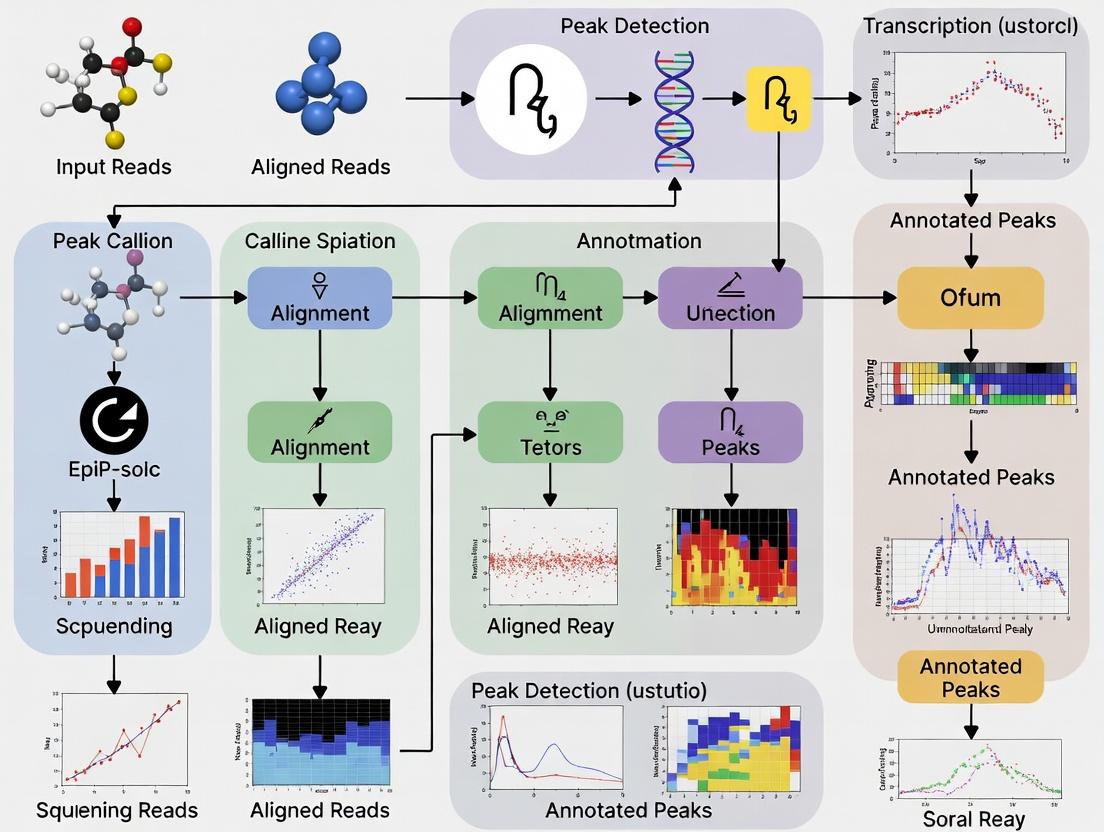
This article provides a complete practical guide for researchers and drug development professionals on analyzing ChIP-seq data, from foundational concepts to advanced applications.
Mastering ChIP-seq Analysis: A Comprehensive Guide to Peak Calling, Annotation, and Best Practices
Abstract
This article provides a complete practical guide for researchers and drug development professionals on analyzing ChIP-seq data, from foundational concepts to advanced applications. It details the standard peak calling workflow established by consortia like ENCODE, covering both transcription factor and histone mark analysis. The guide explores key algorithmic tools for peak detection and motif discovery, addresses common troubleshooting scenarios and quality optimization strategies, and compares methods for validating results and performing differential binding analysis. By integrating current standards, methodological insights, and comparative evaluations, this resource aims to equip scientists with the knowledge to generate robust, biologically interpretable results from their ChIP-seq experiments.
ChIP-seq Fundamentals: From Experimental Principles to ENCODE Standards
Chromatin Immunoprecipitation followed by sequencing (ChIP-seq) is a fundamental technique for mapping genome-wide protein-DNA interactions. Within the context of a thesis on peak calling and annotation, understanding the core workflow and its quantitative outputs is essential. This protocol details the experimental and computational steps to identify transcription factor binding sites or histone modification landscapes, providing the raw data for downstream bioinformatic analysis.
ChIP-seq combines selective immunoprecipitation of protein-DNA complexes with high-throughput sequencing. The core steps involve: crosslinking cells to freeze protein-DNA interactions, chromatin fragmentation, antibody-based pulldown of the target protein with its bound DNA, library preparation, sequencing, and computational mapping of binding sites ("peaks").
Diagram Title: Core ChIP-seq Experimental and Computational Workflow
Detailed Protocol: Crosslinking to Library Preparation
Cell Fixation and Lysis
- Materials: Formaldehyde (1% final concentration), Glycine (125 mM final concentration), PBS, Lysis Buffer (50 mM HEPES-KOH pH 7.5, 140 mM NaCl, 1 mM EDTA, 10% Glycerol, 0.5% NP-40, 0.25% Triton X-100).
- Protocol: Harvest 1x10^6 - 1x10^7 cells. Resuspend in PBS. Add formaldehyde (1% final conc.) and incubate 8-12 minutes at room temperature with gentle agitation. Quench with glycine (125 mM final conc.) for 5 min. Pellet cells, wash with cold PBS. Resuspend pellet in 1 mL Lysis Buffer, incubate 10 min on ice. Centrifuge, discard supernatant.
Chromatin Shearing
- Materials: Sonication device (e.g., Bioruptor, Covaris) or Micrococcal Nuclease (MNase), Tris-EDTA (TE) buffer.
- Protocol (Sonication): Resuspend pellet in 1 mL Shearing Buffer (0.1% SDS, 10 mM EDTA, 50 mM Tris-HCl pH 8.1). Sonicate on ice to achieve fragments of 200-600 bp. Centrifuge to remove debris. Save 50 µL as "Input Control."
- Quantitative Check: Analyze 50 µL of sheared chromatin on a 2% agarose gel to verify fragment size distribution.
Immunoprecipitation and Wash
- Materials: Protein A/G magnetic beads, target-specific validated antibody, IP/Wash buffers (Low Salt, High Salt, LiCl, TE).
- Protocol: Dilute sheared chromatin 5-10 fold in Dilution Buffer (0.01% SDS, 1.1% Triton X-100, 1.2 mM EDTA, 16.7 mM Tris-HCl pH 8.1, 167 mM NaCl). Add 1-10 µg of specific antibody or isotype control. Incubate overnight at 4°C with rotation. Add pre-blocked Protein A/G beads, incubate 2 hours. Wash beads sequentially with: 1) Low Salt Wash Buffer (0.1% SDS, 1% Triton X-100, 2 mM EDTA, 20 mM Tris-HCl pH 8.1, 150 mM NaCl); 2) High Salt Wash Buffer (same, but 500 mM NaCl); 3) LiCl Wash Buffer (0.25 M LiCl, 1% NP-40, 1% Na-deoxycholate, 1 mM EDTA, 10 mM Tris pH 8.1); 4) TE Buffer (twice).
Elution, Reverse Crosslinking, and DNA Cleanup
- Materials: Elution Buffer (1% SDS, 0.1 M NaHCO3), Proteinase K, RNase A, DNA purification columns.
- Protocol: Elute DNA from beads in 200 µL Elution Buffer with shaking (30 min, 65°C). Reverse crosslinks by adding 8 µL 5M NaCl and incubating overnight at 65°C. Add 1 µL RNase A (30 min, 37°C), then 2 µL Proteinase K (2 hours, 55°C). Purify DNA using spin columns. Quantify by Qubit.
Library Preparation and Sequencing
- Protocol: Use a standard Illumina-compatible library prep kit. Perform end repair, A-tailing, adapter ligation, and size selection (target ~250-300 bp insert). Amplify with 12-18 PCR cycles. Validate library quality using Bioanalyzer. Sequence on an Illumina platform (typically 20-50 million single-end 50 bp reads per sample for transcription factors).
Bioinformatic Pipeline: From Reads to Peaks
This section forms the core context for a thesis on peak calling and annotation.
Primary Data Processing
Diagram Title: ChIP-seq Read Processing and Alignment Steps
Peak Calling and Annotation Workflow
Diagram Title: Peak Calling and Annotation Pipeline
Key Quantitative Outputs Table
Table 1: Representative Quantitative Metrics from a Typical ChIP-seq Experiment.
| Metric | Typical Target Value (Transcription Factor) | Typical Target Value (Histone Mark) | Measurement Tool |
|---|---|---|---|
| Sequencing Depth | 20-50 million reads | 30-60 million reads | FastQC, Sequencing report |
| Mapping Rate | >70% (aligned to genome) | >70% | Bowtie2/BWA output |
| PCR Duplicates | <20% of total reads | <20% | Picard MarkDuplicates |
| FRiP Score* | >1% (higher is better) | >10% (higher is better) | calculate from peak caller |
| Number of Peaks | 10,000 - 50,000 | Broad, variable | MACS2/HOMER output |
| Peak Enrichment (Fold) | 5-50x over input | 2-10x over input | MACS2/HOMER output |
*Fraction of Reads in Peaks.
The Scientist's Toolkit: Research Reagent Solutions
Table 2: Essential Materials and Reagents for ChIP-seq Experiments.
| Item | Function / Purpose | Example Product/Type |
|---|---|---|
| Validated ChIP-grade Antibody | Specific immunoprecipitation of the target protein or histone modification. Crucial for success. | Antibodies from Abcam, Cell Signaling, Diagenode. |
| Protein A/G Magnetic Beads | Efficient capture of antibody-antigen complexes for easy washing and elution. | Dynabeads (Thermo Fisher). |
| Formaldehyde (37%) | Reversible crosslinking of proteins to DNA to capture in vivo interactions. | Molecular biology grade. |
| Chromatin Shearing Device | Fragments chromatin to optimal size (200-600 bp) for resolution. | Bioruptor Pico (Diagenode), Covaris S2. |
| DNA Clean & Concentrator Kit | Purifies DNA after reverse crosslinking, removing proteins and salts. | Zymo Research columns. |
| Illumina Library Prep Kit | Prepares sequencing libraries from low-input ChIP DNA. | KAPA HyperPrep Kit, NEB Next Ultra II. |
| Size Selection Beads | Selects DNA fragments of the desired insert size post-ligation. | SPRIselect beads (Beckman Coulter). |
| qPCR Primers (Positive/Negative Control Loci) | Validates enrichment efficiency before sequencing. | Primers for known binding sites and inert genomic regions. |
Within the broader thesis on peak calling and annotation for ChIP-seq data research, a critical distinction exists between the analysis of transcription factor (TF) and histone mark experiments. These differences stem from fundamental biological mechanisms: TFs bind at specific, short genomic loci, while histone modifications form broader, diffuse enrichment domains. This necessitates tailored bioinformatic approaches from experimental design through data interpretation.
Table 1: Fundamental Characteristics Dictating Analysis Pipelines
| Feature | Transcription Factor (TF) ChIP-seq | Histone Mark ChIP-seq |
|---|---|---|
| Typical Binding Profile | Sharp, narrow peaks (< 100 bp) | Broad, diffuse regions (100s bp to kb) |
| Primary Peak Caller Examples | MACS2, HOMER, GEM | SICER, ZINBA, RSEG, BroadPeak (MACS2) |
| Appropriate Control | Input DNA (sonicated genomic DNA) | Input DNA or IgG (for some marks) |
| Read Depth Recommendation | 10-20 million reads (high depth for signal) | 20-40 million reads (coverage over broad regions) |
| Typical Signal-to-Noise | Lower (enrichment 5-20 fold) | Higher (enrichment 2-10 fold) |
| Peak Annotation Priority | Proximal Transcription Start Site (TSS) | Gene body, enhancers, regulatory domains |
| Key Quality Metric | FRiP (Fraction of Reads in Peaks) | Spatial correlation, enrichment over background |
Table 2: Recommended Peak Calling Parameters (MACS2 as Example)
| Parameter | Transcription Factor Setting | Histone Mark (H3K27ac) Setting | Rationale |
|---|---|---|---|
| --call-summits | Yes | No | TF binding precise; summit refines motif location. |
| --broad | No | Yes | Flags MACS2 to call broad regions. |
| --broad-cutoff | N/A | 0.1 | Relaxed cutoff for broad peak calling. |
| --extsize / --shift | Auto or manually set | Manually set to fragment size | TFs: shift for paired tags. Histones: extsize for coverage. |
| --qvalue (narrow) | 0.05 | 0.05 | Standard FDR threshold. |
| --min-length | Default | 1000 | Broad peaks require a larger minimum window. |
Detailed Experimental Protocols
Protocol 1: Standardized ChIP-seq Wet Lab Procedure (Applicable to Both TF and Histones)
Principle: Crosslink proteins to DNA, shear chromatin, immunoprecipitate with specific antibody, and prepare sequencing library.
Key Reagents:
- Formaldehyde (1%): Crosslinking agent.
- Glycine (125 mM): Quenches formaldehyde.
- Sonicator: For chromatin shearing (200-600 bp fragments).
- Protein A/G Magnetic Beads: Antibody capture.
- ChIP-grade Antibody: Validated for immunoprecipitation.
- RNase A & Proteinase K: For DNA purification.
- Library Prep Kit (e.g., NEBNext): For sequencing adapter ligation and amplification.
Steps:
- Crosslinking: Treat cells with 1% formaldehyde for 8-12 minutes. Quench with glycine.
- Cell Lysis: Lyse cells in SDS buffer. Pellet nuclei.
- Chromatin Shearing: Sonicate lysate to shear DNA to desired fragment size (verify by gel).
- Immunoprecipitation: Incubate sheared chromatin with antibody-bound magnetic beads overnight at 4°C.
- Washes: Wash beads with low salt, high salt, LiCl, and TE buffers.
- Elution & Reverse Crosslink: Elute complexes in elution buffer (SDS+NaHCO3) at 65°C with shaking.
- DNA Purification: Treat with RNase A and Proteinase K. Purify DNA using spin columns.
- Library Preparation & Sequencing: Construct library from eluted DNA following kit protocol. Sequence on appropriate platform (e.g., Illumina).
Protocol 2: Computational Analysis Pipeline for Transcription Factor Peak Calling
Principle: Identify narrow, statistically significant enrichment regions from aligned reads using a model accounting for local background.
Tools: FastQC, Trim Galore!, Bowtie2/BWA, SAMtools, MACS2, HOMER.
Steps:
- Quality Control & Trimming: Assess raw reads (
FastQC). Trim adapters and low-quality bases (Trim Galore!). - Alignment: Map reads to reference genome (
Bowtie2). Remove duplicates (samtools rmdupor Picard). - Peak Calling with MACS2:
- Peak Annotation: Annotate peaks to nearest TSS using
HOMER annotatePeaks.pl. - Motif Discovery: Use
HOMER findMotifsGenome.plor MEME-ChIP to discover enriched de novo motifs within peaks.
Protocol 3: Computational Analysis Pipeline for Histone Mark (Broad Peak) Calling
Principle: Identify broad, enriched domains using segmentation or sliding window algorithms sensitive to diffuse signal.
Tools: FastQC, Trim Galore!, Bowtie2/BWA, SAMtools, SICER2 or MACS2 (broad), deepTools.
Steps:
- Quality Control, Trimming & Alignment: As per Protocol 2.
- Broad Peak Calling with SICER2: (Parameters: -w window size, -rt redundancy threshold, -f fragment size, -egf effective genome fraction)
- Alternative with MACS2 (broad mode):
- Visualization & Meta-analysis: Generate genome browser tracks (
deepTools bamCoverage) and compute aggregate profiles over features (deepTools computeMatrix).
Visualization of Analysis Workflows
TF ChIP-seq Narrow Peak Analysis Pipeline
Histone Mark ChIP-seq Broad Peak Analysis Pipeline
The Scientist's Toolkit
Table 3: Essential Research Reagent Solutions for ChIP-seq
| Item | Function & Relevance | Example Product/Cat. No. (Representative) |
|---|---|---|
| ChIP-Validated Antibody | Specific immunoprecipitation of target protein or modification. Critical for success. | Anti-CTCF (Cell Signaling, 3418S); Anti-H3K27ac (Abcam, ab4729) |
| Magnetic Beads (Protein A/G) | Efficient capture of antibody-antigen complexes; reduce background. | Dynabeads Protein A/G (Thermo Fisher, 10009D/10004D) |
| Crosslinking Reagent | Covalently link proteins to DNA to preserve in vivo interactions. | Formaldehyde, 16% (w/v) Methanol-free (Pierce, 28906) |
| Chromatin Shearing Enzyme/Kit | Consistent, tunable fragmentation of chromatin (alternative to sonication). | MNase (Micrococcal Nuclease) (NEB, M0247S) |
| ChIP-seq Library Prep Kit | High-efficiency adapter ligation and PCR for low-input ChIP DNA. | NEBNext Ultra II DNA Library Prep (NEB, E7645S) |
| DNA Clean-up Beads/Columns | Purify DNA after elution and reverse crosslinking. | AMPure XP beads (Beckman Coulter, A63881) |
| qPCR Assay for Validation | Confirm ChIP enrichment at positive/negative control loci prior to sequencing. | SYBR Green PCR Master Mix (Thermo Fisher, 4309155) |
| High-Sensitivity DNA Assay | Accurate quantification of low-concentration ChIP DNA and libraries. | Qubit dsDNA HS Assay Kit (Thermo Fisher, Q32851) |
The effective analysis of ChIP-seq data hinges on selecting the pipeline aligned with the biological target's binding characteristics. Transcription factor analyses demand precision in narrow peak calling and motif discovery, while histone mark analyses require sensitivity to broad domains and contextual enrichment. Adhering to these differentiated protocols ensures accurate biological inference, a cornerstone for downstream applications in functional genomics and therapeutic target identification.
Within the thesis on peak calling and annotation for ChIP-seq data research, understanding the purpose and structure of core bioinformatics file formats is foundational. Each format serves a specific role in the data lifecycle, from raw sequencing reads (FASTQ) to aligned reads (BAM), genomic intervals (BED), and continuous signal data (bigWig). Mastery of these formats is essential for accurate downstream analysis, including the identification of protein-DNA interaction sites (peak calling) and their biological interpretation.
Application Notes and Protocols
FASTQ Format
Application Note: The FASTQ format is the primary output of high-throughput sequencing platforms. It stores both the nucleotide sequence reads and their corresponding per-base quality scores, which are critical for assessing data quality prior to alignment in a ChIP-seq workflow.
Detailed Protocol: FASTQ Quality Control and Preprocessing
- Quality Assessment: Use
FastQCto generate a comprehensive quality report. Key metrics include per-base sequence quality, sequence duplication levels, and adapter contamination.
Adapter Trimming: Remove adapter sequences and low-quality bases using
Trim Galore!orcutadapt.Post-trimming QC: Re-run
FastQCon the trimmed FASTQ file to confirm improvement.
Quantitative Data Table: FASTQ Metrics
| Metric | Description | Typical Target (ChIP-seq) |
|---|---|---|
| Total Reads | Number of raw sequences | 20-50 million |
| Q30 Score | % bases with Phred quality score >30 | >80% |
| GC Content | % of G and C nucleotides | Species-specific |
| Adapter Content | % reads with adapter sequence | <5% post-trimming |
BAM Format
Application Note: The Binary Alignment/Map (BAM) format is the compressed, binary version of the SAM file. It stores the alignment information of each sequencing read relative to a reference genome, including mapping position, mapping quality (MAPQ), and alignment flags. BAM files are the direct input for most peak-calling algorithms.
Detailed Protocol: Generating and Processing BAM Files
- Alignment: Align trimmed FASTQ reads to a reference genome using an aligner like
Bowtie2orBWA.
Conversion and Sorting: Convert SAM to BAM, then sort by genomic coordinate using
samtools.Duplicate Marking/Removal: Identify and mark PCR duplicates using
picardorsamtools.Indexing: Create a
.baiindex file for rapid access.
Quantitative Data Table: BAM Alignment Metrics
| Metric | Description | Importance for Peak Calling |
|---|---|---|
| Alignment Rate | % of reads mapped to reference | High (>90%) indicates good alignment. |
| Duplicate Rate | % of PCR/optical duplicates | High rates can bias signal; removal is critical. |
| Fraction Mapped in Pairs | For paired-end data, % properly paired reads | Indicates library complexity. |
| Mitochondrial Reads | % reads mapping to chrM | High % indicates cytoplasmic contamination. |
BED Format
Application Note: The Browser Extensible Data (BED) format defines genomic intervals as 0-based, half-open coordinates (start is 0-based, end is 1-based). It is the standard output of peak callers (e.g., MACS2) and is used to represent discrete genomic features like binding sites (peaks), gene annotations, and enhancer regions.
Detailed Protocol: Peak Calling to Generate BED Files
- Peak Calling: Use
MACS2to identify regions of significant enrichment (peaks) from the aligned BAM file.
Post-processing: The primary output is a
_peaks.narrowPeakor_peaks.broadPeakfile, which is a BED format with additional columns. Convert to standard BED6 if needed.Annotation: Annotate peaks relative to genomic features (e.g., TSS, exons) using tools like
ChIPseeker(R/Bioconductor) orannotatePeaks.pl(HOMER).
bigWig Format
Application Note: The bigWig format stores dense, continuous genomic data as an indexed binary file, enabling efficient visualization of signal tracks (e.g., read coverage). It is derived from the WIG format but is highly compressed and allows for remote access. bigWig files are crucial for visualizing ChIP-seq enrichment across the genome.
Detailed Protocol: Creating bigWig Coverage Tracks
- Generate Genome Coverage: Use
bamCoveragefrom deepTools to create a normalized coverage track in bigWig format.
Normalization: Common methods are Counts Per Million (CPM), Reads Per Kilobase per Million (RPKM/FPKM), or Bin-Per-Million (BPM). For ChIP-seq, CPM or sequencing depth scaling (RPGC) is typical.
Visualization: Upload the
.bwfile to a genome browser (e.g., IGV, UCSC) for visualization alongside BED peak files and gene annotations.
Quantitative Data Table: Format Comparison and Use Case
| Format | Structure | Primary Use in ChIP-seq | Key Tools |
|---|---|---|---|
| FASTQ | Text, reads + qualities | Raw sequence storage, QC | FastQC, cutadapt |
| BAM | Binary, aligned reads | Alignment storage, peak calling input | Bowtie2, samtools, MACS2 |
| BED | Text, genomic intervals | Peak representation, annotation | MACS2, HOMER, BEDTools |
| bigWig | Binary, continuous signal | Coverage visualization | deepTools, UCSC tools |
Visualization of ChIP-seq Data Analysis Workflow
Diagram 1: ChIP-seq Analysis Workflow from FASTQ to Annotation
Diagram 2: Peak Calling Logic and File Dependencies
The Scientist's Toolkit: Research Reagent Solutions
| Item | Function in ChIP-seq Research |
|---|---|
| Specific Antibody | Immunoprecipitates the target protein of interest (e.g., transcription factor, histone modification). Critical for experiment specificity. |
| Protein A/G Magnetic Beads | Binds antibody-protein-DNA complexes for isolation and subsequent wash steps. |
| Crosslinking Reagent (Formaldehyde) | Fixes protein-DNA interactions in living cells prior to lysis and fragmentation. |
| Sonication Device | Shears crosslinked chromatin into small fragments (200-500 bp) for immunoprecipitation. |
| DNA Clean-up Beads/Columns | Purifies the final ChIP-enriched DNA prior to library preparation for sequencing. |
| High-Fidelity PCR Mix | Amplifies the ChIP DNA library with minimal bias during the NGS library preparation step. |
| SPRIselect Beads | Used for size selection and cleanup of DNA fragments during library preparation. |
| qPCR Assay for Positive/Negative Genomic Loci | Validates ChIP enrichment efficiency prior to deep sequencing. |
Application Notes
In ChIP-seq data analysis for peak calling and annotation, control samples are not merely procedural requirements but are foundational for accurate biological interpretation. The Input and IgG controls serve distinct, non-interchangeable purposes, and their use must be carefully paired with the replicate structure of the experimental IP samples.
Input DNA Control: This represents the genomic DNA prior to immunoprecipitation, sheared and processed in parallel with the ChIP samples. It controls for sequencing biases arising from local chromatin accessibility, DNA shearing efficiency, GC content, and mappability. Peaks called against the Input control identify regions significantly enriched for the target protein or histone mark over this genomic background.
IgG Control: This is an immunoprecipitation performed with a non-specific antibody (typically Immunoglobulin G). It controls for non-specific antibody binding and the background noise of the IP process itself. It is particularly critical for experiments where the target antibody may have low specificity or for marking regions prone to non-specific protein-DNA interactions.
The Imperative of Matching Replicate Structure: The statistical rigor of peak calling is compromised if control samples do not match the biological or technical replicate design of the IP samples. Using a single control library for multiple biological replicate IPs can conflate biological variance with technical noise, leading to inflated false discovery rates. Best practice dictates that each biological replicate IP should have a matched control replicate (Input or IgG) processed in parallel. This allows for pairwise differential analysis and robust consensus peak calling.
Protocols
Protocol 1: Generation of Matched Input Control Libraries
Objective: To produce a sequencing library from sheared, non-immunoprecipitated genomic DNA that matches the experimental ChIP-seq sample processing.
Detailed Methodology:
- Cell Fixation & Lysis: Co-process the cell/tissue sample alongside the experimental ChIP sample. Fix with formaldehyde (e.g., 1% final concentration) for the same duration. Quench with glycine. Pellet cells and lyse in ChIP lysis buffer.
- Chromatin Shearing: Using the same validated sonication or enzymatic shearing method as the ChIP sample, shear the cross-linked chromatin to an average fragment size of 200-500 bp. Verify fragment size distribution via agarose gel electrophoresis or bioanalyzer.
- Reverse Cross-linking & DNA Purification: Add RNase A and Proteinase K. Incubate at 65°C overnight to reverse cross-links. Purify DNA using a PCR purification kit or phenol-chloroform extraction. Quantify by fluorometry.
- Library Preparation: Use the same library preparation kit and protocol as for the ChIP samples. This includes end-repair, A-tailing, adapter ligation, and PCR amplification with a compatible index. Use the same number of PCR cycles.
- Size Selection & QC: Perform double-sided size selection (e.g., using SPRI beads) to isolate fragments in the 250-550 bp range. Quantify the final library by qPCR and assess quality via bioanalyzer/TapeStation.
- Sequencing: Pool and sequence on the same flow cell and sequencing platform as the matched IP replicates, aiming for a sequencing depth that is sufficient (typically 1x the IP depth is a minimum, but deeper sequencing is beneficial).
Protocol 2: Generation of Matched IgG Control Libraries
Objective: To perform a non-specific immunoprecipitation control that matches the experimental ChIP protocol.
Detailed Methodology:
- Prepare Chromatin: Use the same batch of sheared, cross-linked chromatin as the specific IP experiment.
- Pre-clear & Aliquot: Pre-clear chromatin with Protein A/G beads for 1 hour at 4°C. Aliquot an amount equivalent to the specific IP into a fresh tube.
- Non-specific IP: Add species-matched, non-immune IgG (e.g., 1-5 µg) to the chromatin aliquot. Use the same amount as the specific antibody. Incubate with rotation at 4°C for the same duration as the specific IP (e.g., overnight).
- Bead Capture & Washes: Add Protein A/G beads. Incubate. Perform the exact same series of stringent wash buffers as the specific IP (e.g., Low Salt, High Salt, LiCl, TE buffers).
- Elution & Reverse Cross-linking: Elute complexes in fresh elution buffer (e.g., 1% SDS, 0.1M NaHCO3). Add NaCl and reverse cross-links at 65°C overnight alongside the specific IP samples.
- DNA Purification & Library Prep: Purify DNA identically to the specific IP. Use the identical library preparation protocol, reagents, and PCR cycle number as the specific IP and Input samples.
- Sequencing: Sequence to a depth comparable to the Input control, on the same sequencing run.
Data Presentation
Table 1: Comparative Functions of ChIP-seq Controls
| Control Type | Purpose | Controls For | Best Used For | Key Limitation |
|---|---|---|---|---|
| Input DNA | Genomic background model | Chromatin accessibility, shearing bias, GC content, mappability. | All ChIP-seq experiments (TF and histone marks). | Does not control for antibody non-specificity. |
| IgG | Non-specific IP background | Non-specific antibody binding, protein A/G bead background. | Experiments with low-specificity antibodies or high background. | Does not control for open chromatin bias; can be noisy. |
Table 2: Impact of Control Replicate Structure on Peak Calling
| Control Strategy | Replicate Matching | Statistical Robustness | Risk | Recommended Analysis Software |
|---|---|---|---|---|
| Pooled Control | Single library for all IP reps. | Low. Violates assumptions of tools like DESeq2. | High false positives/negatives; conflates biological variance. | Avoid. If necessary, use MACS2 with --broad flag cautiously. |
| Matched Replicate | Each biological IP rep has its own control rep. | High. Enables pairwise comparison. | Minimal when depth is adequate. | Ideal. Use for tools like MACS2, SPP, or for differential binding with DESeq2/edgeR. |
Visualizations
Title: ChIP-seq Control Strategies for Peak Calling
Title: Impact of Control Replicate Structure on Peak Calling
The Scientist's Toolkit
Table 3: Essential Research Reagent Solutions for ChIP-seq Controls
| Reagent / Material | Function in Control Experiments | Key Consideration |
|---|---|---|
| Formaldehyde (37%) | Crosslinks proteins to DNA for both IP and Input samples. | Use same fixation time and concentration across all samples in an experiment. |
| Non-immune IgG | Provides the non-specific antibody for IgG control IPs. | Must match the host species and isotope (e.g., Rabbit IgG) of the specific antibody. |
| Protein A/G Magnetic Beads | Capture antibody-chromatin complexes. | Use the same bead lot and amount for specific IP and IgG control washes. |
| Chromatin Shearing Reagents | Sonicator with microtip or Enzymatic Shearing Kit. | Shearing efficiency must be identical; verify size profile post-shearing. |
| DNA Clean & Concentrator Kit | Purifies DNA post reverse-crosslinking. | Use the same kit and elution volume for all samples to maintain consistency. |
| Indexed Adapter Kit | Prepares sequencing libraries. | Use unique dual indices for each replicate (IP and its matched control). |
| High-Fidelity PCR Mix | Amplifies libraries post-adapter ligation. | Use the same number of PCR cycles to prevent amplification bias. |
| SPRI Size Selection Beads | Selects for optimally sized library fragments. | Critical for removing adapter dimers; use same bead:sample ratio. |
| Library Quantitation Kit | Accurately measures library concentration (qPCR-based). | Essential for pooling libraries at equimolar ratios for sequencing. |
Within the thesis framework of peak calling and annotation for ChIP-seq research, rigorous quality control is paramount. The ENCODE (Encyclopedia of DNA Elements) consortium has established standardized metrics to assess data quality, ensuring reliability and reproducibility in downstream analyses such as transcription factor binding site identification and histone mark annotation. This document details the application of these standards.
Key Quality Metrics & Quantitative Summaries
Table 1: ENCODE Quality Metrics for ChIP-seq Experiments
| Metric | Recommended Threshold (Typical) | Calculation Method | Primary Function in Analysis |
|---|---|---|---|
| Non-Redundant Fraction (NRF) | ≥ 0.8 | Unique reads / Total reads | Measures library complexity; low values indicate over-amplification or PCR bias. |
| PCR Bottleneck Coefficient (PBC) | PBC1 ≥ 0.9, PBC2 ≥ 3 | PBC1: # genomic locations with 1 read / # distinct locations; PBC2: # locations with 1 read / # locations with 2 reads. | Assesses library complexity and saturation. Critical for peak calling sensitivity. |
| NRF Dup Rate Correlation | R² < 0.5 | Correlation between NRF and duplicate rate. | Identifies technical artifacts affecting complexity. |
| Read Depth | TF: ≥ 20M reads; Histone: ≥ 50M reads | Total passed-filter alignable reads. | Ensures sufficient signal for statistical power in peak detection. |
| NSC (Normalized Strand Cross-correlation) | ≥ 1.05 | Ratio of max cross-correlation to background. | Assesses signal-to-noise for fragment-length enrichment. |
| RSC (Relative Strand Cross-correlation) | ≥ 0.8 | Ratio of fragment-length to read-length cross-correlation. | Normalizes NSC for read-length effects. |
| IDR (Irreproducible Discovery Rate) | < 0.05 (for 2 replicates) | Ranks peaks from replicates to measure consistency. | Quantifies reproducibility of peak calls at a given FDR threshold. |
Detailed Experimental Protocols
Protocol 1: Assessing Library Complexity with PBC
Objective: Calculate the PCR Bottleneck Coefficient to evaluate library complexity from aligned BAM files.
- Input: Coordinate-sorted BAM file from aligned ChIP-seq reads.
- Deduplication: Identify duplicate reads using exact genomic start and end positions (5' mapping coordinates for paired-end).
- Generate Distribution: Count the number of distinct genomic locations (
*Distinct*) and tally how many locations have exactly 1 read (*OneRead*), 2 reads (*TwoRead*), etc. - Calculate:
PBC1 = *OneRead* / *Distinct*PBC2 = *OneRead* / *TwoRead*
- Interpretation: A low PBC1 indicates a high bottleneck, where few locations account for most reads, compromising peak calling.
Protocol 2: Determining Optimal Read Depth via Saturation Analysis
Objective: Empirically determine if sequencing depth is sufficient for robust peak calling.
- Subsample Reads: Randomly subsample fractions (e.g., 10%, 20%, ... 100%) of the aligned, deduplicated reads from the full dataset.
- Peak Calling: Perform peak calling (e.g., with MACS2) on each subsampled set using consistent parameters.
- Peak Counting: Count high-confidence peaks (e.g., IDR < 0.05) detected at each depth.
- Plot & Analyze: Plot the number of peaks detected versus sequencing depth. The point where the curve plateaus indicates sufficient depth; additional sequencing yields diminishing returns.
Protocol 3: Evaluating Reproducibility with IDR Analysis
Objective: Compare two replicate experiments to quantify the consistency of peak calls.
- Independent Peak Calling: Run peak caller (e.g., MACS2) on each replicate separately to generate initial peak lists.
- Rank Peaks: Sort peaks from each replicate by their statistical significance (e.g., -log10(p-value) or -log10(q-value)).
- Pool and Rerank: Merge peaks from both replicates and rank them based on a combined metric (e.g., average significance).
- IDR Calculation: For peaks passing a chosen rank threshold, calculate the Irreproducible Discovery Rate—the fraction of peaks that are not consistent across replicates.
- Output: A set of high-confidence, reproducible peaks at a specified IDR threshold (e.g., 0.05).
Visualizations
Title: ChIP-seq Quality Control Workflow
Title: IDR Analysis for Reproducible Peaks
The Scientist's Toolkit: Research Reagent Solutions
Table 2: Essential Materials for ChIP-seq Quality Assessment
| Item | Function in Quality Control |
|---|---|
| High-Fidelity PCR Enzymes | Used during library amplification to minimize PCR duplicates and maintain library complexity (critical for PBC metric). |
| Size Selection Beads | For precise cDNA fragment isolation post-sonication; ensures uniform library insert size, improving NSC/RSC calculations. |
| qPCR Quantification Kits | Accurate library quantification prevents over- or under-clustering on the sequencer, ensuring target read depth is achieved. |
| Phospho-Histone H3 (S10) Antibody | A common positive control antibody for histone mark ChIP-seq; used to benchmark experiment success against ENCODE standards. |
| Spike-in DNA/Chromatin | External reference (e.g., D. melanogaster chromatin in human cells) normalizes for technical variation, improving reproducibility metrics. |
| Bioanalyzer/TapeStation | Provides precise assessment of library fragment size distribution, a key pre-sequencing QC step that influences cross-correlation metrics. |
| Deduplication Software | Essential for calculating NRF and PBC. Tools like picard MarkDuplicates or samtools rmdup identify PCR duplicates. |
| Cross-Correlation Tools | Software like phantompeakqualtools calculates NSC and RSC from aligned BAM files, quantifying signal-to-noise ratio. |
The Peak Calling Workflow: Steps, Tools, and Motif Discovery
In the broader context of a thesis on peak calling and annotation for ChIP-seq data research, rigorous pre-processing and quality assessment are paramount. This initial step determines the validity of all subsequent biological interpretations. The primary objectives are to verify that the sequencing data is of high quality, the immunoprecipitation was successful, and the signal-to-noise ratio is sufficient for reliable peak detection. Two cornerstone metrics for this assessment are the Cross-correlation analysis and the Fraction of Reads in Peaks (FRiP) score.
Core Quality Metrics: Definitions and Significance
Cross-correlation Analysis
Cross-correlation measures the dependence between strand-specific read densities. It calculates the correlation between the forward-strand and reverse-strand tag densities at various strand shift distances. A successful ChIP-seq experiment shows a strong peak in the cross-correlation at a shift distance corresponding to the average fragment length. The key outputs are:
- NSC (Normalized Strand Coefficient): The ratio of the maximum cross-correlation value to the background cross-correlation. NSC >= 1.05 is typical, with higher values (>1.5) indicating stronger signal.
- RSC (Relative Strand Correlation): The ratio of the fragment-length cross-correlation to the read-length cross-correlation. RSC >= 0.8 is acceptable, with >=1.0 indicating good quality.
FRiP (Fraction of Reads in Peaks) Score
The FRiP score is the proportion of all mapped reads that fall within identified peak regions. It is a direct indicator of signal-to-noise ratio and immunoprecipitation efficiency. A low FRiP score suggests a failed experiment or high background.
Table 1: Benchmark Quality Metric Thresholds for ChIP-seq Experiments
| Metric | Poor Quality | Acceptable | Good Quality | Reference/Note |
|---|---|---|---|---|
| NSC | < 1.05 | 1.05 - 1.5 | > 1.5 | ENCODE Guidelines |
| RSC | < 0.8 | 0.8 - 1.0 | > 1.0 | ENCODE Guidelines |
| FRiP | < 1% | 1% - 5% | > 5% | Varies by factor; e.g., >1% for broad marks, >5% for sharp transcription factors |
Detailed Experimental Protocols
Protocol: Cross-correlation Analysis usingphantompeakqualtools
This protocol assesses library quality and predicts fragment length.
I. Prerequisites & Input Data
- Input: Coordinate-sorted BAM file from aligned reads (e.g.,
sample.bam). - Software: R,
spppackage (phantompeakqualtools), samtools. - System: Unix/Linux or macOS environment.
II. Step-by-Step Procedure
- Environment Setup:
Run Cross-correlation Analysis:
-c: Path to input BAM file.-savp: Saves a PDF plot of the cross-correlation.-out: Output file for metrics.
Interpret Output: The output file (
sample_ccmetrics.txt) will contain tab-separated columns: Filename, numReads, estFragLen, correstFragLen, phantomPeak, corrphantomPeak, argmincorr, mincorr, NSC, RSC, QualityTag. Extract NSC and RSC for assessment against Table 1.
Protocol: Calculating the FRiP Score usingMACS2andBEDTools
This protocol quantifies the enrichment of reads in called peak regions.
I. Prerequisites & Input Data
- Input: BAM file (
sample.bam) and a BED file of genomic blacklisted regions (e.g., ENCODE hg38 blacklist). - Software: MACS2, BEDTools, samtools.
- System: Unix/Linux environment.
II. Step-by-Step Procedure
- Filter Reads (Optional but recommended):
Peak Calling with MACS2:
-t: Treatment BAM file.-g: Effective genome size (hsfor human).-n: Base name for output files.- Outputs:
sample_peaks.narrowPeak(peak file),sample_peaks.xls.
Count Reads in Peaks:
Calculate FRiP Score:
Visualizations
Title: ChIP-seq Quality Assessment Workflow
Title: Interpreting Cross-correlation Metrics
The Scientist's Toolkit: Research Reagent Solutions
Table 2: Essential Materials and Tools for ChIP-seq QC
| Item | Function/Description | Example Product/Software |
|---|---|---|
| High-Fidelity Antibody | Critical for specific immunoprecipitation of the target protein or histone mark. A poor antibody is the leading cause of low FRiP scores. | Cell Signaling Technology, Abcam, Diagenode validated ChIP-seq antibodies. |
| Library Preparation Kit | Prepares sequencing libraries from immunoprecipitated DNA. Affects complexity and duplication rates. | NEBNext Ultra II DNA Library Prep Kit, KAPA HyperPrep Kit. |
| Alignment Software | Maps sequenced reads to a reference genome to create BAM files. | BWA-MEM, Bowtie2, STAR. |
| Cross-correlation Tool | Calculates NSC and RSC metrics from BAM files. | phantompeakqualtools (spp), deepTools plotFingerprint. |
| Peak Caller | Identifies enriched regions (peaks) from aligned reads. Required for FRiP calculation. | MACS2, HOMER, SEACR (for broad marks). |
| Genomic Interval Tool | Performs overlap operations (e.g., counting reads in peaks). | BEDTools, bedops. |
| Genome Blacklist | A set of regions with anomalous signal (e.g., high repeats). Reads in these regions should be filtered out before final QC. | ENCODE Consortium Blacklist (for hg19, hg38, mm10, etc.). |
| QC Report Generator | Integrates multiple metrics and visualizations into a single report. | MultiQC, ChIPQC (R/Bioconductor package). |
Application Notes
Peak calling is a critical computational step in ChIP-seq analysis that identifies genomic regions where a protein of interest (e.g., a transcription factor or histone modification) is significantly enriched. The choice of algorithm directly impacts downstream biological interpretations. This overview compares three widely used tools, each based on distinct statistical models to address different chromatin architectures.
MACS2 (Model-based Analysis of ChIP-Seq 2) uses a dynamic Poisson distribution to model the background tag distribution, explicitly accounting for local biases. It is optimized for identifying narrow peaks from transcription factors or co-activators. Its key innovation is the "shift model," which uses the sequenced tag distribution to estimate the fragment size and shift tags to better represent the protein-DNA interaction site.
HOMER (Hypergeometric Optimization of Motif EnRichment) employs a peak-finding algorithm based on finding fixed-width peaks with high counts relative to local background regions. It integrates peak calling with motif discovery and functional annotation, making it a comprehensive suite. HOMER’s peak caller is designed for both narrow and broad domains, though its core strength lies in its advanced de novo motif analysis capabilities tied directly to called peaks.
SICER (Spatial Clustering Approach for Identification of ChIP-Enriched Regions) implements a cluster-based approach specifically designed for identifying broad, diffuse domains from histone modifications like H3K9me3 or H3K27me3. Instead of evaluating single peaks, SICER identifies statistically significant clusters of reads by accounting for spatial information and correcting for genome-wide randomness.
Quantitative Comparison
Table 1: Algorithmic and Practical Comparison of Peak Callers
| Feature | MACS2 | HOMER | SICER |
|---|---|---|---|
| Primary Design For | Narrow Peaks (e.g., TFs) | Narrow & Broad Peaks | Broad Domains (e.g., Histones) |
| Core Statistical Model | Dynamic Poisson / Local Lambda | Poisson vs. Local Background | Randomness-based Clustering |
| Handles Replicates? | Yes (via -t and -c) |
Yes (pool or independent) | Yes (pooled analysis) |
| Key Output | NarrowPeaks, summits | Peak BED files, motifs | Island BED files |
| Integrated Annotations | No (requires separate tools) | Yes (motif, functional analysis) | Limited |
| Typical Run Time* | Fast | Moderate | Slower (due to clustering) |
*Runtime is dataset and genome-size dependent.
Table 2: Typical Command-Line Parameters and Values
| Algorithm | Key Parameter | Typical Value / Setting | Purpose |
|---|---|---|---|
| MACS2 | --qvalue (or -q) |
0.05 | Minimum FDR cutoff for peak detection. |
--extsize |
200 | User-provided fragment length estimation. | |
--broad |
Flag | Use for broad peak calling (e.g., histones). | |
| HOMER | style |
factor / histone | Preset parameters for factor or histone marks. |
size |
200 (factor) / 1000 (histone) | Peak size for tagging regions. | |
minDist |
200 | Minimum distance between neighboring peaks. | |
| SICER | redundancy threshold |
1 | Max identical tags per position in control. |
window size |
200 | Size of sliding window to count tags. | |
gap size |
600 | Max bp between windows to be clustered. | |
FDR |
0.01 | False discovery rate threshold. |
Experimental Protocols
Protocol 1: Peak Calling with MACS2 for Transcription Factor ChIP-seq
Application: Identifying precise binding sites of a transcription factor. Input: Treatment BAM file (IP), Control BAM file (e.g., Input). Procedure:
- Installation: Install via pip:
pip install macs2 - Basic Narrow Peak Calling:
macs2 callpeak -t treatment.bam -c control.bam -f BAM -g hs -n experiment_name --outdir ./results -q 0.05-t: Treatment alignment file.-c: Control file.-f: Input file format.-g: Effective genome size (hsfor human,mmfor mouse).-n: Base name for output files.-q: q-value cutoff.
- Output Interpretation: Key file
*_peaks.narrowPeak(BED6+4 format) contains genomic coordinates, peak height, and q-value.
Protocol 2: Peak Calling and Motif Discovery with HOMER
Application: Finding enriched peaks and discovering de novo DNA binding motifs. Input: Treatment and Control BAM files, or a single BED file of tag directories. Procedure:
- Installation: Download and configure from http://homer.ucsd.edu/homer/.
- Create Tag Directories:
makeTagDirectory treatment_tagdir/ treatment.bammakeTagDirectory control_tagdir/ control.bam - Call Peaks:
findPeaks treatment_tagdir/ -style factor -o auto -i control_tagdir/-style factor: Uses settings optimized for transcription factors.-o auto: Outputs to a file in the tag directory.
- Find De Novo Motifs:
findMotifsGenome.pl peaks_file.bed hg38 motif_output_dir/ -size 200 -mask
Protocol 3: Broad Histone Mark Peak Calling with SICER
Application: Identifying large, enriched domains for histone modifications like H3K27me3. Input: Treatment and Control BED files (read positions). Procedure:
- Installation: Requires Python 2.7 and
pybedtools. Download from https://github.com/zanglab/SICER2. - Convert BAM to BED: Use
bedtools bamtobed. - Run SICER with Recommended Parameters:
SICER.sh treatment.bed control.bed output_dir hg38 1 200 600 0.01 0.1- Argument order: Input treatment BED, control BED, output directory, effective genome, redundancy threshold, window size, gap size, FDR, fraction of gap size for merging islands.
- Output Interpretation: The
*-island.bedfile lists significantly enriched genomic "islands" (broad peaks).
Visualizations
Title: MACS2 Peak Calling Workflow
Title: HOMER Integrated Analysis Pipeline
Title: SICER Spatial Clustering Algorithm
The Scientist's Toolkit
Table 3: Essential Research Reagent Solutions for ChIP-seq Peak Calling
| Item / Solution | Function in Context |
|---|---|
| High-Quality ChIP DNA | Starting material for library prep. Enrichment efficiency directly impacts peak signal-to-noise ratio. |
| Sequencing Library Prep Kit | Prepares immunoprecipitated DNA for high-throughput sequencing (e.g., Illumina TruSeq). |
| Cluster Generation & Sequencing Reagents | Flow cell chemistry and sequencing-by-synthesis reagents (e.g., Illumina SBS kits) to generate raw reads. |
| Alignment Software (BWA, Bowtie2) | Maps sequenced reads (FASTQ) to a reference genome, producing BAM files for peak calling input. |
| Genome Annotation Files (GTF/BED) | Provides gene models and genomic features for annotating called peaks (e.g., from ENSEMBL, UCSC). |
| Control (Input) DNA | Genomic DNA processed without immunoprecipitation; essential for modeling background noise. |
| Benchmark Peak Sets (e.g., from ENCODE) | Gold-standard datasets for validating and comparing the performance of peak calling algorithms. |
This application note addresses a critical, practical decision point within the broader thesis on ChIP-seq data analysis: the selection of appropriate peak-calling parameters based on the biological target. The choice between 'narrow' and 'broad' peak-calling modes is fundamental, as it directly impacts downstream interpretation, annotation, and biological inference. Incorrect selection can lead to significant loss of true signal or excessive background noise, compromising the entire research pipeline from differential binding analysis to mechanistic understanding in drug discovery.
Core Definitions and Biological Rationale
Narrow Peaks: Characteristic of transcription factors (TFs) and other sequence-specific DNA-binding proteins. These proteins bind to well-defined, localized genomic regions, typically resulting in sharp, punctate ChIP-seq signal distributions. Broad Peaks: Characteristic of histone modifications (e.g., H3K27me3, H3K36me3), some chromatin regulators (e.g., RNA Polymerase II), and co-activators like p300. These marks often spread across larger genomic domains, such as promoters, enhancers, or repressed regions, producing diffuse and wide signal enrichment.
Quantitative Comparison of Peak-Calling Parameters
Table 1: Recommended Parameters and Software for Narrow vs. Broad Peak Calling
| Feature | Narrow Peak Calling (e.g., for TFs) | Broad Peak Calling (e.g., for Histones) | ||||
|---|---|---|---|---|---|---|
| Primary Software | MACS2, HOMER, GEM | MACS2 (broad mode), SICER2, BroadPeak, SEACR | ||||
| Critical Parameter | --call-summits (MACS2), -size 200 (HOMER) |
--broad (MACS2), --broad-cutoff |
Typical Peak Width | 100 - 500 bp | 1,000 - 10,000 bp | |
| Fragment Size (--extsize) | Set to fragment length | Often set to sonication size; less critical | ||||
| False Discovery Rate (FDR/q-value) | Stringent (e.g., q < 0.01) | Can be relaxed (e.g., q < 0.05) due to diffuse signal | ||||
| Signal-to-Noise Handling | Optimized for sharp, high-fold enrichment | Requires smoothing algorithms to connect extended domains | ||||
| Typical Output | Precise summit coordinates | Enriched region coordinates without a single summit |
Table 2: Impact of Parameter Choice on Downstream Analysis
| Analysis Stage | Consequence of Using Narrow on Histone Data | Consequence of Using Broad on TF Data |
|---|---|---|
| Peak Number | Severe underestimation; peaks fragmented | Massive overestimation; false positives rise |
| Annotation Accuracy | Misses true broad domains | Loses precise binding site resolution |
| Motif Discovery | N/A (if peaks found) | Becomes noisy; true TFBS obscured |
| Differential Analysis | Fails to capture domain-level changes | Introduces variance, reduces statistical power |
| Integration with omics | Poor overlap with RNA-seq expression blocks | Poor correlation with TF binding motifs |
Experimental Protocols
Protocol 4.1: Narrow Peak Calling for Transcription Factors using MACS2
Purpose: To identify precise, high-confidence binding sites for a transcription factor from ChIP-seq data.
Materials:
- Processed, aligned ChIP-seq reads in BAM format (
TF_ChIP.bam). - Matched control/input DNA reads (
Input_Control.bam). - MACS2 software (v2.2.x+).
- Compute environment with ≥8 GB RAM.
Procedure:
- Estimate Fragment Size: Run
macs2 predictd -i TF_ChIP.bam -g hs(for human). Review the model to confirm a sharp, predicted fragment length peak. - Call Narrow Peaks: Execute the primary command:
- Post-processing: Use the
*_summits.bedfile for precise motif analysis. The*_peaks.narrowPeakfile is used for general annotation.
Protocol 4.2: Broad Peak Calling for Histone Modifications using MACS2
Purpose: To identify extended genomic domains enriched for a histone modification (e.g., H3K27me3).
Materials:
- Processed, aligned ChIP-seq reads in BAM format (
Histone_ChIP.bam). - Matched control/input DNA reads (
Input_Control.bam). - MACS2 software (v2.2.x+).
Procedure:
- Parameter Adjustment: The
predictdstep is often less informative for broad marks due to diffuse signal. - Call Broad Regions: Execute the broad peak command:
- Output Interpretation: The
*_peaks.broadPeakfile contains the broad domains. The*_peaks.gappedPeakfile combines both broad and possible narrow signals within them.
Protocol 4.3: Validation and Crossover Assessment
Purpose: To empirically determine the optimal peak-calling strategy for a new or ambiguous target.
Materials: ChIP-seq dataset for the target of interest, control dataset, both narrow and broad peak-calling pipelines.
Procedure:
- Run both Protocol 4.1 (without
--call-summits) and Protocol 4.2 on the same dataset. - Visual Inspection: Load both result tracks in a genome browser (e.g., IGV). Assess which track better captures the visual morphology of the enrichment.
- Biological Validation:
- For a putative TF: Intersect narrow and broad peaks with known motifs or databases (e.g., JASPAR). Higher motif enrichment in narrow peaks supports TF-like behavior.
- For a putative histone mark: Check overlap with gene annotation features. Broad peaks over gene bodies may indicate H3K36me3-like activity; broad promoter peaks may indicate H3K4me3-like activity.
- Quantitative Crossover: Use the tool
bedtools jaccardto compute the similarity between narrow and broad peak sets. Low similarity suggests the target produces a distinct signal type, affirming the need for a specific mode.
Visualization of Decision Workflow and Impact
Title: Peak Calling Strategy Decision Workflow
Title: Comparative Impact of Calling Mode on Results
The Scientist's Toolkit: Research Reagent Solutions
Table 3: Essential Materials and Tools for Peak-Calling Strategy Implementation
| Item | Function in Protocol | Example/Description |
|---|---|---|
| High-Quality Antibody | Target-specific immunoprecipitation. | Validated ChIP-grade antibody for target TF (e.g., Anti-CTCF) or histone mark (e.g., Anti-H3K27ac). Critical for clean signal. |
| Paired Control DNA | Background noise modeling. | Input DNA (sonicated genomic DNA) or IgG control. Non-negotiable for accurate peak calling in both modes. |
| Peak-Caller Software | Core analysis algorithm. | MACS2: Versatile, widely used. SICER2: Specialized for broad, diffuse marks with spatial clustering. HOMER: Integrates calling with motif analysis. |
| Genome Browser | Visual validation of results. | Integrative Genomics Viewer (IGV): Enables direct comparison of signal morphology against called narrow/broad peaks. |
| Motif Database | Functional validation for TFs. | JASPAR/CIS-BP: Used to test enrichment of known motifs within narrow peaks, confirming TF-like binding. |
| Genomic Annotation File | Contextual interpretation of peaks. | RefSeq or GENCODE GTF: For annotating peaks to genes (promoters, exons, etc.), especially important for broad histone marks. |
| Benchmark Dataset | Positive control for optimization. | Public data (e.g., from ENCODE) for a known TF (e.g., EP300) and a known histone mark (e.g., H3K4me3) to tune parameters. |
Application Notes
Within the broader thesis on ChIP-seq peak calling and annotation, the Irreproducible Discovery Rate (IDR) framework is a critical statistical methodology for assessing the reproducibility of high-throughput experiments, particularly when analyzing biological replicates. It moves beyond simplistic overlap comparisons to model the consistency of ranked signal intensities (e.g., peak p-values or scores) between replicates. The core principle is to distinguish signals that are reproducible across replicates from those that are likely irreproducible, non-specific noise.
Key Quantitative Insights: IDR analysis provides standardized metrics for comparing replication quality across experiments and studies. A lower IDR value indicates higher reproducibility for a given set of peaks. Common practice is to select peaks passing an IDR threshold (e.g., 0.01, 0.02, 0.05) for downstream biological annotation and interpretation, ensuring robust and reliable findings.
Table 1: Typical IDR Thresholds and Their Implications in ChIP-seq Analysis
| IDR Threshold | Interpretation | Expected FDR | Common Use Case |
|---|---|---|---|
| 0.01 | Highly conservative, top reproducible peaks | ~1% | Defining a very high-confidence set for critical validation or mechanistic studies. |
| 0.02 | Standard stringent threshold | ~2% | General analysis for publication-quality peak sets; recommended by ENCODE. |
| 0.05 | Balanced threshold | ~5% | Including a broader, yet reproducible, set for exploratory or integrative analyses. |
| > 0.1 | Less reproducible | >10% | Generally avoided for final peak calls; indicates potential replicate discordance. |
Table 2: Comparison of Replicate Concordance Assessment Methods
| Method | Basis of Comparison | Advantages | Limitations |
|---|---|---|---|
| Peak Overlap | Count of overlapping genomic intervals. | Simple, intuitive. | Highly dependent on peak number and thresholds; no statistical confidence. |
| Pearson Correlation | Correlation of signal scores across the genome. | Measures global similarity. | Sensitive to outliers; does not provide a per-peak reproducibility measure. |
| IDR Framework | Rank-ordered consistency of peak signals. | Provides a statistically rigorous, per-peak reproducibility score; robust to threshold choice. | Requires replicates; assumes a bivariate normal mixture model for the data. |
Experimental Protocols
Protocol 1: Performing IDR Analysis on ChIP-seq Replicates
Objective: To identify a set of reproducible, high-confidence peaks from two or more biological replicates of a ChIP-seq experiment.
Materials:
- Input Files: Sorted, filtered peak files (e.g., in
.narrowPeakor.bedformat) from a peak caller (e.g., MACS2) for each replicate. Peaks must be associated with a significance score (e.g., -log10(p-value) or -log10(q-value)). - Software: IDR package (available via pip:
pip install idror from GitHub). UNIX/Linux or macOS command-line environment.
Methodology:
- Peak Calling: Call peaks independently on each biological replicate using your chosen peak caller (e.g., MACS2). Use consistent parameters across replicates.
Ranking Peaks: Sort each peak file by its significance score in descending order.
Running IDR: Execute the IDR algorithm on the sorted peak files.
Output Interpretation: The primary output file (
idr_results.narrowPeak) contains peaks passing the default IDR threshold (0.05). Key columns includeIDR score(column 5) andlocal IDR(column 7). Peaks are re-ranked by this score.Generating the Final Peak Set: Extract peaks passing your chosen IDR threshold (e.g., ≤ 0.05). This set represents the reproducible consensus peaks.
Note: In the
.narrowPeakformat, column 5 is -log10(IDR). A value of 5 corresponds to IDR = 10^-5 = 0.00001, which is more stringent than the typical 0.05 threshold. To get IDR ≤ 0.05, use$5 >= 1.3(since -log10(0.05) ≈ 1.3).
Protocol 2: IDR for Pseudo-replicates (Assessing Self-Consistency)
Objective: To evaluate the internal consistency of a single, pooled ChIP-seq dataset, often used when true biological replicates are unavailable.
Materials: Pooled aligned reads from multiple replicates (pooled_aligned.bam).
Methodology:
- Create Pseudo-replicates: Randomly split the pooled reads into two subsets of equal size.
- Independent Peak Calling: Call peaks on each pseudo-replicate independently.
- IDR Analysis: Follow Protocol 1, using the pseudo-replicate peak files as input. The resulting IDR measures the self-consistency of the experiment.
Diagrams
IDR Analysis Workflow for ChIP-seq Replicates
IDR Statistical Mixture Model Concept
The Scientist's Toolkit
Table 3: Essential Research Reagent Solutions for ChIP-seq and IDR Analysis
| Item | Function/Description | Example/Note |
|---|---|---|
| Crosslinking Reagent | Fixes protein-DNA interactions in living cells. | Formaldehyde (1% final concentration). |
| Chromatin Shearing Enzymes/System | Fragments crosslinked chromatin to optimal size (200-600 bp). | Micrococcal Nuclease (MNase) or focused ultrasonicator (Covaris). |
| Protein-Specific Antibody | Immunoprecipitates the target protein-DNA complex. | Validated ChIP-grade antibody critical for success. |
| Magnetic Protein A/G Beads | Captures antibody-bound complexes for purification. | Beads allow efficient washing and elution. |
| ChIP-seq Library Prep Kit | Prepares sequencing libraries from immunoprecipitated DNA. | Kits from NEB, Illumina, or Diagenode include necessary enzymes/buffers. |
| High-Sensitivity DNA Assay | Quantifies low-yield ChIP and library DNA. | Qubit dsDNA HS Assay or Bioanalyzer. |
| Peak Calling Software | Identifies regions of significant enrichment from aligned reads. | MACS2, SPP, HOMER. Provides the ranked peak lists for IDR. |
| IDR Software Package | Implements the IDR statistical framework to assess replicate reproducibility. | Available from https://github.com/nboley/idr. |
Application Notes
Following peak calling in a ChIP-seq experiment, the critical step of peak annotation translates genomic coordinates into biological meaning by associating enriched regions with proximal genomic features. This process is central to generating testable hypotheses in transcription factor binding studies, epigenetic mapping, and drug target identification.
Core Principles
Annotation links a peak to the nearest gene's Transcription Start Site (TSS) or genomic feature (e.g., exon, intron, promoter, intergenic). The definition of "promoter" varies but is commonly set at 1-3 kb upstream of the TSS. Current tools utilize comprehensive genome assemblies (e.g., GRCh38, GRCm39) and annotation databases (ENSEMBL, RefSeq, GENCODE) to provide context.
Key Considerations
- Distance-to-TSS vs. Gene Body Annotation: A peak within a gene body may be functionally relevant but distant from the TSS. Modern protocols require both assessments.
- Strand-Awareness: Annotation must account for gene orientation.
- Non-Coding Regions: Peaks in intergenic or distal enhancer regions require advanced annotation using chromatin interaction data (e.g., Hi-C) or enhancer databases (e.g., ENCODE, FANTOM5).
- Statistical Enrichment: Determining if observed feature overlaps (e.g., "peaks in promoters") are statistically significant versus a random background is essential.
Table 1: Typical Peak Distribution Across Genomic Features (Example from H3K4me3 ChIP-seq)
| Genomic Feature | Percentage of Peaks (%) | Common Biological Interpretation |
|---|---|---|
| Promoter (≤ 3kb from TSS) | 45-60% | Active transcription initiation |
| 5' UTR | 5-10% | Potential regulatory role in translation |
| Exon | 3-8% | Possible role in splicing or exon recognition |
| Intron | 15-25% | Potential enhancer or regulatory elements |
| 3' UTR | 2-7% | mRNA stability and localization |
| Downstream (≤ 3kb) | 1-5% | Transcription termination/regulation |
| Distal Intergenic | 10-20% | Candidate enhancers or novel elements |
Table 2: Comparison of Popular Peak Annotation Tools
| Tool | Programming Language | Key Feature | Primary Output |
|---|---|---|---|
| ChIPseeker (R) | R/Bioconductor | Rich visualization, genomic annotation stats | GRanges, plots, summary tables |
| HOMER (findMotifsGenome.pl) | Perl | Integrated de novo motif discovery | Text files with annotation & motifs |
| bedtools (closest) | Command-line | Extremely fast, flexible genomic arithmetic | BED format files |
| Ensembl Variant Effect Predictor (VEP) | Web/Perl | Excellent for non-coding variant consequence | Detailed HTML/TSV reports |
Experimental Protocols
Protocol 1: Annotation with ChIPseeker in R/Bioconductor
This protocol provides statistical summaries and visualizations of peak genomic context.
Materials:
- Peak file (BED or narrowPeak format).
- R installation (≥ v4.0) with Bioconductor.
- Reference genome TxDb package (e.g.,
TxDb.Hsapiens.UCSC.hg38.knownGene) and annotation package (e.g.,org.Hs.eg.db).
Method:
- Install and load packages.
Load peak file.
Annotate peaks.
Generate annotation visualization and summary.
Protocol 2: Functional Enrichment Analysis of Annotated Genes
Following annotation, link target genes to biological pathways.
Method:
- Extract gene list from annotation.
- Perform Gene Ontology (GO) and KEGG pathway enrichment using clusterProfiler.
Mandatory Visualization
Title: Peak Annotation and Downstream Analysis Workflow
Title: Logic of Peak Annotation to Genomic Features
The Scientist's Toolkit
Table 3: Essential Research Reagent Solutions for ChIP-seq Peak Annotation
| Item | Function in Peak Annotation |
|---|---|
| Reference Genome FASTA File (e.g., GRCh38.p14) | Provides the nucleotide sequence for the reference genome; essential for accurately mapping peak coordinates and retrieving flanking sequences for motif analysis. |
| Genome Annotation File (GTF/GFF3 from GENCODE/ENSEMBL) | Contains coordinates and identifiers of all known genes, transcripts, exons, UTRs, and other features; the primary resource for linking peaks to features. |
| TxDb Database Package (Bioconductor) | A processed R database object of the genome annotation, enabling efficient querying and manipulation within R/Bioconductor workflows (e.g., using ChIPseeker). |
Organism-Specific Annotation Package (e.g., org.Hs.eg.db) |
Provides mappings between different gene identifier types (e.g., Entrez ID, Gene Symbol, ENSEMBL ID) and links to functional databases. |
| Bedtools Software Suite | A collection of command-line tools for fast, flexible genomic arithmetic, including finding closest features (bedtools closest) and intersecting genomic intervals. |
| Functional Annotation Databases (GO, KEGG, Reactome) | Used in downstream enrichment analysis to assign biological meaning to the list of genes associated with annotated peaks. |
| Chromatin Interaction Data (Hi-C, ChIA-PET from public repositories) | Critical for assigning distal intergenic peaks to potential target genes via chromatin looping, moving beyond simple "nearest gene" annotation. |
Within the comprehensive thesis on ChIP-seq data analysis, following peak calling and annotation, lies the critical step of motif analysis. This phase seeks to identify the precise DNA sequence patterns—motifs—bound by the transcription factor or epigenetic marker under study. MEME-ChIP and HOMER are two powerful, complementary suites designed for de novo motif discovery and enrichment analysis from peak regions. This protocol details their integrated application to transition from a list of genomic intervals to biologically interpretable transcription factor binding models.
Application Notes
- MEME-ChIP is an integrated tool suite ideal for shorter peak regions (<500 bp). Its strength lies in its ability to perform discriminative de novo discovery, separating likely true motifs from background, and its rich visualization outputs, including position-specific scoring matrices (PSSMs) and sequence logos.
- HOMER provides a robust environment for de novo motif finding and known motif enrichment analysis against custom or built-in databases. It excels at handling diverse genomic regions, offers sophisticated annotation tools, and is optimized for speed, making it suitable for large datasets.
- Synergistic Use: A recommended strategy is to use HOMER for initial, fast de novo discovery and known motif identification, followed by MEME-ChIP for deeper, discriminative analysis and high-quality visualizations of the top candidate motifs.
Table 1: Typical Output Metrics from MEME-ChIP and HOMER Analysis
| Tool | Key Metric | Description | Typical Value/Format |
|---|---|---|---|
| MEME-ChIP (DREME) | E-value | Statistical significance of the de novo motif. Lower values indicate higher significance. | e.g., 1.2e-10 |
| Motif Width | Length of the discovered DNA sequence pattern in base pairs. | 6-20 bp | |
| MEME-ChIP (CentriMo) | Central P-value | Significance of motif enrichment in the center of peak sequences. | e.g., 1e-15 |
| Central Region | The span (bp) where motif enrichment is most significant. | e.g., -50 to +50 | |
| HOMER (de novo) | p-value | Statistical significance (binomial test) of the de novo motif. | e.g., 1e-12 |
| % of Targets | Percentage of input peak sequences containing the motif. | e.g., 35.5% | |
| % of Background | Percentage of background sequences containing the motif. | e.g., 8.2% | |
| HOMER (Known Motifs) | p-value | Enrichment p-value (hypergeometric or binomial test). | e.g., 1e-25 |
| Log Odds Enrichment | Fold enrichment (log2) vs. background. | e.g., 3.5 | |
| Matched Motif | Closest known motif from the database (e.g., JASPAR, TRANSFAC). | e.g., CTCF (MA0139.1) |
Experimental Protocols
Protocol 1:De NovoMotif Discovery with HOMER
Objective: To identify overrepresented, unknown DNA sequence patterns within ChIP-seq peak regions.
- Input Preparation: Generate a HOMER-compatible peak file (
peaks.bed) and a genome assembly file (e.g.,hg38). Create Custom Background: Generate a matched background set to control for local sequence composition biases.
Run De Novo Motif Discovery: Execute the
findMotifsGenome.plcommand.-size 200: Analyze 200 bp regions centered on peaks.-mask: Repeat-mask the sequences.-p 8: Use 8 processors.
- Output: The primary results are in
output_directory/homerResults.htmlandhomerMotifs.all.motifs.
Protocol 2: Integrated Motif Analysis with MEME-ChIP
Objective: To perform discriminative motif discovery and central enrichment analysis on peak sequences.
Sequence Extraction: Extract FASTA sequences from peak coordinates using
bedtools.Run MEME-ChIP: Execute the MEME-ChIP wrapper script.
-db: Specify a known motif database for comparison.-meme-mod zoops: Zero or one occurrence per sequence (Zoops) model.-meme-minw/-maxw 6 20: Set motif width bounds.-meme-nmotifs 5: Discover top 5 motifs.
- Interpretation: Review the
meme_chip_output/meme-chip.htmlreport. Key outputs include DREME (de novo motifs), CentriMo (centrality plots), and Tomtom matches to known databases.
Visualizations
Title: Integrated Motif Analysis Workflow with MEME-ChIP and HOMER
Title: Principle of CentriMo Central Enrichment Analysis
The Scientist's Toolkit
Table 2: Essential Research Reagent Solutions for ChIP-seq Motif Analysis
| Item | Function/Description | Key Considerations |
|---|---|---|
| High-Quality Peak Set | Input genomic coordinates (BED format) from a robust peak-caller (e.g., MACS2). | Low false-positive rate is critical; use appropriate controls (IgG, Input). |
| Reference Genome FASTA | The nucleotide sequence file for the organism studied (e.g., GRCh38/hg38). | Must match the alignment build; include all chromosomes. |
| Motif Databases (e.g., JASPAR, TRANSFAC) | Curated collections of known transcription factor binding motifs as PSSMs. | Essential for annotating discovered de novo motifs. |
| Sequence Extraction Tool (bedtools) | Software to extract FASTA sequences corresponding to BED file coordinates. | Accurate extraction is fundamental for downstream analysis. |
| Computational Resources | Sufficient CPU (≥8 cores), RAM (≥16 GB), and storage for motif scanning. | HOMER and MEME can be resource-intensive for large peak sets. |
| Background/Control Sequences | A matched set of genomic sequences not expected to be bound (e.g., random, input-derived). | Crucial for calculating statistical enrichment and reducing bias. |
Solving Common ChIP-seq Problems: Troubleshooting and Quality Optimization
1. Introduction and Context within ChIP-seq Research
Accurate peak calling is foundational to ChIP-seq data interpretation, enabling the identification of protein-DNA interaction sites such as transcription factor binding or histone modifications. Within the broader thesis on peak calling and annotation, a critical practical challenge is the failure of initial analyses, manifesting as "No Peaks" (false negatives) or "Too Many Peaks" (false positives). This application note provides a systematic diagnostic framework, linking these outcomes to algorithm selection and parameter tuning, supported by current best practices and quantitative benchmarks.
2. Quantitative Benchmark Data of Common Peak Callers
The performance and resource requirements of peak callers vary significantly. Selection should be guided by the experimental target (point-source vs. broad marks) and computational environment.
Table 1: Comparison of Widely Used Peak Calling Algorithms
| Algorithm | Optimal Target | Key Strength | Key Limitation | Typical CPU Time (on 50M reads) | Peak Count Sensitivity (Relative) |
|---|---|---|---|---|---|
| MACS2 | Point-source (TFs) | Robust FDR control, widely adopted. | Less ideal for broad marks. | ~45 minutes | High (Baseline) |
| SEACR | Sparse & strong signals (e.g., CUT&Tag) | Ultra-specific, minimal parameter tuning. | Requires control for best results. | ~15 minutes | Low |
| SICER2 | Broad domains (Histones) | Explicitly models spatial dependence of reads. | Computationally intensive. | ~2 hours | Medium |
| Genrich | ATAC-seq, no control | Does not require a control sample. | May over-call without control. | ~30 minutes | High |
| HOMER | Integrated de novo motif discovery | Excellent annotation and motif suite. | Peak calling less sensitive than dedicated tools. | ~1 hour | Medium |
3. Diagnostic Workflow and Protocol for Problem Resolution
The following step-by-step protocol should be followed when anomalous peak numbers are observed.
Protocol 3.1: Diagnostic Workflow for Peak Calling Issues Objective: To systematically identify the cause of "No Peaks" or "Too Many Peaks" and apply corrective actions. Inputs: Aligned BAM files (treatment and control), genome size file. Software: FastQC, samtools, deepTools, chosen peak caller.
Step 1: Pre-Calling Quality Control (QC).
1.1. Generate QC metrics: Use samtools flagstat and samtools idxstats to verify mapping statistics and distribution.
1.2. Assess signal-to-noise: Use deepTools plotFingerprint to calculate the AUC (Area Under Curve) between treatment and control. An AUC < 0.8 suggests a weak or noisy experiment, which can lead to "No Peaks."
1.3. Visualize signal: Use deepTools bamCoverage (normalizing to CPM or RPKM) followed by computeMatrix and plotHeatmap at known binding sites. Lack of clear enrichment indicates experimental issues.
Step 2: Verify Peak Caller Parameters.
2.1. For "No Peaks":
* Lower the p-value or q-value threshold (e.g., from 0.01 to 0.05).
* Widen the --extsize (MACS2) or fragment size estimate.
* Disable the --broad flag if used inappropriately.
* For Genrich, lower the -p parameter.
2.2. For "Too Many Peaks":
* Stricter q-value threshold (e.g., 0.001).
* Increase the --min-length or --gap (SICER2).
* Ensure a proper control/background sample is being used and specified correctly.
* For HOMER, increase the -F (fold-change) and -P (p-value) thresholds.
Step 3: Post-Calling Validation.
3.1. Annotate peaks relative to genomic features (e.g., using HOMER's annotatePeaks.pl). A valid TF experiment should show strong promoter-proximal enrichment.
3.2. Perform de novo motif discovery on a subset of top peaks. Failure to recover the expected motif suggests false positives.
3.3. Compare peak sets from different callers using bedtools intersect. Low concordance indicates parameter sensitivity.
Diagram Title: Diagnostic Workflow for Peak Calling Anomalies
4. The Scientist's Toolkit: Essential Research Reagents & Materials
Table 2: Key Reagents and Computational Tools for ChIP-seq Peak Diagnostics
| Item / Solution | Function / Purpose | Example / Notes |
|---|---|---|
| High-Quality Antibody | Specific immunoprecipitation of target protein or histone mark. | Validated for ChIP-seq by ENCODE or literature. Primary cause of "No Peaks". |
| Library Prep Kit | Preparation of sequencing libraries from immunoprecipitated DNA. | Kits with low input adaptability (e.g., from NEB or Diagenode) reduce background. |
| SPRI Beads | Size selection and purification of DNA fragments. | Critical for removing adapter dimers that create artifactual "peaks". |
| Phusion High-Fidelity PCR Master Mix | Amplification of ChIP-seq libraries with high fidelity. | Minimizes PCR duplicates and bias. |
| Alignment Software (Bowtie2/BWA) | Maps sequenced reads to reference genome. | Parameters (--very-sensitive) impact deduplication and subsequent signal. |
| Peak Calling Software Suite | Detects significant enrichment regions. | As per Table 1. Installation via Conda is recommended for version control. |
| Control/Input DNA | Background genomic DNA sample. | Non-immunoprecipitated or IgG control. Mandatory for accurate FDR estimation. |
| Genome Annotation File (GTF/GFF3) | Contextualizes called peaks within genes and regulatory elements. | From ENSEMBL or UCSC. Used in validation steps. |
5. Detailed Experimental Protocol for Comparative Benchmarking
Protocol 5.1: Benchmarking Peak Callers on a Controlled Dataset Objective: To empirically determine the optimal algorithm and parameters for a specific lab's data type. Duration: 2-3 days of computational time.
Dataset Acquisition:
- Download a publicly available, well-characterized ChIP-seq dataset (e.g., ENCODE's TF or histone mark data) along with its control. Include both point-source and broad mark examples.
Uniform Preprocessing:
- Use a consistent pipeline: Trim adapters (Trim Galore!), align (Bowtie2 with
--very-sensitive), remove duplicates (picard MarkDuplicates), and filter for mapping quality.
- Use a consistent pipeline: Trim adapters (Trim Galore!), align (Bowtie2 with
Parallel Peak Calling:
- Call peaks using each algorithm in Table 1 with default parameters. Use the same treatment and control BAMs for all.
- For MACS2:
macs2 callpeak -t treatment.bam -c control.bam -f BAM -g hs -n output - For SEACR:
bash SEACR_1.3.sh treatment.bedgraph control.bedgraph norm stringent output - For SICER2:
sicer -t treatment.bam -c control.bam -s hg38 -o output_dir
Performance Metric Calculation:
- Compare outputs to a "gold standard" peak set from ENCODE or curated regions.
- Use
bedtools intersectto calculate % recovery (sensitivity). - Use the irreproducible discovery rate (IDR) analysis pipeline to assess consistency between replicates for different callers.
Resource Profiling:
- Use the
/usr/bin/time -vcommand to record peak memory usage and CPU time for each caller.
- Use the
Synthesis:
- Create a decision matrix balancing sensitivity, specificity, and computational cost for your specific experimental context.
Introduction Within the broader thesis on peak calling and annotation for ChIP-seq research, a central challenge is the low reproducibility of identified binding sites across experimental replicates. This undermines confidence in downstream biological interpretations and drug target validation. This Application Note details protocols for statistically rigorous replicate concordance assessment using the Irreproducible Discovery Rate (IDR) framework, moving beyond naive overlap to ensure robust, high-quality peak sets for annotation and analysis.
Quantitative Metrics for Replicate Assessment The table below summarizes key metrics used to evaluate replicate concordance before and after IDR application.
Table 1: Key Quantitative Metrics for Replicate Concordance Assessment
| Metric | Description | Typical Threshold for High-Quality Data |
|---|---|---|
| Peak Overlap (Naive) | Number or percentage of peaks shared between two replicate peak lists. | Highly variable; not a reliable standalone metric. |
| IDR Score | For each peak, a score reflecting the probability it is an irreproducible discovery. Lower is better. | Peaks with IDR < 0.05 are considered high-confidence. |
| IDR Global Threshold | The IDR value at which the procedure stops adding peaks to the high-confidence set. | Default is 0.05 (5% irreproducible). |
| Number of High-Confidence Peaks | Count of peaks passing the specified IDR threshold. | Used for final analysis and annotation. |
| Rescue Ratio | Proportion of high-confidence peaks that would be lost if using strict rank-based cutoffs (e.g., top N peaks). | Highlights IDR's advantage in preserving reproducible, lower-signal peaks. |
Detailed Protocol: Irreproducible Discovery Rate (IDR) Analysis Objective: To derive a conservative, high-confidence set of reproducible peaks from two or more ChIP-seq replicates.
Materials & Software:
- Sorted BAM files for at least two biological replicates.
- Peak files (narrowPeak or broadPeak format) for each replicate, called with a consistent peak caller (e.g., MACS2).
- Unix/Linux environment.
- IDR package installed (
pip install idror from source).
Procedure:
- Initial Peak Calling: Call peaks independently on each replicate BAM file using your chosen peak caller (e.g., MACS2). Save output in
narrowPeakformat.
Ranking Peaks: The IDR algorithm requires peaks to be ranked by a measure of significance. The
-log10(p-value)or-log10(q-value)from MACS2 is typically used. Ensure the ranking column is correctly specified.Running IDR on Two Replicates: Execute the IDR algorithm to compare two replicates.
Interpreting Output: The main output file (
idr_output.narrowPeak) contains the union of peaks from both inputs. The key column is the10th(IDR score). Peaks are ranked by this score. Extract peaks passing an IDR threshold (e.g., ≤ 0.05).(Note: -log10(0.05) ≈ 1.30)
Assessment and Visualization: Use the generated
idr_output.pngplot to assess reproducibility. It shows peak rank vs. IDR score and the correspondence between replicate peak signals before and after thresholding.
Protocol for Assessing Multiple Replicates via Pairwise IDR For more than two replicates, a conservative approach is to perform pairwise IDR analyses and take the intersecting high-confidence peaks.
Procedure:
- Perform IDR analysis on all possible pairs of replicates (e.g., Rep1vsRep2, Rep1vsRep3, Rep2vsRep3).
- Extract high-confidence peaks (IDR ≤ 0.05) from each pairwise comparison.
- Take the intersection of these high-confidence sets using tools like
bedtools intersect.
Visualization of Workflows and Relationships
Title: IDR Analysis Workflow for Two Replicates
Title: IDR Statistical Model Logic
The Scientist's Toolkit: Research Reagent & Computational Solutions Table 2: Essential Tools for ChIP-seq Replicate Concordance Analysis
| Item / Solution | Function in Replicate Assessment |
|---|---|
| MACS2 (Peak Caller) | Industry-standard software for initial identification of enrichment peaks from aligned sequence data for each replicate. |
| IDR Package (R/Python) | Core statistical software implementing the Irreproducible Discovery Rate algorithm to measure consistency between replicates. |
| BedTools | Versatile suite for intersecting, merging, and comparing genomic interval files (e.g., peak sets) from different replicates. |
| DeepTools plotCorrelation | Tool to generate Spearman correlation plots of read counts across genomic bins, providing a preliminary measure of replicate similarity. |
| spp (from PhantomPeakQuails) | R package useful for cross-correlation analysis (NSC, RSC) and conservative peak calling that facilitates IDR input. |
| High-Quality Antibodies | The fundamental biological reagent; specificity and immunoprecipitation efficiency are the largest experimental variables affecting reproducibility. |
| SPRI Beads (e.g., AMPure) | For consistent library fragment size selection and cleanup, reducing technical variation between replicate libraries. |
| Unique Dual-Index Adapters | Prevents index hopping and sample cross-talk, ensuring sequencing data purity for each replicate. |
Within the broader thesis on peak calling and annotation for ChIP-seq research, the Fraction of Reads in Peaks (FRiP) score is a critical quality control metric. A low FRiP score indicates a high background noise-to-signal ratio, compromising downstream peak detection and biological interpretation. This application note details protocols and strategies to diagnose and rectify low-FRiP scenarios, thereby improving experimental design and data quality.
The following table summarizes benchmark FRiP scores and influential factors based on current ENCODE guidelines and recent literature.
Table 1: FRiP Score Benchmarks and Impact Factors
| Factor | Typical Target/Effect | Impact on FRiP |
|---|---|---|
| General QC Target (ENCODE) | FRiP ≥ 0.01 (1%) for broad marks; ≥ 0.05 (5%) for narrow marks | Direct measurement of success. |
| Antibody Specificity | High, validated antibody (ChIP-grade) | Primary determinant. Low specificity drastically reduces FRiP. |
| Input DNA Quality | High Molecular Weight DNA, A260/A280 ~1.8 | Degraded input increases non-specific background. |
| Cross-linking Efficiency | Optimized formaldehyde concentration/time | Under-fixing reduces yield; over-fixing fragments DNA excessively. |
| Sonication Efficiency | Fragment size: 200-600 bp (average ~300 bp) | Poor shearing creates inaccessible chromatin, lowering signal. |
| Sequencing Depth | 10-30 million aligned reads for narrow marks | Insufficient depth fails to capture peaks; excessive depth yields diminishing returns on FRiP. |
| Cell Number | 0.5-1 million cells per immunoprecipitation | Too few cells yield low IP'd DNA, increasing technical noise. |
Experimental Protocols
Protocol 1: Pre-Experimental Antibody Validation (Primary Fix)
Objective: To confirm antibody specificity and immunoprecipitation efficiency before full-scale ChIP-seq.
- Western Blot: Perform a western blot on cross-linked and sonicated chromatin (prior to IP) using the ChIP antibody. A clear band at the expected target size confirms recognition.
- qPCR ChIP (Positive/Negative Control Loci):
- Design: Select 2-3 positive control genomic loci known to be bound by the target and 2-3 negative control loci (e.g., gene deserts).
- Perform: Execute a small-scale ChIP (using 100,000 cells) followed by qPCR.
- Analysis: Calculate %Input for each locus. A successful validation shows enrichment (≥10-fold) at positive controls and minimal signal at negative controls.
Protocol 2: Optimization of Cross-linking & Sonication
Objective: To generate optimally sized chromatin fragments for efficient IP.
- Cross-linking Titration: Prepare aliquots of cells. Fix with 1% formaldehyde for varying times (e.g., 5, 8, 10, 15 min) at room temperature. Quench with 125mM glycine.
- Sonication Optimization: Lyse fixed cells and sonicate using a focused ultrasonicator. Test a gradient of cycles/energy settings.
- Fragment Analysis: Reverse cross-link a portion of each sample, purify DNA, and analyze on a high-sensitivity Bioanalyzer or TapeStation.
- Selection: Choose the condition yielding the highest proportion of fragments between 200-600 bp. Verify by running the sonicated, non-reversed chromatin on an agarose gel to confirm a smear of ~100-1000 bp.
Protocol 3: Post-Sequencing FRiP Diagnosis & Salvage
Objective: To analyze low-FRiP data and apply computational salvage techniques.
- Initial QC: Calculate FRiP using peak calls from a standard caller (e.g., MACS2) against the aligned BAM file.
- Visual Inspection: Use a genome browser (e.g., IGV) to visualize read pileups. Look for diffuse, low-amplitude peaks versus sharp, high-amplitude peaks.
- Adapter/Quality Trimming: Re-process raw FASTQs with a tool like
fastporTrim Galore!to remove adapter sequences and low-quality bases. - Stringent Filtering: Re-align trimmed reads. Filter aligned BAMs for uniquely mapping, high-quality reads (e.g., MAPQ ≥ 10) and remove PCR duplicates.
- Iterative Peak Calling: Re-run peak calling with more stringent parameters (e.g., higher
-qvalue in MACS2). Compare FRiP scores pre- and post-salvage.
Visualization of Key Workflows
Diagram 1: Low FRiP Diagnostic & Mitigation Workflow (99 chars)
The Scientist's Toolkit: Essential Research Reagents & Materials
Table 2: Key Reagent Solutions for High FRiP ChIP-seq
| Reagent/Material | Function & Importance for FRiP |
|---|---|
| Validated ChIP-grade Antibody | The single most critical reagent. Specificity directly determines the proportion of on-target reads. |
| High-Sensitivity DNA Assay Kits (e.g., Qubit dsDNA HS, Bioanalyzer HS DNA) | Accurate quantification of low-yield IP and input DNA is essential for library prep normalization. |
| Magnetic Protein A/G Beads | Provide consistent, low-background immunoprecipitation compared to slurry beads, improving reproducibility. |
| Dual-Indexed UMI Adapter Kits | Unique Molecular Identifiers (UMIs) enable accurate PCR duplicate removal, reducing false-positive noise in peak calling. |
| Cross-linking Reversal Buffer (with Proteinase K) | Efficient reversal and digestion are required for complete recovery of IP'd DNA. Incomplete reversal lowers yield. |
| PCR Amplification Enzyme for Low DNA Input | Specialized polymerases efficiently amplify the nanogram-scale DNA from ChIP without introducing excessive bias. |
| Control Cell Lines (e.g., with known histone modifications or TF binding sites) | Provide a positive experimental control to validate the entire protocol and benchmark FRiP scores. |
Within ChIP-seq research for peak calling and annotation, a significant challenge arises when studying transcription factors (TFs) and chromatin regulators with atypical or broad binding profiles. Unlike factors with sharp, localized peaks, these "challenging proteins" exhibit extensive genomic domains (e.g., broad H3K36me3 marks) or frequent, low-affinity interactions (e.g., pioneer factors). This application note details protocols and analytical strategies to optimize experimental design and computational analysis for such factors, ensuring accurate peak identification and biological interpretation in drug discovery contexts.
The table below summarizes the core characteristics and analytical challenges of atypical/binding factors compared to canonical factors.
Table 1: Characteristics of Challenging vs. Canonical Binding Profiles in ChIP-seq
| Feature | Canonical Sharp Peaks (e.g., NF-κB) | Atypical/Broad Domains (e.g., H3K27me3) | Factors with Broad Profiles (e.g., Pioneer Factors) |
|---|---|---|---|
| Genomic Shape | Focal, narrow (<1 kb) | Broad regions (10-100 kb) | Combination of sharp and broad signals |
| Peak Calling | Standard algorithms (MACS2) perform well | Requires specialized tools (SICER2, BroadPeak) | Needs multi-modal detection approaches |
| Signal-to-Noise | Typically high | Can be diffuse, lower local enrichment | Variable, with many low-affinity sites |
| Biological Role | Classical enhancer/promoter binding | Heterochromatic silencing, poised states | Chromatin opening, cooperative binding |
| Primary Challenge | Resolution of adjacent peaks | Defining region boundaries accurately | Distinguishing true binding from background |
Experimental Protocols
This protocol enhances the stabilization of weak or transient interactions critical for profiling factors with broad binding landscapes.
- Cell Fixation: Treat cells with 1% formaldehyde for 10 minutes at room temperature. Quench with 125 mM glycine.
- Secondary Crosslinking (Optional but recommended): For factors with very transient interactions, perform a second crosslinking step using 2 mM Disuccinimidyl glutarate (DSG) for 45 minutes at room temperature prior to formaldehyde fixation.
- Cell Lysis: Lyse cells in LB1 Buffer (50 mM HEPES-KOH pH 7.5, 140 mM NaCl, 1 mM EDTA, 10% Glycerol, 0.5% NP-40, 0.25% Triton X-100) for 10 min on ice. Pellet. Resuspend in LB2 Buffer (10 mM Tris-HCl pH 8.0, 200 mM NaCl, 1 mM EDTA, 0.5 mM EGTA) for 10 min on ice. Pellet.
- Chromatin Shearing: Using a focused ultrasonicator, shear chromatin to a fragment size range of 200-500 bp in Sonication Buffer (0.1% SDS, 1 mM EDTA, 10 mM Tris-HCl pH 8.0). Critical Note: For broad histone marks, aim for larger fragments (300-500 bp) to preserve domain integrity. Perform optimization via time-course shearing and gel electrophoresis.
- Immunoprecipitation: Follow standard ChIP protocols with high-quality, validated antibodies. Increase antibody incubation time to overnight at 4°C with rotation to capture low-affinity interactions.
This protocol isolates DNA bound by two different factors sequentially, useful for deciphering overlapping broad and sharp profiles within a region.
- First IP: Perform a standard ChIP experiment as per Protocol 1 for the first target (e.g., a broad histone mark). Elute the immune complexes not with standard elution buffer, but with 10 mM DTT in TE buffer for 30 min at 37°C.
- Dilution & Re-IP: Dilute the eluate 1:50 with Re-ChIP Dilution Buffer (1% Triton X-100, 2 mM EDTA, 150 mM NaCl, 20 mM Tris-HCl pH 8.0). Use this as input for a second round of immunoprecipitation targeting the second factor (e.g., a transcription factor).
- Final Elution & Cleanup: Perform the final elution of the Re-ChIP material using standard SDS-containing ChIP elution buffer. Reverse crosslinks and purify DNA simultaneously with a PCR purification kit.
- Analysis: Analyze first IP, second IP, and Re-ChIP samples via qPCR at control and target loci before proceeding to library prep for sequencing.
Data Analysis Workflow for Challenging Profiles
The following diagram outlines the integrated computational pipeline for peak calling and annotation of atypical/broad factors, contextualized within a broader ChIP-seq thesis.
Workflow for Analyzing Atypical ChIP-seq Binding Profiles
The Scientist's Toolkit: Research Reagent Solutions
Table 2: Essential Reagents for Challenging Protein ChIP-seq
| Item | Function & Rationale |
|---|---|
| Dual Crosslinkers (Formaldehyde + DSG) | Stabilizes transient, low-affinity protein-DNA and protein-protein interactions critical for factors with broad profiles. |
| Validated High-Titer ChIP-Grade Antibodies | Essential for low-abundance or broadly distributed targets; reduces background and false negatives. |
| Magnetic Protein A/G Beads | Provide consistent, low-nonspecific binding capture of immune complexes, improving reproducibility. |
| PCR-Free Library Prep Kit | Minimizes amplification bias in GC-rich or repetitive regions common within broad chromatin domains. |
| Spike-in Control Chromatin (e.g., S. cerevisiae) | Normalizes for technical variation (crosslinking efficiency, shearing), crucial for quantitative comparisons. |
| RNase A & Proteinase K | Complete removal of RNA and proteins during reverse crosslinking ensures pure DNA for sequencing. |
| Size Selection Beads (SPRI) | Allows precise selection of sheared chromatin fragment sizes (e.g., 300-500 bp for broad marks). |
| qPCR Primers for Positive/Negative Genomic Loci | Pre-sequencing validation of ChIP enrichment at known target and control regions. |
Pathway: Coordination of Sharp and Broad Factors in Gene Regulation
The following diagram illustrates a generalized signaling and recruitment pathway explaining how factors with sharp and broad binding profiles can interact to regulate gene expression—a key thesis concept for annotating co-bound genomic regions.
Interaction of Broad and Sharp Factors in Gene Activation
Best Practices for Antibody Validation and Control Experiments
Within the context of ChIP-seq data analysis for peak calling and annotation, the reliability of the entire experimental pipeline is fundamentally dependent on the specificity and performance of the antibody used for chromatin immunoprecipitation. Invalid or poorly characterized antibodies are a primary source of irreproducible results, leading to false-positive or false-negative peak identification. This document outlines essential validation practices and control experiments to ensure antibody specificity, sensitivity, and reproducibility in ChIP-seq and related epigenomic studies.
Key Validation Strategies & Quantitative Benchmarks
Table 1: Core Antibody Validation Strategies for ChIP-seq
| Strategy | Description | Key Metrics/Outcome |
|---|---|---|
| Genetic Controls | Knockout (KO), knockdown (KD), or knockout-rescue of target antigen. | ≥80% reduction in ChIP signal in KO/KD vs. wild-type. Rescue should restore signal. |
| Orthogonal Validation | Comparison with independent method (e.g., RNA-seq after transcription factor ChIP, histone modification by MNase-seq). | High correlation (e.g., Pearson's r > 0.7) between ChIP-seq peaks and orthogonal data. |
| Independent Antibody Correlation | Use of a second, well-validated antibody against a different epitope on the same target. | Significant overlap of called peaks (e.g., >70% overlap in high-confidence peaks). |
| Peak Motif Analysis | De novo motif discovery within transcription factor ChIP-seq peaks. | Enrichment of the known binding motif for the target TF (E-value < 1e-10). |
| IP-MS Verification | Immunoprecipitation followed by mass spectrometry to identify all proteins pulled down. | Target protein should be the top, and often only, significantly enriched protein. |
Table 2: Essential Control Experiments for ChIP-seq
| Control Type | Purpose | Expected Result |
|---|---|---|
| Isotype Control | Assess non-specific antibody binding. | Minimal, randomly distributed peaks. Used for baseline comparison. |
| Input DNA | Control for sequencing bias from open chromatin, GC content, and mappability. | Serves as background for peak calling algorithms. |
| Positive Control Region | Verify IP efficiency using a known binding site. | Significant enrichment (e.g., 10-fold over input) at the control locus via qPCR. |
| Negative Control Region | Verify specificity in a genomic region devoid of the target. | No significant enrichment (≈1-fold over input) via qPCR. |
| Mock IP (No Antibody) | Control for non-specific chromatin precipitation. | Should yield minimal DNA, similar to isotype control. |
Detailed Protocols
Protocol 1: Genetic Knockout Validation for a Histone Modification Antibody
Objective: To confirm antibody specificity by demonstrating loss of signal in cells lacking the histone mark. Materials: Wild-type (WT) and isogenic mutant cell lines (e.g., via CRISPR-Cas9 knockout of the histone methyltransferase). Procedure:
- Cell Culture: Maintain WT and KO cell lines under identical conditions.
- Cross-linking & ChIP: Perform parallel ChIP experiments on both cell lines using the antibody in question, following a standard ChIP-seq protocol.
- qPCR Analysis:
- Design primers for 3-5 genomic regions known to harbor the histone mark in WT cells.
- Perform qPCR on immunoprecipitated DNA from both lines.
- Calculate % input and fold-enrichment.
- Data Interpretation: Specific antibody signal should show ≥80% reduction in the KO line at positive regions. Signals at negative control regions should remain low in both.
Protocol 2: Orthogonal Validation for a Transcription Factor (TF) ChIP
Objective: Correlate TF binding sites with changes in gene expression. Procedure:
- Perform ChIP-seq: Generate genome-wide binding profile for the TF.
- Perform RNA-seq: Use the same cell line/treatment, sequencing transcriptional changes after TF perturbation (KO, KD, or activation).
- Bioinformatic Integration:
- Annotate ChIP-seq peaks to the nearest transcription start site (TSS).
- Integrate with differentially expressed genes (DEGs) from RNA-seq.
- Validation: A significant subset of genes bound by the TF at promoters/enhancers (from ChIP-seq) should show altered expression in the corresponding RNA-seq data, supporting functional binding.
Protocol 3: Isotype Control & Input Sample Preparation
Objective: Generate essential controls for accurate peak calling. Procedure for Isotype Control:
- Use an immunoglobulin from the same host species and subclass (e.g., rabbit IgG) as the specific antibody, at the same concentration.
- Process the isotype control sample identically to the specific antibody ChIP sample throughout the entire protocol. Procedure for Input Control:
- After cross-linking and sonication, reserve an aliquot of chromatin (typically 1-10% of the volume used per IP).
- Reverse cross-links, purify DNA, and process it alongside the IP samples for library preparation and sequencing.
The Scientist's Toolkit: Research Reagent Solutions
Table 3: Essential Materials for Antibody Validation in ChIP-seq
| Item | Function & Importance |
|---|---|
| Validated Positive Control Cell Line | Provides a known source of antigen for consistent positive results (e.g., cell line with well-characterized ERα binding for an ERα antibody). |
| Isogenic Knockout Cell Line | Gold-standard genetic control for antibody specificity, generated via CRISPR-Cas9. |
| ChIP-Grade Antibody | Antibodies specifically certified for ChIP, with lot-specific validation data provided by the supplier. |
| Magnetic Protein A/G Beads | Uniform beads for efficient IP, reducing background vs. agarose/salmon sperm slurry. |
| Spike-In Control Chromatin (e.g., D. melanogaster) | Normalizes for technical variation between IPs, allowing quantitative comparisons between samples. |
| PCR Primers for Validated Loci | Pre-designed, verified primers for known positive and negative genomic regions for rapid qPCR validation. |
| Fragment Analyzer / Bioanalyzer | Essential for accurately sizing sonicated chromatin (200-500 bp optimal) and final libraries before sequencing. |
Visualization of Workflows and Relationships
Diagram Title: Antibody Validation Funnel for Reliable ChIP-seq Analysis
Diagram Title: ChIP-seq Sample and Control Processing Workflow
Validation, Comparison, and Advanced Differential Analysis
Application Notes
Peak calling is a critical computational step in ChIP-seq data analysis, transforming aligned sequence reads into interpretable regions of transcription factor binding or histone modification. Within the broader thesis of peak calling and annotation, benchmarking the performance, accuracy, and usability of different algorithms is fundamental for robust biological interpretation and downstream applications in drug target discovery.
Current tools can be broadly categorized into generations. MACS2 (2012) and HOMER (2010) represent well-established, widely-used algorithms. Newer tools like Genrich, MACS3 (the actively developed successor to MACS2), and SEACR (designed for sparse data like CUT&RUN/TAG) incorporate modern statistical approaches and optimizations for emerging assay types. Key benchmarking metrics, derived from studies using gold-standard datasets or spike-in controls, include:
- Sensitivity/Recall: Ability to identify true binding events.
- Precision/Positive Predictive Value: Proportion of called peaks that are true bindings.
- Reproducibility: Consistency of peaks across biological replicates.
- Running Time & Memory Efficiency: Practical computational resource requirements.
- Resolution: Narrowness of the called peak, crucial for pinpointing binding motifs.
Benchmarks consistently show a trade-off between sensitivity and precision. While MACS2 remains a robust, all-purpose standard with good balance, newer tools often excel in specific contexts (e.g., SEACR for high signal-to-noise assays). HOMER, while also providing extensive annotation suites, may show variable performance in default peak calling compared to more statistically rigorous models. The choice of tool must be guided by the experimental design (e.g., factor vs. broad histone mark, presence of controls, assay type).
Table 1: Comparative Performance of Peak Calling Tools on a Standard H3K4me3 ChIP-seq Dataset
| Tool | Sensitivity (%) | Precision (%) | Mean Runtime (min) | Peak Count (×10^3) | Average Peak Width (bp) |
|---|---|---|---|---|---|
| MACS2 | 88.5 | 85.2 | 25 | 45.2 | 890 |
| HOMER | 92.1 | 79.8 | 32 | 58.7 | 1050 |
| Genrich | 85.3 | 89.7 | 18 | 41.1 | 820 |
| SEACR (stringent) | 78.4 | 91.5 | 12 | 35.6 | 760 |
Table 2: Performance on a Sparse Transcription Factor (CTCF) CUT&Tag Dataset
| Tool | Sensitivity (%) | Precision (%) | Reproducibility (IDR) | Peak Count | Recommended Use Case |
|---|---|---|---|---|---|
| MACS2 | 75.2 | 81.3 | 0.87 | 12,540 | General-purpose, robust |
| HOMER | 81.5 | 72.4 | 0.79 | 16,890 | Integrated discovery & annotation |
| SEACR (sensitive) | 92.8 | 88.6 | 0.95 | 14,320 | Sparse data assays |
| MACS3 | 83.7 | 85.1 | 0.91 | 13,750 | Improved signal processing |
Experimental Protocols
Protocol 1: Benchmarking Workflow Using Spike-In Controlled ChIP-seq Data
This protocol outlines a method to quantitatively assess peak caller accuracy using experiments with externally added spike-in chromatin and antibody.
Materials: See "The Scientist's Toolkit" below. Software: Nextflow/Snakemake for workflow management, R/Bioconductor for analysis.
Method:
- Data Acquisition: Download publicly available spike-in ChIP-seq datasets (e.g., from S. cerevisiae or Drosophila chromatin added to human samples). Obtain paired-end reads for both experimental (e.g., human H3K9ac) and spike-in (e.g., yeast H3K9ac) channels.
- Dual-Alignment: Align reads separately to the experimental (hg38) and spike-in (sacCer3) reference genomes using a splice-aware aligner (e.g., Bowtie2, BWA). Retain only uniquely mapped reads.
- Peak Calling: Run each peak-calling tool (MACS2, HOMER, Genrich, SEACR) on the experimental channel BAM file, using the matched input or IgG control if available. Use default parameters initially, then optimize as needed.
- Example MACS2 command:
macs2 callpeak -t ChIP.bam -c Input.bam -f BAMPE -g hs -n output --outdir ./macs2_results - Example HOMER command:
makeTagDirectory TagDir/ ChIP.bamfollowed byfindPeaks TagDir/ -style histone -o auto -i InputTagDir/
- Example MACS2 command:
- Truth Set Definition: Call peaks from the spike-in channel alignment. This set, derived from a known genome with controlled antibody efficiency, serves as a high-confidence "ground truth" for the experimental channel.
- Metric Calculation: Compare experimental peaks to the truth set using BEDTools. Calculate Sensitivity (TP/[TP+FN]) and Precision (TP/[TP+FP]), where overlap is defined as ≥1 bp or 50% reciprocal overlap. Use the IRFinder package for reproducibility analysis via the Irreproducible Discovery Rate (IDR) across replicates.
- Visualization: Generate precision-recall curves and summary bar plots (like data in Table 1) using ggplot2 in R.
Protocol 2: Comparative Analysis of Peak Annotation and Motif Discovery
This protocol evaluates the functional output of peaks called by different tools, a key step in thesis research for linking peaks to biological insight.
Method:
- Peak Set Preparation: Generate consensus peak sets from at least two callers (e.g., MACS2 and SEACR) for the same dataset using BEDTools
intersectormerge. - Genomic Annotation: Annotate peaks with genomic features (promoters, introns, enhancers) using ChIPseeker (R) or HOMER's
annotatePeaks.pl.- Command:
annotatePeaks.pl peaks.bed hg38 > annotated_output.txt
- Command:
- Motif Analysis: Perform de novo motif discovery on the top 1000 peaks (ranked by p-value or signal) from each tool using HOMER's
findMotifsGenome.pl.- Command:
findMotifsGenome.pl peaks.bed hg38 motif_output_dir -size 200 -mask
- Command:
- Comparison: Compare the top enriched motifs between tools. Evaluate if one caller more consistently identifies the known binding motif for the immunoprecipitated factor. Use the annotation distribution to assess if callers bias towards certain genomic regions.
Visualizations
Title: Peak Caller Benchmarking Workflow and Metrics
Title: Comparative Peak Calling Analysis Pipeline
The Scientist's Toolkit
Table 3: Essential Research Reagents and Materials for ChIP-seq Benchmarking
| Item | Function in Benchmarking Context |
|---|---|
| Spike-in Chromatin (e.g., S. cerevisiae, D. melanogaster) | Provides an internal, sequence-distinct control for normalizing between samples and establishing a quantitative "truth set" for accuracy calculations. |
| Spike-in Antibody (Species-matched) | Antibody targeting the same modification/factor as the experimental antibody, but specific to the spike-in chromatin species. |
| Validated Positive Control Cell Line & Antibody Pair | A well-characterized model (e.g., K562 cells with anti-CTCF) to generate consistent, reproducible ChIP-seq data for tool comparison. |
| High-Fidelity DNA Polymerase & Library Prep Kit | Ensures minimal bias during PCR amplification of immunoprecipitated DNA, critical for accurate peak shape and quantitative comparison. |
| Size Selection Beads (SPRI) | For consistent library fragment size selection, affecting peak resolution and background signal. |
| High-Sensitivity DNA Assay Kit (e.g., Qubit, Bioanalyzer) | Accurate quantification of library DNA is essential for balanced sequencing and avoiding artifacts. |
| Bowtie2/BWA Reference Genome Indexes | For both primary and spike-in genomes. Accurate alignment is the foundational step before peak calling. |
| Benchmarking Software Suite (BEDTools, R/Bioconductor) | Tools for overlapping genomic intervals, calculating performance metrics, and generating visualizations. |
Within the broader thesis on peak calling and annotation for ChIP-seq data research, this application note addresses the critical validation step. High-confidence peak calls from algorithms (e.g., MACS2, HOMER) must be functionally contextualized. Correlating genomic binding events (ChIP-seq peaks) with transcriptomic changes (RNA-seq) provides strong, orthogonal validation of a transcription factor's (TF) or histone mark's regulatory role, moving beyond in silico prediction to direct biological inference.
Table 1: Common Metrics for Integrative Correlation Analysis
| Metric | Calculation | Interpretation | Typical Threshold for Significance |
|---|---|---|---|
| Peak-Gene Proximity | Distance from TSS to nearest peak summit. | Assigns peaks to potential target genes. | Often ≤ 10 kb for direct regulators. |
| Expression Fold Change (FC) | Log₂(FPKM/TPM in condition vs control). | Magnitude of transcriptional change. | |log₂FC| > 1 & adjusted p-value < 0.05. |
| Correlation Coefficient (r) | Pearson/Spearman correlation of peak signal intensity vs gene expression across samples. | Strength of linear/monotonic relationship. | |r| > 0.7, p-value < 0.05. |
| Overlap Significance (Odds Ratio) | (Observed Overlap / Expected Overlap) from hypergeometric test. | Enrichment of genes near peaks among differentially expressed genes (DEGs). | Odds Ratio > 2, FDR < 0.01. |
Table 2: Example Output from an Integrative Analysis (Hypothetical Data: p53 ChIP-seq & RNA-seq)
| Gene Category | Genes with Peak within 10kb of TSS | DEGs (p53 KO vs WT) | Overlap (Observed) | Expected Overlap | Odds Ratio | FDR (Enrichment) |
|---|---|---|---|---|---|---|
| All Expressed Genes | 1,850 | 1,200 | 580 | 310 | 2.87 | 1.2e-25 |
| Up-regulated DEGs | 1,850 | 750 | 420 | 150 | 4.10 | 5.5e-32 |
| Down-regulated DEGs | 1,850 | 450 | 160 | 160 | 1.01 | 0.82 |
Detailed Experimental Protocols
Protocol 3.1: Integrated Workflow for ChIP-seq & RNA-seq Correlation
Objective: To systematically associate transcription factor binding sites with changes in gene expression.
Materials: Aligned ChIP-seq (BAM) and RNA-seq (BAM/Count) files; Reference genome (GTF); High-performance computing cluster or workstation.
Procedure:
- Peak Calling & Annotation:
- Call peaks from treatment BAM vs. control BAM using MACS2 (v2.2.7.1):
macs2 callpeak -t treatment.bam -c control.bam -f BAM -g hs -n SampleName --outdir peaks -B --broad (if histone mark) - Annotate peaks to genomic features (e.g., TSS) using HOMER (v4.11):
annotatePeaks.pl peaks.narrowPeak hg38 > AnnotatedPeaks.txt - Filter peaks for significance (e.g., q-value < 0.01).
- Call peaks from treatment BAM vs. control BAM using MACS2 (v2.2.7.1):
Differential Expression Analysis:
- Generate gene count matrix from RNA-seq BAM files using featureCounts (subread v2.0.3):
featureCounts -T 8 -a gencode.v44.annotation.gtf -o counts.txt *.bam - Perform differential expression analysis in R using DESeq2 (v1.40.0), defining contrast (e.g., Knockout vs Wildtype).
- Extract list of significant Differentially Expressed Genes (DEGs) (adj. p-value < 0.05 & \|log2FC\| > 1).
- Generate gene count matrix from RNA-seq BAM files using featureCounts (subread v2.0.3):
Integrative Association:
- Proximity Association: Assign each significant peak to the gene with the closest TSS within a user-defined window (e.g., ± 50 kb). Custom scripts (Python/R) or tools like ChIPseeker (R/Bioconductor) are used.
- Overlap Enrichment Analysis: Perform a statistical over-representation analysis (hypergeometric test) to determine if genes associated with ChIP-seq peaks are significantly enriched among the DEGs.
- Correlation Across Samples: If multiple matched ChIP-seq/RNA-seq samples exist (e.g., time series, doses), calculate correlation (Pearson) between peak height (read density) and expression level of the associated gene across samples.
Visualization & Validation:
- Generate scatter plots (peak signal vs. expression).
- Create integrative genomic browser tracks (IGV).
- Perform pathway analysis (e.g., GO, KEGG) on the overlapping gene set.
Protocol 3.2: Functional Validation using RT-qPCR on Candidate Targets
Objective: Technically validate the regulatory relationship inferred from integrative analysis.
Materials: Cell line/model system; Primers for target gene and control; qPCR reagents (SYBR Green); cDNA reverse transcribed from RNA.
Procedure:
- Select 3-5 candidate target genes from the high-confidence overlap list (strong peak near TSS, highly DEG).
- Design exon-spanning qPCR primers. Include a positive control gene (known target) and housekeeping genes (e.g., GAPDH, ACTB).
- Perform RT-qPCR in triplicate for each condition (e.g., TF overexpression vs. control).
- Analyze data using the ΔΔCt method. Compare expression changes observed via RNA-seq and RT-qPCR for consistency.
Mandatory Visualizations
Diagram Title: Integrative ChIP-seq & RNA-seq Analysis Workflow
Diagram Title: Mechanistic Link: TF Binding to Transcriptional Output
The Scientist's Toolkit: Research Reagent Solutions
Table 3: Essential Reagents & Tools for Integrative Validation Experiments
| Item | Function & Application | Example Product/Software |
|---|---|---|
| High-Fidelity Antibody | For specific immunoprecipitation of the target protein (TF or histone mark) in ChIP-seq. Critical for clean signal. | Cell Signaling Technology, Active Motif, Abcam ChIP-grade antibodies. |
| Chromatin Shearing Reagents | To fragment chromatin to optimal size (200-500 bp) for ChIP. Enzymatic (MNase) or sonication (Covaris) kits. | Covaris truChIP Chromatin Shearing Kit; Micrococcal Nuclease. |
| Library Prep Kits (NGS) | For preparing sequencing libraries from ChIP DNA and total RNA. | Illumina TruSeq ChIP & Stranded mRNA kits; KAPA HyperPrep. |
| Differential Expression Software | Statistical analysis of RNA-seq count data to identify DEGs. | DESeq2, edgeR, Limma-Voom. |
| Peak Annotation & Integration Tool | Annotates peaks to genomic features and facilitates overlap with gene lists. | HOMER, ChIPseeker (R), ChIPpeakAnno (R). |
| Genomic Region Enrichment Tool | Tests for significant overlap between peak-associated genes and DEGs or pathways. | clusterProfiler (R), GREAT, Enrichr. |
| RT-qPCR Master Mix | For sensitive and quantitative validation of candidate gene expression changes. | SYBR Green master mixes (Bio-Rad, Thermo Fisher), TaqMan assays. |
Differential peak calling (DPC) is a critical analytical step in ChIP-seq research that moves beyond identifying binding sites in a single condition. It systematically compares chromatin immunoprecipitation sequencing data across two or more biological conditions (e.g., treatment vs. control, different cell types, or disease states) to pinpoint transcription factor binding or histone modification regions that exhibit significant, condition-specific changes. Within the broader thesis of peak calling and annotation, DPC represents the functional comparative layer, transforming static binding maps into dynamic insights about regulatory mechanisms driving phenotypic differences.
Table 1: Common Differential Peak Calling Tools and Their Key Features
| Tool | Statistical Core | Key Strength | Input Requirement | Citation |
|---|---|---|---|---|
| DiffBind | EdgeR or DESeq2 | Handles replicates well; full workflow from alignment to consensus peaks. | Aligned BAMs and peak sets. | |
| DESeq2 (adapted) | Negative binomial model | Robust for low-count data; excellent with complex designs. | Count matrix from peak regions. | - |
| edgeR (adapted) | Negative binomial model | Efficient for many replicates; quasi-likelihood methods. | Count matrix from peak regions. | - |
MACS2 (bdgdiff) |
Local Poisson | Works directly on fold-change tracks; no replicates needed. | Pileup BedGraph files. | - |
| ChIPComp | Beta-binomial | Integrates differential binding and detection. | Aligned BAMs and peak sets. |
Table 2: Typical Output Metrics from a DPC Analysis
| Metric | Description | Typical Threshold/Value |
|---|---|---|
| Fold Change (FC) | Log2 ratio of normalized read counts between conditions. | |log2FC| > 1 |
| p-value | Probability that observed difference is due to chance. | < 0.05 |
| FDR / q-value | Adjusted p-value correcting for multiple hypothesis testing. | < 0.05 |
| Peak Category | Classification (e.g., gained, lost, constant, common). | Gained/Lost: FDR < 0.05 & |log2FC| > 1 |
Experimental Protocols
Protocol 1: Differential Analysis Using DiffBind
This protocol is adapted from the DiffBind methodology and Bioconductor package .
I. Sample Preparation and Peak Calling
- Perform ChIP-seq for your target protein/histone mark in at least two biological conditions with a minimum of two biological replicates per condition.
- Align raw reads (FASTQ) to the reference genome (e.g., using Bowtie2, BWA).
- Call peaks independently for each sample using a primary peak caller (e.g., MACS2). Output: BED or narrowPeak files.
II. Creating the DiffBind Dataset (DBA Object)
- Create a sample sheet (
samples.csv) with columns:SampleID,Tissue,Factor,Condition,Replicate,bamReads,Peaks. - Load DiffBind library in R and input the sample sheet:
III. Consensus Peak Set & Counting Reads
- Generate a master set of peaks present in multiple samples:
- This step counts aligned reads from each BAM file in every consensus peak region, creating a binding matrix.
IV. Establishing Contrast & Differential Analysis
- Define the contrast between conditions (e.g., Treatment vs Control):
- Perform the differential analysis using the specified statistical engine (default: edgeR):
V. Retrieving and Interpreting Results
- Extract the significantly differential peaks (FDR < 0.05, \|log2FC\| > 1):
- The report is a data frame with genomic coordinates, fold change, p-value, and FDR for each differential peak.
Protocol 2: Differential Calling with MACS2bdgdiff
This protocol is for experiments without biological replicates.
I. Generate BedGraph Files
- For each condition, pool aligned reads (BAM) from all replicates.
- Use MACS2 to create signal pileup tracks:
II. Run Differential Calling
- Use
macs2 bdgdiffto compare the two BedGraph tracks:
- Outputs three BED files:
*_cond1.bed(gained in condition1),*_cond2.bed(gained in condition2),*_common.bed.
Mandatory Visualizations
Diagram Title: DiffBind Differential Peak Calling Workflow
Diagram Title: Tool Selection Logic for Differential Peak Calling
The Scientist's Toolkit: Research Reagent Solutions
Table 3: Essential Materials and Tools for DPC Experiments
| Item | Function in DPC Workflow | Example/Note |
|---|---|---|
| High-Quality Antibodies | Specific immunoprecipitation of target protein or histone mark. Validated for ChIP is critical. | Anti-H3K27ac, Anti-CTCF, Anti-RNA Pol II. |
| Cell/Tissue Samples | Source of chromatin for comparing conditions (e.g., diseased vs. healthy, +/- drug). | Maintain consistent cell numbers across IPs. |
| ChIP-seq Library Prep Kit | Prepares sequencing-ready libraries from immunoprecipitated DNA. | Kits from Illumina, NEB, or Diagenode. |
| High-Throughput Sequencer | Generates raw read data (FASTQ). | Illumina NovaSeq, NextSeq. |
| Primary Peak Caller Software | Identifies binding sites in individual samples. | MACS2, HOMER, SICER. |
| Differential Peak Caller Software | Statistically compares binding signals across conditions. | DiffBind R package, DESeq2. |
| Genome Browser Software | Visualizes aligned reads and called peaks for validation. | IGV, UCSC Genome Browser. |
| Functional Annotation Tools | Interprets biological meaning of differential peaks. | HOMER annotatePeaks.pl, ChIPseeker R package. |
Comparative Review of Differential Analysis Tools (e.g., ODIN, THOR)
Within the broader thesis on peak calling and annotation for ChIP-seq data research, a critical step is the identification of differential binding sites (DBS) or differential peaks across conditions (e.g., treatment vs. control, different cell types). This comparative review focuses on two prominent computational tools designed for this task: ODIN (Optimal DIscrete decomposition of chip-seq sigNals) and THOR (Tool for High-Resolution chromatin Occupancy Representation). Accurate differential analysis is fundamental for downstream research in gene regulation, biomarker discovery, and therapeutic target identification in drug development.
Quantitative Comparison of ODIN and THOR
Table 1: Core Algorithmic and Functional Characteristics
| Feature | ODIN | THOR |
|---|---|---|
| Primary Statistical Model | Negative Binomial model with spatial dependence (Hidden Markov Model) | Negative Binomial regression with genomic parameterization (read count and mappability) |
| Key Innovation | HMM for spatial smoothing; models signal shape and magnitude. | Explicitly accounts for mappability and GC content biases; uses a fixed-size window approach. |
| Input Requirement | Pre-called peaks from each condition (e.g., MACS2 output). | Aligned BAM files directly. |
| Output | List of differential binding events (DBEs) with p-values and FDR. | Genomic regions with differential score, p-value, and fold-change. |
| Handling of Replicates | Integrates replicates within the HMM framework. | Explicitly models replicates via the Negative Binomial framework. |
| Strengths | Excellent at capturing sharp, focal differences; less sensitive to broad background changes. | Robust against technical biases; provides high-resolution, base-pair level differential tracks. |
| Limitations | Dependent on initial peak caller performance. | Can be computationally intensive for large datasets. |
| Typical Use Case | Identifying condition-specific transcription factor binding. | High-resolution analysis of histone mark changes or nucleosome positioning. |
Table 2: Performance Metrics from Cited Literature Data synthesized from benchmark studies .
| Metric | ODIN Performance | THOR Performance | Notes |
|---|---|---|---|
| Precision (Positive Predictive Value) | High for focal TF targets | Consistently High | Both outperform simple fold-change methods. |
| Recall (Sensitivity) | Moderate to High | High, especially for broad marks | THOR's window-based approach aids in recall. |
| F1-Score | ~0.85 (simulated data) | ~0.88 (simulated data) | Context-dependent; THOR has slight edge in benchmarks. |
| Run Time (per sample) | Moderate | Higher than ODIN | THOR's comprehensive bias correction increases compute. |
| False Discovery Rate Control | Well-calibrated | Well-calibrated | Both effectively control FDR when replicates are available. |
Experimental Protocols for Differential ChIP-seq Analysis
Protocol 2.1: Differential Analysis Workflow Using ODIN
Aim: To identify differential transcription factor binding sites between two conditions (e.g., Wild-Type vs. Knockout) using ODIN.
Materials:
- Input Data: Processed ChIP-seq BAM files (aligned, duplicates marked) for the TF of interest, plus corresponding Input/Control BAM files for each condition. Minimum of two biological replicates per condition is strongly recommended.
- Software: Peak caller (MACS2), ODIN (R package), BEDTools, R/Bioconductor.
- Compute Resources: Linux/macOS server with sufficient RAM (>8GB recommended).
Procedure:
- Peak Calling per Condition: Call peaks separately for each condition's replicates using MACS2. Pool replicates for initial sensitivity.
Merge Condition-Specific Peaks: Create a unified set of potential DBEs.
Read Count Matrix Generation: Count reads from every BAM file in each unified peak region.
ODIN Execution in R:
Output Analysis: Filter results (e.g., FDR < 0.05, absolute fold-change > 2). Annotate peaks relative to genes using tools like ChIPseeker.
Protocol 2.2: Differential Analysis Workflow Using THOR
Aim: To identify differential histone modification regions (e.g., H3K27ac) between drug-treated and untreated cell lines using THOR.
Materials:
- Input Data: Processed ChIP-seq BAM files and Input BAM files for each replicate and condition. Mappability track (bigWig format) for the reference genome.
- Software: THOR (Java application), BEDTools, WiggleTools.
- Compute Resources: Multi-core Linux server recommended.
Procedure:
- Prepare Configuration File: Create a
design_thor.txttab-separated file. - Run THOR: Execute with bias correction options.
Parameters: --exts sets fragment extension size; --gc-mappability-correction enables key bias adjustment.
- Post-processing: THOR outputs BED files of differential regions and normalized signal tracks (bigWig). Merge adjacent significant windows:
- Visualization & Annotation: Load normalized bigWig tracks into a genome browser (e.g., IGV). Annotate merged differential regions to nearest genes.
Visualizations: Workflows and Logical Relationships
Diagram Title: ODIN Differential Analysis Protocol Workflow
Diagram Title: THOR Differential Analysis Protocol Workflow
Diagram Title: Decision Logic for Selecting ODIN or THOR
The Scientist's Toolkit: Research Reagent Solutions
Table 3: Essential Materials & Reagents for Differential ChIP-seq Experiments
| Item | Function in Differential ChIP-seq | Example/Notes |
|---|---|---|
| ChIP-grade Antibody | Specific immunoprecipitation of target protein or histone modification. | Validate specificity using knockout/knockdown controls (e.g., Abcam, Cell Signaling Tech). |
| Magnetic Protein A/G Beads | Efficient capture of antibody-antigen complexes. | Beads compatible with automation (e.g., Dynabeads). |
| Crosslinking Reagent | Fix protein-DNA interactions in vivo. | 1% Formaldehyde for standard crosslinking. |
| Cell Lysis & Sonication Buffers | Lyse cells and shear chromatin to optimal fragment size (200-600 bp). | Include protease inhibitors. Use focused ultrasonicator (e.g., Covaris) for consistent shearing. |
| DNA Clean-up Kit | Purify and concentrate immunoprecipitated DNA for sequencing. | Silica-membrane columns or SPRI beads (e.g., MinElute PCR Purification Kit, AMPure XP). |
| High-Fidelity PCR Kit | Amplify library fragments with minimal bias during library prep. | Kapa HiFi HotStart ReadyMix or similar. |
| Dual-Indexed Adapters | Multiplex libraries from different conditions/replicates for pooled sequencing. | Illumina TruSeq or IDT for Illumina indexes. |
| Size Selection Beads | Select for appropriately sized library fragments post-amplification. | Double-sided selection with SPRI beads. |
| Quality Control Assays | Assess DNA quantity, fragment size, and library integrity. | Qubit dsDNA HS Assay, Bioanalyzer/Tapestation (High Sensitivity DNA chip). |
| High-Throughput Sequencer | Generate short-read sequencing data. | Illumina NovaSeq or NextSeq platform. |
Within a thesis on peak calling and annotation for ChIP-seq data, the identification of transcription factor binding sites or histone modification marks is only the first step. The subsequent and critical phase is the functional validation of these genomic annotations to infer biological meaning, such as disrupted pathways in disease. This document outlines application notes and protocols for transitioning from a list of annotated genomic regions to biologically actionable insights through pathway analysis, framed within ChIP-seq research.
Application Note: From Peaks to Biological Pathways
Following peak calling (e.g., using MACS2) and annotation (e.g., via HOMER or ChIPseeker), a typical output is a set of genes associated with enriched genomic regions. The functional validation of these target gene sets involves several strategic steps to avoid false-positive interpretations and to pinpoint relevant biology.
Key Strategic Steps:
- Gene List Pruning: Filter target gene lists based on metrics like fold-change, p-value, and proximity to peak summit.
- Functional Enrichment Analysis: Use statistical methods to test for over-representation of biological functions, pathways, or disease terms within the gene set.
- Integration with Complementary Data: Correlate ChIP-seq target genes with differentially expressed genes from RNA-seq to identify functionally relevant, direct targets.
- Experimental Validation: Design wet-lab experiments (e.g., siRNA knockdown, CRISPR inhibition) to test the role of key candidate genes or pathways.
Protocols
Protocol 3.1: Integrated ChIP-seq and RNA-seq Analysis for Direct Target Validation
Objective: To identify high-confidence, direct target genes of a transcription factor by integrating peak annotation data with gene expression changes upon factor perturbation.
Materials & Software:
- Annotated peak list from ChIP-seq (e.g.,
*_annotatedPeaks.txtfrom HOMER). - Differential gene expression results (e.g., from DESeq2, edgeR) for knockout/knockdown of the same factor.
- R statistical environment with packages
dplyr,ggplot2,ChIPseeker,TxDbobject for your organism.
Method:
- Generate Proximal Gene Lists: From the ChIP-seq annotation, extract genes with peaks in promoter regions (e.g., -1kb to +100bp from TSS). Create a binary vector (1=target, 0=non-target).
- Integrate with Expression Data: Merge the target gene list with the differential expression results using gene identifiers.
- Statistical Association Test: Perform a hypergeometric test or Fisher's exact test to determine if genes bound by the factor (ChIP-seq targets) are significantly enriched among differentially expressed genes (RNA-seq).
- Define High-Confidence Direct Targets: Classify genes as direct high-confidence targets if they are: a) bound in the promoter (Step 1), and b) significantly differentially expressed upon factor perturbation (Step 3).
Data Presentation: Table 1: Example Output from Integrated Analysis of TFX ChIP-seq and RNA-seq (Knockdown)
| Gene Category | Total Genes | Up-regulated | Down-regulated | p-value (Enrichment) |
|---|---|---|---|---|
| Promoter-bound Targets | 450 | 85 | 210 | 2.5e-18 |
| Non-target Genes | 18500 | 450 | 620 | - |
| Enrichment (Down) | - | 1.2x | 5.7x | - |
Protocol 3.2: Functional Enrichment Analysis using ClusterProfiler
Objective: To identify over-represented KEGG pathways and Gene Ontology (GO) terms among a set of high-confidence target genes.
Method:
- Prepare Input: Create a vector of Entrez Gene IDs for your high-confidence target genes (from Protocol 3.1).
- Run Enrichment Analysis (R Code):
- Interpret Results: Visualize the top enriched terms using
dotplot(go_enrich) or cnetplot(kegg_enrich) to see gene-term networks.
The Scientist's Toolkit
Table 2: Key Research Reagent Solutions for Functional Validation
Item
Function in Validation
Example/Supplier
Validated siRNAs or shRNAs
Knockdown of candidate target genes identified from pathway analysis to test functional necessity.
Dharmacon ON-TARGETplus, Sigma MISSION shRNA
CRISPR-Cas9 Knockout/Knock-in Kits
Generate stable cell lines with knockout of a transcription factor or knock-in of a tag at an endogenous locus for downstream assays.
Synthego Edit-R kits, Takara Bio In-Fusion HD kits
Pathway Reporter Assays
Validate the activation or repression of a specific pathway (e.g., Wnt, NF-κB) implicated by the enrichment analysis.
Qiagen Cignal Reporter Assays, Promega PATHWAY Assays
ChIP-Grade Antibodies
Essential for initial ChIP-seq experiment and for follow-up validation ChIP-qPCR on specific loci.
Cell Signaling Technology, Abcam, Diagenode
Multiplex qPCR Kits
Efficiently validate expression changes of multiple candidate genes from a pathway in perturbation experiments.
Bio-Rad CFX384 system with PrimePCR assays, Qiagen Quantitect
Visualizations
Workflow: Functional Validation from ChIP-seq Peaks
Pathway: TF Targets Converge on Phenotype via Core Pathways
Conclusion
Successful ChIP-seq analysis requires a deliberate integration of rigorous quality control, appropriate tool selection, and biological validation. Adherence to established standards, such as those from the ENCODE consortium, for replicate handling and quality metrics forms the bedrock of reliable peak identification[citation:1][citation:5]. The choice of peak caller and subsequent motif discovery tools must be guided by the biological target—distinctly different for punctate transcription factors and broad histone marks[citation:1][citation:5][citation:9]. As the field advances, researchers must critically evaluate new algorithms[citation:7] and embrace sophisticated methods for differential analysis to uncover condition-specific regulatory dynamics[citation:6][citation:9]. The future of ChIP-seq lies in tighter integration with multi-omics data, the development of robust single-cell methodologies[citation:10], and the application of these techniques to elucidate disease mechanisms and identify novel therapeutic targets in biomedicine.