ChIPseeker: A Comprehensive Guide to Epigenomic Data Preparation, Annotation, and Analysis for Biomedical Research
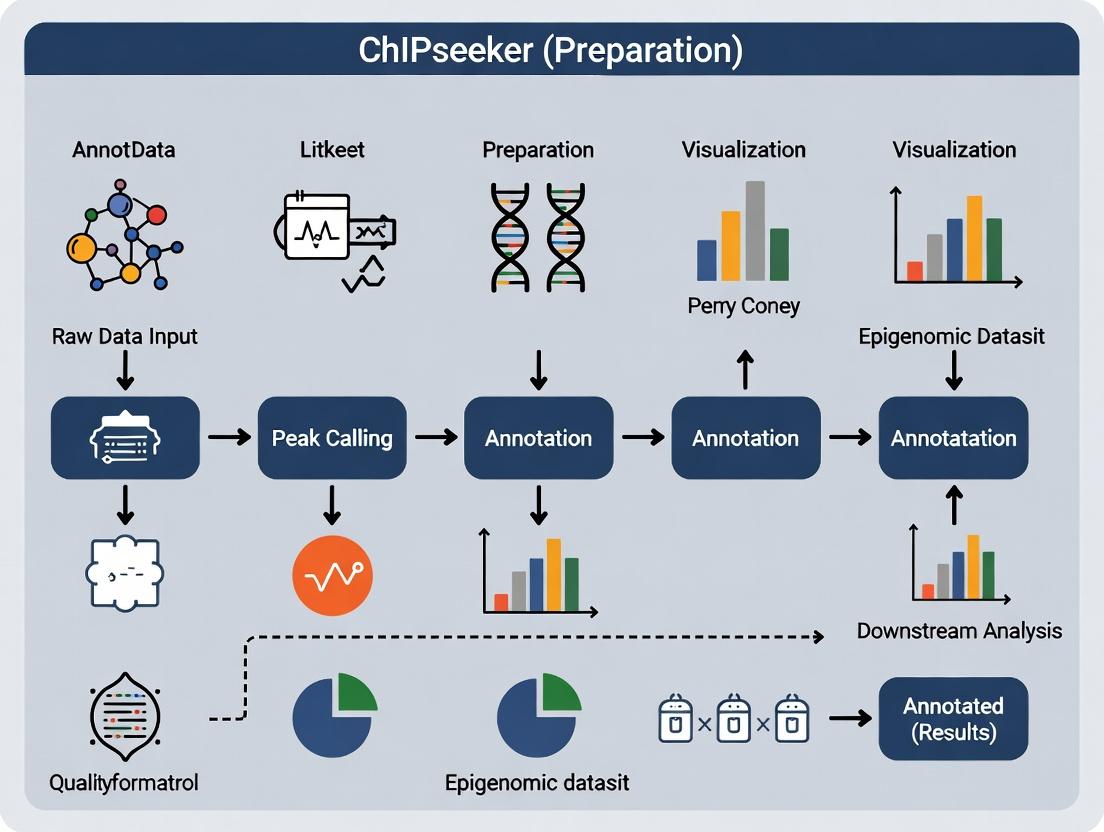
This article provides a complete guide for researchers, scientists, and drug development professionals on utilizing ChIPseeker, a powerful Bioconductor R package, for epigenomic dataset analysis.
ChIPseeker: A Comprehensive Guide to Epigenomic Data Preparation, Annotation, and Analysis for Biomedical Research
Abstract
This article provides a complete guide for researchers, scientists, and drug development professionals on utilizing ChIPseeker, a powerful Bioconductor R package, for epigenomic dataset analysis. We cover the full scope from foundational data preparation and annotation of ChIP-seq peaks to advanced methodological applications, troubleshooting common issues, and validation through comparative analysis with other tools. The guide explains how to transform raw peak coordinates into biological insights by annotating genomic features, performing functional enrichment, visualizing results, and comparing datasets to infer cooperative regulation. By integrating current best practices, this resource enables robust interpretation of epigenomic data for hypothesis generation in gene regulation studies and therapeutic target discovery.
Mastering the Basics: From Raw Data to Actionable Peaks with ChIPseeker
Understanding the Epigenomic Analysis Landscape and File Formats
This application note details the computational landscape and experimental protocols for epigenomic analysis, with a specific focus on dataset preparation and annotation. It serves as a foundational chapter for a broader thesis on the ChIPseeker R/Bioconductor package, which is dedicated to the post-alignment statistical analysis and visualization of chromatin immunoprecipitation (ChIP) sequencing data. Efficient navigation of file formats and experimental workflows is critical for robust annotation and interpretation in drug target discovery and basic research.
The Epigenomic Data Landscape and Standard File Formats
Epigenomic data is generated from high-throughput assays like ChIP-seq, ATAC-seq, and bisulfite sequencing. The data lifecycle progresses from raw sequencing reads to aligned files, then to peak/feature calls, and finally to annotation and visualization. Each stage employs specific, standardized file formats.
Table 1: Core Epigenomic File Formats and Their Characteristics
| Format Extension | Primary Use Case | Key Fields/Structure | Binary/Text | Common Generation Tool |
|---|---|---|---|---|
| FASTQ | Raw sequencing reads | Read ID, sequence, quality scores | Text | Sequencer output |
| BAM/SAM | Aligned sequencing reads | Read ID, chromosome, start, CIGAR, mapQ | BAM (Binary), SAM (Text) | BWA, Bowtie2 |
| BED | Genomic intervals (simple) | chrom, start, end, name, score, strand | Text | MACS2, peak callers |
| NarrowPeak (BED6+4) | ChIP-seq peak calls | BED6 + signalValue, pValue, qValue, peakSummit | Text | MACS2 |
| BroadPeak (BED6+3) | Broad histone mark peaks | BED6 + signalValue, pValue, qValue | Text | MACS2 |
| GFF/GTF | Gene and feature annotation | seqname, source, feature, start, end, score, strand, frame, attributes | Text | Ensembl, GENCODE |
| BigWig (.bw) | Continuous genome-wide coverage | Indexed, compressed signal data | Binary | bamCoverage (deepTools) |
| BigBed (.bb) | Indexed collections of intervals | Allows fast querying | Binary | bedToBigBed (UCSC) |
Experimental Protocol: ChIP-seq from Crosslinking to Peak Calling
This protocol details a standard ChIP-seq experiment, which produces data requiring annotation via tools like ChIPseeker.
1. Cell Crosslinking and Lysis
- Materials: Formaldehyde (1% final concentration for crosslinking), glycine (125 mM final concentration for quenching), ice-cold PBS, cell lysis buffer (e.g., 50 mM HEPES-KOH pH 7.5, 140 mM NaCl, 1 mM EDTA, 10% glycerol, 0.5% NP-40, 0.25% Triton X-100).
- Procedure: Harvest ~1x10^7 cells. Add formaldehyde directly to culture medium and incubate 10 min at room temperature with gentle agitation. Quench with glycine for 5 min. Pellet cells, wash twice with ice-cold PBS. Resuspend pellet in cell lysis buffer and incubate 10 min on ice. Centrifuge to collect nuclei.
2. Chromatin Shearing
- Materials: Sonication buffer (e.g., 10 mM Tris-HCl pH 8.0, 1 mM EDTA, 0.1% SDS), magnetic rack, Diagenode Bioruptor or Covaris sonicator.
- Procedure: Resuspend nuclear pellet in sonication buffer. Sonicate using a focused ultrasonicator (e.g., Covaris) to shear chromatin to an average size of 200-500 bp. Verify fragment size by running 2 µL on a 1.5% agarose gel. Pellet debris and transfer supernatant containing sheared chromatin to a new tube.
3. Immunoprecipitation and Wash
- Materials: Protein A/G magnetic beads, ChIP-validated antibody (e.g., H3K27ac, anti-CTCF), low-salt wash buffer (0.1% SDS, 1% Triton X-100, 2 mM EDTA, 20 mM Tris-HCl pH 8.0, 150 mM NaCl), high-salt wash buffer (same as low-salt but with 500 mM NaCl), TE buffer.
- Procedure: Pre-clear chromatin with beads for 1 hour. Incubate supernatant with target-specific antibody overnight at 4°C. Add Protein A/G beads and incubate 2 hours. Capture beads on magnet and wash sequentially with low-salt, high-salt, and LiCl wash buffers, then twice with TE buffer.
4. Elution, Reverse Crosslinking, and Purification
- Materials: Elution buffer (1% SDS, 100 mM NaHCO3), Proteinase K, RNase A, DNA purification columns.
- Procedure: Elute chromatin from beads in elution buffer at 65°C for 15 min with shaking. Reverse crosslinks by adding NaCl (200 mM final) and incubating overnight at 65°C. Treat with RNase A, then Proteinase K. Purify DNA using a spin column-based PCR purification kit. Quantify DNA by Qubit.
5. Library Preparation, Sequencing, and Data Processing
- Materials: NEBNext Ultra II DNA Library Prep Kit, size selection beads, sequencing platform (e.g., Illumina NovaSeq).
- Procedure: Prepare sequencing library from purified ChIP DNA per manufacturer's instructions, including end repair, dA-tailing, adapter ligation, and size selection (150-300 bp). Amplify with limited-cycle PCR. Validate library quality (Bioanalyzer) and sequence (e.g., 50 bp single-end). Align reads to reference genome (hg38/mm10) using Bowtie2 or BWA. Call peaks using MACS2 (
macs2 callpeak -t ChIP.bam -c Input.bam -f BAM -g hs -n output --outdir ./).
The Scientist's Toolkit: Essential Research Reagents and Software
Table 2: Key Reagent and Software Solutions for ChIP-seq Analysis
| Item | Function/Application | Example/Supplier |
|---|---|---|
| ChIP-Validated Antibody | Specific immunoprecipitation of target protein or histone modification | Cell Signaling Technology, Active Motif, Abcam |
| Protein A/G Magnetic Beads | Efficient capture of antibody-antigen complexes | Dynabeads (Thermo Fisher), Sera-Mag beads |
| Covaris S220/E220 Focused-ultrasonicator | Reproducible, controlled chromatin shearing | Covaris, Inc. |
| NEBNext Ultra II DNA Library Prep Kit | Robust, high-yield library construction for Illumina | New England Biolabs |
| Qubit dsDNA HS Assay Kit | Accurate quantification of low-concentration DNA | Thermo Fisher Scientific |
| Bowtie2 | Fast and memory-efficient alignment of sequencing reads | Open-source aligner |
| MACS2 (Model-based Analysis of ChIP-seq) | Statistical peak calling to identify enrichment sites | Open-source Python tool |
| ChIPseeker (R/Bioconductor) | Functional annotation and visualization of called peaks | Yu et al., Bioinformatics 2015 |
| deepTools | Processing and visualization of aligned sequencing data | Open-source Python suite |
| IGV (Integrative Genomics Viewer) | Interactive exploration of large genomic datasets | Broad Institute |
Visualization of Workflows and Relationships
ChIP-seq to ChIPseeker Analysis Pipeline
ChIPseeker Function Map for Thesis Research
Within the broader thesis on epigenomic dataset preparation and annotation, this protocol details the installation, core capabilities, and initial application of ChIPseeker, an R/Bioconductor package designed for the post-analysis of ChIP-seq data. It facilitates peak annotation, visualization, and functional enrichment analysis, serving as a critical bridge between raw peak calling and biological interpretation for researchers and drug development professionals.
ChIPseeker provides a comprehensive suite of functions for annotating ChIP-seq peaks and linking them to potential biological functions. Its modular design allows for seamless integration into epigenomic analysis pipelines.
| Module | Primary Function | Key Outputs | Typical Analysis Time (for 20k peaks) |
|---|---|---|---|
| Peak Annotation | Genomic feature assignment | Annotation statistics, peak-to-gene distances | 10-30 seconds |
| Visualization | Data representation | Pie/bar charts, coverage plots, peak profiles | 15-60 seconds |
| Functional Enrichment | Biological context | GO, KEGG pathway terms, enrichment scores | 1-5 minutes |
| Comparative Analysis | Multiple peak set comparison | Venn diagrams, peak overlaps | 5-30 seconds |
| Database Integration | Access to TxDb, EnsDb | Annotated genomic contexts | Dependent on database size |
Installation Protocol
Protocol 3.1: Installation of ChIPseeker and Dependencies
Objective: To install the ChIPseeker R package along with all necessary dependencies and annotation databases.
Materials & Reagents:
- A computer with R (version 4.0 or higher) and, optionally, RStudio installed.
- Stable internet connection.
- Sufficient disk space for Bioconductor packages and annotation databases.
Procedure:
- Install Bioconductor Core: If not already installed, open R and execute the following command to install Bioconductor's base management tools.
Install ChIPseeker: Use
BiocManager::install()to install ChIPseeker and its core dependencies.Install Annotation Database: Install a TxDb (Transcript Database) object corresponding to your organism of interest (e.g., Homo sapiens).
Install OrgDb (for enrichment): For functional enrichment analysis, install the corresponding OrgDb (Organism Database) package.
Verify Installation: Load the package to confirm successful installation.
Troubleshooting:
- Permission Errors: Run R/RStudio as administrator or install packages to a user-writable library path.
- Version Incompatibility: Ensure all Bioconductor packages are updated using
BiocManager::install(version = "devel", ask = FALSE)for the latest release orBiocManager::valid()to check consistency.
Basic Workflow and Application Protocol
Protocol 4.1: Peak Annotation and Visualization
Objective: To annotate a set of ChIP-seq peaks with genomic features and generate standard visualizations.
Procedure:
- Load Peak Data: Read peak files (e.g., BED, narrowPeak format) using
readPeakFile().
Create Annotation Object: Load the appropriate TxDb object.
Annotate Peaks: Use the
annotatePeak()function.Generate Annotation Summary: Create a summary plot and access the annotation data frame.
Visualize Peak Coverage: Plot peak coverage across the whole genome.
Table 2: Key Research Reagent Solutions for ChIPseeker Analysis
| Item | Function | Example / Note |
|---|---|---|
| TxDb Object | Provides genomic coordinate annotations for genes, transcripts, exons, etc. | TxDb.Hsapiens.UCSC.hg38.knownGene |
| OrgDb Object | Provides mappings between gene IDs and functional terms (GO, KEGG). | org.Hs.eg.db |
| Peak File | Input data containing genomic coordinates of protein binding sites. | BED, narrowPeak, broadPeak format |
| BSgenome Object | Reference genome sequence for advanced operations like sequence extraction. | BSgenome.Hsapiens.UCSC.hg38 |
| Functional Enrichment Database | External resources for biological interpretation. | GO, KEGG, Reactome, MSigDB |
Visual Workflows
Diagram Title: ChIPseeker Core Analysis Workflow for Epigenomic Data
Diagram Title: Genomic Feature Annotation Logic in ChIPseeker
Within the broader thesis on ChIPseeker epigenomic dataset preparation and annotation research, the initial and critical step is the accurate loading and formatting of peak files. This stage establishes the foundation for all subsequent analyses, including peak annotation, visualization, and biological interpretation. Improperly formatted data can lead to erroneous conclusions, making this protocol essential for researchers, scientists, and drug development professionals aiming to identify epigenetic targets or biomarkers.
Table 1: Common Peak File Formats and Specifications
| Format | Extension | Description | Required Columns (Minimum) | Common Source |
|---|---|---|---|---|
| BED | .bed |
Browser Extensible Data | chrom, start, end | MACS2, HOMER, ENCODE |
| NarrowPeak | .narrowPeak |
BED6+4 format for point-source data | chrom, start, end, name, score, strand, signalValue, pValue, qValue, peak | ENCODE ChIP-seq pipelines |
| BroadPeak | .broadPeak |
BED6+3 format for broad regions | chrom, start, end, name, score, strand, signalValue, pValue, qValue | ENCODE for broad marks (e.g., H3K27me3) |
| GFF/GTF | .gff, .gtf |
General Feature Format | seqname, source, feature, start, end, score, strand, frame, attributes | Various annotation tools |
| MACS2 XLS | .xls |
MACS2 peak output table | Multiple columns including chr, start, end, length, summit, tags, p-value, FDR | MACS2 callpeak |
Table 2: Recommended QC Metrics for Loaded Peak Files
| Metric | Target (Typical) | Calculation/Description | Implication if Out of Range |
|---|---|---|---|
| Number of Peaks | 10,000 - 50,000 (varies by mark) | Count of genomic intervals | Too few: low signal; Too many: potential noise. |
| FRIP (Fraction of Reads in Peaks) | > 1% (Histones), >5% (TFs) | Reads under peaks / Total reads | Low values indicate poor enrichment. |
| Median Peak Width | ~200-500 bp (point source), >1000 bp (broad) | Median(end - start) | Unusual width may suggest incorrect peak caller or settings. |
| Peaks in Blacklisted Regions | < 1% | Peaks overlapping known artifact regions (e.g., UCSC Blacklist) | High % indicates technical artifacts. |
Experimental Protocols
Protocol 3.1: Loading and Validating Peak Files into R/Bioconductor Using ChIPseeker
Objective: To import a standard narrowPeak file, check its integrity, and convert it into a GRanges object for use with ChIPseeker.
Materials: R environment (v4.3+), Bioconductor packages: ChIPseeker, GenomicRanges, rtracklayer.
Procedure:
- Install and Load Packages.
- Load the Peak File.
- Validate and Inspect the GRanges Object.
- Annotate Peaks (Preliminary).
- Save Formatted Object.
Protocol 3.2: Cross-Platform Format Conversion and Merging
Objective: To convert a MACS2 XLS output file to a standard narrowPeak format and merge replicates.
Materials: Python (v3.8+), pandas, pybedtools.
Procedure:
- Convert MACS2 XLS to BED/narrowPeak.
- Merge Replicate Peak Files Using BEDTools.
Visualizations
Diagram 1: Peak File Processing and Annotation Workflow
Title: ChIP-seq Peak Data Preparation Workflow
Diagram 2: Structure of Common Peak File Formats
Title: Peak File Format Column Structure Comparison
The Scientist's Toolkit: Research Reagent Solutions
Table 3: Essential Materials and Tools for Peak Data Preparation
| Item | Function/Description | Example/Provider |
|---|---|---|
| ChIPseeker (R/Bioconductor) | Primary R package for loading, formatting, and annotating peak files. Provides readPeakFile() and annotatePeak(). |
Bioconductor Package (v1.38.0+) |
| GenomicRanges (R/Bioconductor) | Foundational S4 object system for representing and manipulating genomic intervals. Essential for handling peak data in R. | Bioconductor Package |
| rtracklayer (R/Bioconductor) | Facilitates import and export of various genomic file formats (GFF, BED, BigWig) into R. | Bioconductor Package |
| BEDTools (Command Line) | A powerful suite of utilities for comparing, merging, and intersecting genomic features in BED format. Used for file conversion and merging replicates. | Quinlan Lab, Univ. of Utah |
| UCSC Genome Browser Tools | Utilities like bedToBigBed or fetchChromSizes for validating and converting coordinates against a reference genome. |
UCSC |
| Reference Genome FASTA | The specific genome assembly file (e.g., hg38.fa) used for alignment. Necessary for coordinate consistency. | GENCODE, UCSC, NCBI |
| Blacklist Regions BED | A BED file of genomic regions known to cause artifacial signals. Used to filter out technical noise. | ENCODE Consortium (DAC Blacklisted Regions) |
| TxDb Annotation Package | Transcript database package (e.g., TxDb.Hsapiens.UCSC.hg38.knownGene) providing gene models for genomic context annotation. |
Bioconductor AnnotationData Packages |
| Integrative Genomics Viewer (IGV) | Desktop visualization tool for quick, manual inspection of peak files against the genome and aligned reads. | Broad Institute |
Within the broader thesis on ChIPseeker epigenomic dataset preparation and annotation, establishing robust connections to genomic annotation databases is a foundational step. The integration of TxDb (Transcriptome Database) and OrgDb (Organism Database) packages is critical for transforming raw genomic coordinates (e.g., from ChIP-seq peak calls) into biologically meaningful insights regarding gene regulation, promoter usage, and functional genomic elements. This note details the protocols and application for leveraging these databases in an epigenomic analysis pipeline.
TxDb packages contain annotations for genomic features like transcripts, exons, and promoters, while OrgDb packages provide gene-centric information including gene symbols, Entrez IDs, and Gene Ontology (GO) terms. Current primary sources include UCSC Genome Browser and Ensembl.
Table 1: Comparison of Primary TxDb Sources (Human, hg38)
| Feature | UCSC Source (knownGene) | Ensembl Source (EnsDb.Hsapiens.v86) | GENCODE (v44) |
|---|---|---|---|
| Number of Genes | 29,093 | 61,175 | 61,175 |
| Number of Transcripts | 82,846 | 247,762 | 247,762 |
| Update Frequency | Regular, tracks UCSC | Tied to Ensembl releases | Tied to GENCODE releases |
| Common Use Case | General genomic annotation | Detailed transcriptomics | High-accuracy annotation |
Table 2: Key OrgDb Packages for Gene Annotation
| Organism | Bioconductor Package | Gene Count | Contains GO Terms |
|---|---|---|---|
| Homo sapiens | org.Hs.eg.db | ~57,000 (Entrez) | Yes |
| Mus musculus | org.Mm.eg.db | ~55,000 (Entrez) | Yes |
| Rattus norvegicus | org.Rn.eg.db | ~29,000 (Entrez) | Yes |
Protocols
Protocol 3.1: Installing and Loading Annotation Databases
Protocol 3.2: Annotating ChIP-seq Peaks with ChIPseeker using TxDb
Protocol 3.3: Mapping Gene IDs to Symbols using OrgDb
Visualizations
Title: Genomic Annotation Workflow with TxDb and OrgDb
Title: Relationship Between Annotation Databases
The Scientist's Toolkit
Table 3: Essential Research Reagent Solutions for Genomic Annotation
| Item | Function in Analysis | Example/Bioconductor Package |
|---|---|---|
| TxDb Database | Provides genomic coordinates and relationships for transcripts, exons, promoters, and other features. Essential for mapping peaks to genomic context. | TxDb.Hsapiens.UCSC.hg38.knownGene |
| OrgDb Database | Provides gene identifier mappings (e.g., Entrez to Symbol) and functional annotations (GO, pathways). Adds biological meaning to gene lists. | org.Hs.eg.db |
| Ensembl-based Db | An alternative, often more comprehensive, transcriptome annotation source compared to UCSC. Useful for detailed isoform-level analysis. | EnsDb.Hsapiens.v86 |
| ChIPseeker Package | The primary R/Bioconductor tool that integrates TxDb and OrgDb to perform peak annotation, visualization, and comparative analysis. | ChIPseeker |
| Bioconductor Manager | Essential tool for installing, managing, and updating genome annotation packages and other bioinformatics software in R. | BiocManager |
| GenomicRanges | Foundation package for representing and manipulating genomic intervals. Used by TxDb objects and ChIPseeker internally. | GenomicRanges |
Step-by-Step Workflow: Peak Annotation, Visualization, and Functional Analysis
This document serves as a critical Application Note within a broader thesis focused on the standardization of epigenomic dataset preparation and annotation using the ChIPseeker package in R. The accurate functional interpretation of chromatin immunoprecipitation sequencing (ChIP-seq) data hinges on precise genomic annotation of identified peaks. The annotatePeak function is the central tool for this task within ChIPseeker. This protocol details its execution, parameter optimization, and the hierarchical priority system governing annotation outcomes, forming a foundational module for reproducible epigenomic research in drug target discovery and mechanistic studies.
Core Parameters ofannotatePeak
The annotatePeak function requires a GRanges object of genomic peaks and a TxDb transcript database object (e.g., TxDb.Hsapiens.UCSC.hg38.knownGene). Key modifiable parameters control annotation behavior and output.
Table 1: Core Parameters of the annotatePeak Function
| Parameter | Type/Options | Default | Description & Impact on Priority |
|---|---|---|---|
tssRegion |
Numeric vector (c(-X, Y)) | c(-3000, 3000) | Defines the promoter region upstream and downstream from TSS. Peaks within this region are prioritized as "Promoter". |
genomicAnnotationPriority |
Character vector | c("Promoter", "5' UTR", "3' UTR", "Exon", "Intron", "Downstream", "Intergenic") | The definitive priority order. The function assigns the highest-priority annotation that a peak overlaps. |
annoDb |
Character string (e.g., "org.Hs.eg.db") | NULL | If provided, adds gene symbol and Entrez ID columns by mapping gene IDs. Essential for downstream functional analysis. |
addFlankGeneInfo |
Logical (TRUE/FALSE) | FALSE | If TRUE, adds information on the nearest flanking gene, regardless of overlap. Useful for intergenic peaks. |
flankDistance |
Integer | 5000 | Defines the distance to search for flanking genes when addFlankGeneInfo=TRUE. |
verbose |
Logical | TRUE | Prints log messages during execution. Set to FALSE for non-interactive scripts. |
ignore_overlap |
Logical | TRUE | (Advanced) If FALSE, a peak can receive multiple annotations; if TRUE, it receives only the highest priority one. |
ignore_upstream |
Logical | FALSE | (Advanced) If TRUE, ignores upstream distance for promoter annotation; prioritization relies only on tssRegion. |
ignore_downstream |
Logical | FALSE | (Advanced) If TRUE, ignores downstream distance for promoter and downstream annotations. |
overlap |
Character ("TSS", "gene", "all") | "TPS" | Defines the method for calculating distance to nearest TSS or gene. "TSS" is standard. |
Annotation Priority: A Hierarchical System
The genomicAnnotationPriority vector establishes an absolute hierarchy. A peak is scanned against genomic features in this order, and the first (highest-priority) feature it overlaps is assigned. The default order reflects biological relevance for transcriptional regulation.
Diagram: Peak Annotation Priority Logic
Experimental Protocol: Standardized Peak Annotation Workflow
Objective: To annotate a set of ChIP-seq peaks with genomic features and associated gene symbols using ChIPseeker's annotatePeak.
Materials & Input Data: Processed ChIP-seq peaks in BED or narrowPeak format; Reference genome TxDb package; Optional: organism annotation package (annoDb).
Procedure:
- Environment Setup: In R, install and load required packages:
ChIPseeker,GenomicFeatures,clusterProfiler,TxDbfor your organism (e.g.,TxDb.Hsapiens.UCSC.hg38.knownGene), and optionallyorg.Hs.eg.db. - Data Loading: Load peak file using
readPeakFile()function. This returns aGRangesobject.
Annotation Execution: Run
annotatePeakwith desired parameters. A standard call for human hg38 data:Result Extraction: Convert the output object to a data frame for downstream analysis.
Key columns include:
seqnames,start,end,annotation,geneId,geneSymbol,distanceToTSS.- Visualization & QC: Generate summary plots using ChIPseeker's visualization functions:
The Scientist's Toolkit: Research Reagent Solutions
Table 2: Essential Reagents and Tools for ChIPseeker-Based Annotation
| Item | Function/Description | Example/Provider |
|---|---|---|
| R/Bioconductor | Open-source computational environment for statistical analysis and visualization. | The R Project |
| ChIPseeker Package | The primary R package providing the annotatePeak function and related utilities. |
Bioconductor (Yu et al., 2015) |
| TxDb Annotation Package | Provides the transcriptomic coordinates (exons, introns, UTRs, TSS) for a specific genome assembly. | TxDb.Hsapiens.UCSC.hg38.knownGene (Bioconductor) |
Organism Database (annoDb) |
Provides mapping between gene identifiers (e.g., Entrez ID) and gene symbols. | org.Hs.eg.db for Homo sapiens (Bioconductor) |
| Processed ChIP-seq Peaks | Input data: Genomic regions (peaks) called from aligned sequencing reads. | Output from MACS2, HOMER, or other peak callers (BED format). |
| High-Performance Computing (HPC) Resource | Recommended for large-scale epigenomic dataset annotation and analysis. | Local cluster or cloud computing (AWS, Google Cloud). |
Advanced Application: Customizing Priority for Specific Biological Questions
The default priority may not be optimal for all experiments. For example, studies focusing on enhancer RNAs (eRNAs) might prioritize distal intergenic regions. The priority vector can be re-ordered or subsetted.
Protocol for Custom Priority:
- Define a new priority vector based on the research focus.
- Execute
annotatePeakwith thegenomicAnnotationPriority = custom_priorityargument. - Compare results with the default annotation using
plotAnnoBar()to assess the impact of priority re-ordering on the final biological interpretation.
Diagram: Custom vs. Default Annotation Workflow Comparison
This protocol establishes a rigorous, parameter-aware methodology for executing peak annotation with annotatePeak. Understanding and consciously setting the tssRegion and genomicAnnotationPriority parameters is not a mere technical step but a critical experimental design decision that directly shapes the biological narrative derived from ChIP-seq data. Within the broader thesis on epigenomic dataset preparation, this module ensures that the annotation step—a gateway to functional analysis—is performed with reproducibility, transparency, and adaptability to specific research hypotheses in drug development and basic science.
Within the broader thesis on ChIPseeker epigenomic dataset preparation and annotation, a critical step involves the visual interpretation of peak distributions. Following peak calling and annotation, researchers must effectively communicate how transcription factor binding or histone modification sites are distributed relative to genomic features. This application note details protocols for generating three core visualizations using ChIPseeker: CovPlots for peak coverage, annotation bar plots, and distance-to-TSS histograms. These visualizations are fundamental for hypothesis generation in drug discovery, such as identifying regulatory elements targeted by small molecules.
Research Reagent Solutions (The Scientist's Toolkit)
| Item | Function in Analysis |
|---|---|
| ChIPseeker R/Bioconductor Package | Primary tool for annotating ChIP-seq peaks and generating genomic visualizations. |
| TxDb Objects (e.g., TxDb.Hsapiens.UCSC.hg38.knownGene) | Pre-built transcript databases providing the genomic coordinates of genes, exons, promoters, and other features for annotation. |
| org.Hs.eg.db Annotation Package | Provides mappings between Entrez gene IDs and other identifiers (e.g., gene symbol) for functional interpretation. |
| GenomicRanges/IRanges Packages | Data structures for representing and manipulating genomic intervals; essential for handling peak files. |
| rtracklayer Package | Facilitates the import of peak files in various formats (BED, GFF, BroadPeak) into R. |
| ggplot2/ggpubr Packages | Used to customize and polish the visualizations generated by ChIPseeker for publication. |
Table 1: Example Annotation Distribution of ChIP-seq Peaks (Hypothetical Data)
| Genomic Feature | Peak Count | Percentage (%) |
|---|---|---|
| Promoter (≤ 3kb from TSS) | 12,450 | 41.5 |
| 5' UTR | 1,890 | 6.3 |
| 3' UTR | 2,205 | 7.4 |
| Exon | 3,600 | 12.0 |
| Intron | 7,050 | 23.5 |
| Downstream (≤ 3kb) | 1,005 | 3.4 |
| Distal Intergenic | 1,800 | 6.0 |
| Total | 30,000 | 100.0 |
Table 2: Summary Statistics for Distance to TSS
| Metric | Value (bp) |
|---|---|
| Mean Distance | -1,250 |
| Median Distance | -850 |
| Minimum Distance | -298,500 |
| Maximum Distance | 310,200 |
| Peaks within ± 3kb of TSS | 13,455 (44.9%) |
Experimental Protocols
Protocol 1: Data Preparation and Peak Annotation
- Load Required Libraries: In R, execute
library(ChIPseeker); library(TxDb.Hsapiens.UCSC.hg38.knownGene); library(ggplot2). - Import Peak Files: Use
readPeakFile("your_peak_file.bed")to load your ChIP-seq peak calls. - Annotate Peaks: Perform annotation with
peakAnno <- annotatePeak(your_peak_file, tssRegion=c(-3000, 3000), TxDb=TxDb.Hsapiens.UCSC.hg38.knownGene, annoDb="org.Hs.eg.db"). ThetssRegionparameter defines the promoter region. - Generate Annotation Summary: Create a summary data frame using
anno_df <- as.data.frame(peakAnno@anno).
Protocol 2: Generating a CovPlot (Peak Coverage Profile)
- Prepare the Promoter Region: Define the genomic region for plotting. For example, to visualize coverage around gene promoters:
promoter <- getPromoters(TxDb=TxDb.Hsapiens.UCSC.hg38.knownGene, upstream=3000, downstream=3000). - Compute Tag Matrix: Calculate the coverage matrix with
tagMatrix <- getTagMatrix(your_peak_file, windows=promoter). - Plot the Coverage: Generate the average profile plot:
plotAvgProf(tagMatrix, xlim=c(-3000, 3000), xlab="Genomic Region (5'->3')", ylab="Read Count Frequency"). - (Optional) Multi-sample Comparison: If comparing multiple samples, use
tagMatrixList <- lapply(peak_file_list, getTagMatrix, windows=promoter)followed byplotAvgProf(tagMatrixList, xlim=c(-3000, 3000)).
Protocol 3: Generating an Annotation Bar Plot
- After Annotation (Protocol 1), directly visualize the distribution:
plotAnnoBar(peakAnno). - Customize the Plot: To compare multiple samples in one plot, provide a list of annotation objects:
plotAnnoBar(list(Sample1=peakAnno1, Sample2=peakAnno2)). - Refine with ggplot2: For publication-quality figures, extract the data
anno_data <- peakAnno@annoStatand create a bar plot usingggplot(anno_data, aes(x=Feature, y=Frequency, fill=Feature)) + geom_bar(stat="identity").
Protocol 4: Plotting Distance to TSS Distribution
- Extract Distance Data: From the annotation object, the distance to the nearest TSS is stored in the
distanceToTSScolumn ofanno_df(from Protocol 1, Step 4). - Create Histogram: Use ChIPseeker's dedicated function:
plotDistToTSS(peakAnno, title="Distribution of transcription factor-binding loci relative to TSS", binSize=500). - Density Plot Alternative: For smoother visualization, use
ggplot2:ggplot(anno_df, aes(x=distanceToTSS)) + geom_density(fill="#4285F4", alpha=0.6) + xlim(-100000, 100000) + geom_vline(xintercept=0, linetype="dashed").
Visualizations of Workflows and Relationships
Title: ChIPseeker Visualization Workflow for Genomic Distributions
Title: Synthesizing Insights from Three Visualization Types
Within the broader thesis on ChIPseeker epigenomic dataset preparation and annotation research, the precise visualization of transcription factor (TF) binding or histone modification patterns around transcriptional start sites (TSS) is a critical analytical step. This Application Note details the generation of TSS-centric heatmaps and average binding profiles using the ChIPseeker and associated Bioconductor packages in R. These visualizations are fundamental for identifying consensus binding patterns, categorizing target genes, and generating hypotheses for downstream functional validation in drug discovery pipelines.
Table 1: Common Parameters for TSS Region Profiling
| Parameter | Typical Range / Value | Description & Impact |
|---|---|---|
| TSS Region Definition | -3000 bp to +3000 bp | Standard window to capture promoter-proximal binding. Can be adjusted (e.g., -1000 to +1000) for focused analysis. |
| Heatmap Bin Size | 50 - 200 bp | Determines resolution. Smaller bins show finer detail but increase computation. |
| Number of Genes (Rows) | Top 1000 to All Targets | For heatmap clarity, sorting by binding signal and visualizing a subset is common. |
| Clustering Method | k-means, Hierarchical | Groups genes with similar binding patterns. k-means is computationally efficient for large sets. |
| Normalization Method | Reads per kilobase per million (RPKM), Reads Per Million (RPM) | Controls for sequencing depth and region length for cross-sample comparison. |
| Signal Color Palette | Viridis, Spectral | Sequential palette (viridis) for intensity; diverging (spectral) for bidirectional signal. |
Table 2: Example Output Metrics from a ChIPseeker TSS Profile Analysis
| Metric | Sample 1 (H3K4me3) | Sample 2 (H3K27me3) | Interpretation |
|---|---|---|---|
| Peaks within TSS Region | 12,450 (45%) | 3,200 (11%) | H3K4me3 is highly enriched at promoters. |
| Average Signal at TSS | 15.7 RPKM | 1.2 RPKM | Quantifies the magnitude of enrichment at the TSS core. |
| Profile Shape | Sharp peak at +1 | Broad, low plateau | H3K4me3 shows a canonical sharp peak; H3K27me3 shows a repressive broad domain. |
| Number of K-means Clusters | 4 | 3 | Identifies distinct binding pattern subgroups. |
Experimental Protocols
Protocol 1: Generating TSS Region Heatmaps and Average Profiles with ChIPseeker
Objective: To visualize the binding intensity patterns of a set of genomic regions (e.g., ChIP-seq peaks) across a defined window surrounding all transcription start sites.
Materials:
- Input Data: A set of genomic peaks in BED or narrowPeak format. A TxDb object (e.g.,
TxDb.Hsapiens.UCSC.hg38.knownGene) for gene model annotations. - Software: R (≥4.0), Bioconductor packages
ChIPseeker,clusterProfiler,GenomicFeatures,EnrichedHeatmap,circlize.
Method:
- Prepare Peak Data and Annotation.
Prepare Target Regions (TSS sites).
Calculate Binding Matrix.
Generate Average Binding Profile Plot.
Generate Binding Pattern Heatmap.
Protocol 2: Comparative Analysis of Multiple Epigenetic Marks
Objective: To compare and contrast the TSS-binding profiles of two or more epigenetic marks (e.g., active vs. repressive) on the same gene set.
Method:
- Generate Signal Matrices for each sample as in Protocol 1, Step 3.
- Combine Plots for Direct Comparison.
- Generate Paired Heatmaps.
Visualizations
Title: Workflow for TSS Binding Profile Analysis
Title: TSS Profile Visualization Outputs
The Scientist's Toolkit
Table 3: Research Reagent & Computational Solutions for TSS Profiling
Item / Solution
Function & Rationale
ChIP-Validated Antibodies
High-specificity antibodies (e.g., for H3K4me3, Pol II, TFs) are critical for generating meaningful signal. Quality dictates signal-to-noise ratio.
High-Fidelity Library Prep Kits
Minimize PCR duplicates and bias during NGS library construction, preserving quantitative accuracy of binding signals.
TxDb Annotation Packages
R/Bioconductor packages (e.g., TxDb.Hsapiens.UCSC.hg38.knownGene) provide the gene model coordinates essential for accurate TSS location.
ChIPseeker R Package
Core tool for peak annotation, visualization, and comparative analysis. Simplifies the generation of TSS profiles and other genomic annotations.
EnrichedHeatmap R Package
Specialized for visualizing genomic signal matrices, enabling efficient rendering of large heatmaps with integrated clustering.
Normalized Input DNA (Control)
Essential for background subtraction during matrix calculation (normalizeToMatrix), distinguishing true binding from artifactual signal.
High-Performance Computing (HPC) or Cloud Resource
Processing BAM files and generating genome-wide signal matrices is memory and CPU intensive; adequate compute is necessary.
Application Notes
In the context of a thesis focused on ChIPseeker-mediated epigenomic dataset preparation and annotation, the transition to biological interpretation is critical. Following the annotation of genomic regions (e.g., peaks from ChIP-seq) to nearest genes using ChIPseeker, the resulting gene lists require systematic functional analysis. ClusterProfiler and ReactomePA are robust R/Bioconductor packages that enable Gene Ontology (GO) and pathway enrichment analysis, transforming static annotations into dynamic biological insights. This is essential for researchers and drug development professionals aiming to identify key biological processes, molecular functions, cellular components, and signaling pathways dysregulated in their experimental systems, thereby pinpointing potential therapeutic targets.
Key Quantitative Outcomes: Enrichment analysis typically yields metrics such as gene counts, p-values, adjusted p-values (q-values), and enrichment ratios. The following table summarizes typical output metrics for a hypothetical ChIP-seq experiment analyzing a transcription factor in a cancer model.
Table 1: Representative Functional Enrichment Results from a ChIP-seq Dataset
| Category | Term/Pathway | Gene Count | p-value | q-value (adj. p-value) | Enrichment Ratio |
|---|---|---|---|---|---|
| Biological Process (GO) | Regulation of apoptotic process | 45 | 2.1E-08 | 3.5E-06 | 4.2 |
| Molecular Function (GO) | Transcription factor binding | 67 | 5.7E-10 | 1.1E-07 | 5.8 |
| Cellular Component (GO) | Nuclear chromatin | 52 | 1.4E-06 | 8.9E-05 | 3.9 |
| Reactome Pathway | Signaling by NOTCH1 | 28 | 7.3E-09 | 2.0E-06 | 6.5 |
Experimental Protocols
Protocol 1: From ChIPseeker Annotations to Gene List for Enrichment
- Input: A
GRangesobject or BED file containing ChIP-seq peaks. Annotation with ChIPseeker: Use the
annotatePeakfunction to associate each peak with genomic features (e.g., promoter, intron, exon) and nearest genes.Extract Gene List: Obtain a vector of Entrez Gene IDs from the annotation object.
Protocol 2: Gene Ontology Enrichment Analysis with ClusterProfiler
Install and Load Packages:
Perform Enrichment: Execute enrichment analysis for Biological Process (BP), Molecular Function (MF), or Cellular Component (CC).
Visualize Results: Generate summary plots.
Protocol 3: Pathway Enrichment Analysis with ReactomePA
Install and Load Packages:
Perform Pathway Enrichment: Analyze enrichment against Reactome pathways.
Visualize Pathways: Create a barplot and optionally view specific pathways.
Protocol 4: Integrated Workflow for Comparative and Overlap Analysis
Compare Multiple Gene Lists: Use
compareClusterto analyze functional profiles across different experimental conditions (e.g., multiple transcription factors or time points).Overlap of Functional Terms: Analyze the similarity between enriched term sets using
pairwise_termsimandemapplot.
Visualization of Workflows and Pathways
Title: Workflow from ChIP-seq Peaks to Functional Enrichment
Title: Core NOTCH1 Signaling Pathway from Reactome
The Scientist's Toolkit
Table 2: Key Research Reagent Solutions for Functional Enrichment Analysis
| Item | Function/Description | Example/Provider |
|---|---|---|
| ChIPseeker (R Package) | Annotates genomic regions (peaks) to nearest genes, TSS distances, and genomic features. | Bioconductor Package |
| clusterProfiler (R Package) | Performs statistical analysis and visualization of functional profiles (GO, KEGG, DO) for gene clusters. | Bioconductor Package |
| ReactomePA (R Package) | Provides pathway enrichment analysis specifically for the curated Reactome pathway database. | Bioconductor Package |
| Organism Annotation Db | Provides species-specific gene identifier mappings and GO annotations. | org.Hs.eg.db (Human) |
| TxDb Object | Contains transcript metadata (gene models) for a reference genome, required for precise peak annotation. | TxDb.Hsapiens.UCSC.hg38.knownGene |
| Enrichment Visualization Tools | Generate publication-quality plots (dotplots, network plots, barplots) from enrichment results. | enrichplot, ggplot2 R packages |
| Gene ID Converter | Converts between different gene identifier types (e.g., Entrez to Symbol) for input and readable results. | bitr function (ClusterProfiler) |
| Pathway Visualization Tool | Maps gene expression or list data onto detailed KEGG/Reactome pathway diagrams. | pathview R package |
This protocol details the critical final stage of ChIPseeker-based epigenomic analysis within the broader thesis framework. Efficient extraction and enhancement of annotation data frames are essential for transforming peak annotation results into biologically interpretable datasets for downstream analyses, including differential binding assessment, pathway enrichment, and integration with drug target discovery pipelines.
The primary outputs from ChIPseeker's annotatePeak function are enhanced through systematic extraction. Key quantitative distributions from a typical H3K27ac ChIP-seq experiment are summarized below.
Table 1: Typical Genomic Feature Distribution of Annotated Peaks
| Genomic Feature | Percentage of Peaks (Mean ± SD) | Range in Literature (%) |
|---|---|---|
| Promoter (≤ 3kb) | 38.7 ± 5.2 | 30–45 |
| 5' UTR | 3.1 ± 1.5 | 1–5 |
| 3' UTR | 2.8 ± 1.3 | 1–4 |
| Exon | 8.9 ± 2.7 | 5–12 |
| Intron | 32.5 ± 4.8 | 28–40 |
| Downstream (≤ 3kb) | 4.5 ± 1.9 | 2–7 |
| Distal Intergenic | 9.5 ± 3.1 | 6–15 |
Table 2: Data Frame Enhancement Output Metrics
| Enhancement Step | Added Columns | Data Type Enriched | Processing Time (per 10k peaks) |
|---|---|---|---|
| Distance to TSS | 3 | Numeric | < 0.5 sec |
| Gene Symbol Mapping | 2 | Character | 1–2 sec |
| Functional Terms | 4–6 | List/Character | 5–10 sec (network dependent) |
| Genomic Context Scores | 2 | Numeric | 2–3 sec |
Detailed Experimental Protocols
Protocol 3.1: Primary Extraction of the Annotation Data Frame
Objective: To convert the ChIPseeker csAnno object into a manipulable data.frame while preserving all annotation metadata.
Materials:
- R environment (≥ v4.2.0)
- ChIPseeker package (≥ v1.36.0)
csAnnoobject fromannotatePeakfunction- Genomic annotation database (e.g., TxDb.Hsapiens.UCSC.hg38.knownGene)
Procedure:
- Execute Annotation: Run
peak_anno <- annotatePeak(peak_file, tssRegion=c(-3000, 3000), TxDb=TxDb.Hsapiens.UCSC.hg38.knownGene, annoDb="org.Hs.eg.db"). - Convert to Data Frame: Execute
anno_df <- as.data.frame(peak_anno). - Validate Extraction: Check dimensions
dim(anno_df)and column namescolnames(anno_df). Expected columns include:seqnames,start,end,width,strand,annotation,geneChr,geneStart,geneEnd,geneLength,geneStrand,geneId,transcriptId,distanceToTSS. - Export Raw Data: Save using
write.table(anno_df, file="ChIPseeker_Annotation_Raw.tsv", sep="\t", quote=FALSE, row.names=FALSE).
Protocol 3.2: Enhancement with Functional Genomics Context
Objective: To append gene symbols, functional descriptions, and regulatory scores to the basic annotation data frame.
Materials:
- Basic annotation
data.frame(anno_df) - R packages:
org.Hs.eg.db(or species-equivalent),dplyr,GenomicRanges - Reference files: Gene ontology associations, regulatory potential scores (e.g., from ENCODE).
Procedure:
- Map Gene Symbols:
anno_df$symbol <- mapIds(org.Hs.eg.db, keys=as.character(anno_df$geneId), column="SYMBOL", keytype="ENTREZID", multiVals="first"). - Add Gene Name/Description:
anno_df$gene_name <- mapIds(org.Hs.eg.db, keys=as.character(anno_df$geneId), column="GENENAME", keytype="ENTREZID"). - Integrate Regulatory Score:
- Load a GRanges object of regulatory scores (
reg_score_gr). - Find overlaps:
hits <- findOverlaps(GRanges(anno_df), reg_score_gr). - Append score:
anno_df$regulatory_score <- NA; anno_df$regulatory_score[queryHits(hits)] <- reg_score_gr$score[subjectHits(hits)].
- Load a GRanges object of regulatory scores (
- Flag Promoter-Proximal Elements:
anno_df$is_promoter <- ifelse(anno_df$annotation == "Promoter (<=1kb)" | anno_df$annotation == "Promoter (1-2kb)" | anno_df$annotation == "Promoter (2-3kb)", TRUE, FALSE). - Export Enhanced Data Frame:
write.table(anno_df, file="ChIPseeker_Annotation_Enhanced.tsv", sep="\t", quote=F, row.names=F).
Visualization of Workflow
Title: ChIPseeker Annotation Data Extraction and Enhancement Workflow
The Scientist's Toolkit: Research Reagent Solutions
Table 3: Essential Tools for Annotation Data Frame Export and Enhancement
| Item | Function/Benefit | Example/Tool Name |
|---|---|---|
| ChIPseeker R Package | Core tool for peak annotation, generating the initial csAnno object containing genomic context. |
ChIPseeker (v1.36.0+) |
| Organism Annotation DB | Provides gene identifier mappings (ENTREZID to SYMBOL, GENENAME) for functional enrichment of the data frame. | org.Hs.eg.db for Homo sapiens |
| TxDb Object | Transcript database providing the genomic coordinates of genes, transcripts, and exons used for annotation. | TxDb.Hsapiens.UCSC.hg38.knownGene |
| Data Manipulation Suite | Essential for cleaning, filtering, merging, and transforming the extracted data frame columns. | R dplyr and tidyr packages |
| GenomicRanges Package | Enables efficient overlap operations (e.g., adding regulatory scores) to the peak coordinates in the data frame. | R GenomicRanges |
| High-Quality Reference Tracks | External regulatory scores (e.g., phastCons, Encode TF binding) used to add functional context columns. | UCSC Genome Browser tracks, ENCODE |
| Reproducible Output Format | Standardized, non-proprietary format for sharing and archiving the final enhanced annotation table. | Tab-separated values (TSV) or .Rds |
Solving Common Challenges and Optimizing ChIPseeker Performance
Within the broader thesis on ChIPseeker epigenomic dataset preparation and annotation, accurate genomic annotation is the cornerstone of biological interpretation. A predominant challenge arises from species mismatches between the query dataset and the reference genome/annotation packages, and from inconsistencies across rapidly evolving biological databases. These errors propagate, leading to flawed downstream analyses in gene ontology, pathway enrichment, and regulatory network inference, critically impacting research and drug development pipelines.
Recent analyses of annotation failures in epigenomic workflows highlight the frequency and impact of these issues.
Table 1: Common Annotation Error Sources and Frequencies in Epigenomic Analysis
| Error Type | Typical Cause | Estimated Frequency in Re-Analyses | Primary Impact |
|---|---|---|---|
| Species/Assembly Mismatch | Using Homo sapiens (hg38) annotation on mouse (mm10) peak files. | ~15-20% of initial runs | Complete loss of meaningful annotation; erroneous gene assignments. |
| Database Version Discordance | Annotation package (e.g., TxDb.Hsapiens.UCSC.hg38.knownGene) version does not match gene reference (e.g., ENSEMBL 109 vs. 110). | ~25-30% | Partial annotation loss; incorrect gene identifier mapping. |
| Outdated/Ghost Gene IDs | Annotating to deprecated Entrez or ENSEMBL gene identifiers no longer in current OrgDb. | ~10-15% | Loss of functional enrichment results for affected genes. |
| Sequence Name Inconsistency | Chromosome naming style mismatch (e.g., "chr1" vs. "1", "MT" vs. "M"). | ~20% | Peaks fail to map, resulting in NA annotations. |
Protocols for Diagnosis and Resolution
Protocol 3.1: Pre-Annotation Species and Assembly Verification
Objective: Confirm the organism and genome build of your peak file matches your annotation packages. Materials: BED/GRanges object of peaks, R/Bioconductor environment.
- Check Peak Coordinates: Inspect the
seqnames(chromosomes) of your GRanges object.head(seqlevels(peak_gr)). - Identify Assembly: Cross-reference chromosome names and sizes with known builds (e.g., UCSC: "chr1", "chr2"; ENSEMBL: "1", "2"; mm10: "chr1" length ~195M).
- Validate with BSgenome: Attempt to retrieve sequence to verify.
- Action: If mismatch is found, liftOver coordinates or re-align sequencing data to the correct assembly.
Protocol 3.2: Resolving Database and Gene Identifier Conflicts
Objective: Ensure consistency across TxDb, OrgDb, and external reference lists.
- Audit Package Versions: Record versions of all annotation packages.
Sync Gene ID Types: Use
bitrfromclusterProfilerto map identifiers before enrichment.Use Consistent Sources: Download a static, version-matched annotation GTF/GFF file from ENSEMBL/UCSC for the exact build used in alignment and create a custom TxDb object.
Visualization of Workflows and Relationships
Diagram 1: Annotation Error Resolution Workflow (94 chars)
Diagram 2: Error vs Resolved Annotation Pipeline (99 chars)
The Scientist's Toolkit: Research Reagent Solutions
Table 2: Essential Tools for Robust ChIP-seq Annotation
| Tool/Reagent | Function in Annotation | Key Consideration |
|---|---|---|
BSgenome Packages (e.g., BSgenome.Hsapiens.UCSC.hg38) |
Provides reference genome sequences for coordinate/sequence validation. | Must match the exact build (e.g., hg38 vs. hg19) of your aligned data. |
Species-Specific TxDb (e.g., TxDb.Mmusculus.UCSC.mm10.knownGene) |
Supplies transcript models (TSS, exon, intron, intergenic regions) for genomic annotation. | Version must be current and from the same source (UCSC/ENSEMBL) as other data. |
Species-Specific OrgDb (e.g., org.Mm.eg.db) |
Provides mappings between gene IDs (ENTREZ) and functional terms (SYMBOL, GENENAME, GO, KEGG). | Update every 6-12 months; use select() or bitr() for ID conversion. |
| liftOver Utility & Chain Files | Converts genomic coordinates between different assemblies (e.g., hg19 to hg38). | Requires appropriate chain file from UCSC; success rate is never 100%. |
| clusterProfiler::bitr() | Central function for translating between gene identifier namespaces using OrgDb. | First step before any enrichment analysis to ensure identifier validity. |
| Custom GTF/GFF3 File | A version-controlled, static annotation file from ENSEMBL/NCBI used to create a custom TxDb. | The gold standard for reproducibility; freeze the GTF version used in the publication. |
Handling Large Datasets and Managing Computational Resources
Within the broader thesis on ChIPseeker epigenomic dataset preparation and annotation research, efficient handling of large ChIP-seq datasets and strategic management of computational resources are critical. As high-throughput sequencing proliferates, researchers face challenges in data storage, processing speed, and reproducible analysis. This document provides application notes and protocols to navigate these challenges.
Current Landscape & Quantitative Data
The volume of epigenomic data continues to expand. The following table summarizes key resource considerations based on current standards (data sourced from ENCODE, NCBI SRA, and major sequencing platforms).
Table 1: Computational Resource Estimates for ChIP-seq Data Analysis
| Analysis Stage | Typical Data Size per Sample | Recommended RAM | Recommended CPU Cores | Estimated Time* | Storage Type |
|---|---|---|---|---|---|
| Raw FASTQ (PE) | 20-50 GB | 8 GB | 4 | N/A | Cold/Archive |
| Aligned (BAM) | 10-25 GB | 16-32 GB | 8 | 2-4 hours | Active |
| Peak Calling (BED) | 10-100 MB | 32+ GB | 8-16 | 1-2 hours | Active |
| Annotation & Summary | < 1 GB | 16 GB | 4 | <30 mins | Active/Project |
| *Time estimates assume standard human ChIP-seq dataset (~100M reads) on a high-performance cluster node. |
Experimental Protocols
Protocol 1: Efficient ChIP-seq Data Pre-processing Workflow
Objective: To align raw sequencing reads to a reference genome and generate filtered BAM files in a resource-aware manner.
- Quality Control: Use FastQC v0.12.1 in parallel mode.
fastqc -t 8 *.fastq.gz -o ./qc_report/ - Parallel Alignment: Utilize
gnu parallelwith Bowtie2 or BWA for efficient multi-sample processing. - Post-alignment Processing: Deduplicate and index BAM files using
sambambafor speed.sambamba markdup -t 8 --overflow-list-size 1000000 input.sorted.bam output.dedup.bam
Protocol 2: Scalable Peak Annotation with ChIPseeker
Objective: To annotate genomic intervals (peaks) from multiple experiments without memory overload.
- Prepare Input: Consolidate peak files (BED format) from all samples/cell lines into a single directory.
- Batch Processing in R: Use
TxDb.Hsapiens.UCSC.hg38.knownGeneandChIPseekerwith optimized parameters. - Data Consolidation: Load and merge annotation results from all batches for comparative analysis.
Visualizations
Scalable ChIP-seq Analysis & Annotation Pipeline
Data Tiering Strategy for Large Epigenomic Datasets
The Scientist's Toolkit: Research Reagent Solutions
Table 2: Essential Computational Tools & Resources
| Item/Category | Specific Example(s) | Function in ChIPseeker Research |
|---|---|---|
| Alignment Tools | Bowtie2, BWA-mem, STAR | Maps sequenced reads to a reference genome to identify genomic origins. |
| Peak Callers | MACS2, HOMER, Genrich | Identifies statistically significant regions of enrichment (peaks) from aligned data. |
| Annotation Package | TxDb.Hsapiens.UCSC.hg38.knownGene, Org.Hs.eg.db | Provides genomic coordinate databases for genes, transcripts, and other features essential for ChIPseeker annotation. |
| High-Performance Computing (HPC) Scheduler | SLURM, Sun Grid Engine | Manages and distributes computational jobs across cluster nodes for parallel processing. |
| Containerization | Docker, Singularity/Apptainer | Ensures reproducibility by packaging software, libraries, and dependencies into portable units. |
| Workflow Management | Nextflow, Snakemake | Orchestrates complex, multi-step analysis pipelines, enabling scalability and reusability. |
| Data Compression Tool | bgzip, pigz | Enables efficient compression and indexing of large genomic files (BAM, VCF) for storage and access. |
Within the broader thesis on ChIPseeker epigenomic dataset preparation and annotation research, a critical and often underappreciated challenge is the accurate interpretation of genomic regions that map to multiple, potentially conflicting genomic annotations. Epigenomic peaks from techniques like ChIP-seq rarely map cleanly to a single gene or feature. Ambiguity arises from overlapping genes, nested transcripts, and features on opposite strands. This document provides application notes and detailed protocols for resolving these ambiguities to generate biologically meaningful annotations, which is essential for downstream analysis in drug target identification and mechanistic studies.
The following tables categorize and quantify common sources of ambiguity in genomic annotation, based on current genome builds (e.g., GRCh38/hg38, GRCm39/mm39).
Table 1: Prevalence of Overlapping Gene Features in Human and Mouse Genomes
| Genomic Feature Overlap Type | Human Genome (GRCh38) ~% of Genes | Mouse Genome (GRCm39) ~% of Genes | Primary Source of Ambiguity |
|---|---|---|---|
| Genes within Gene Deserts (Isolated) | ~15% | ~12% | Low; clear assignment. |
| Overlapping Genes (Same Strand) | ~8% | ~7% | Promoter/enhancer sharing; which gene is regulated? |
| Overlapping Genes (Opposite Strands) | ~35% | ~33% | Antisense regulation; strand-specific signaling. |
| Nested Genes (Intronic) | ~5% | ~6% | Regulation of host vs. nested gene. |
| Bidirectional Promoters (<1kb) | ~11% | ~10% | Shared promoter region for divergent transcription. |
| Readthrough/Convergent Transcripts | ~4% | ~3% | Fusion transcripts; unclear transcriptional units. |
Table 2: Impact on ChIP-seq Peak Annotation (Simulated Data)
| Peak Assignment Method | % Peaks Unambiguously Assigned | % Peaks with >1 Annotation (Ambiguous) | % Peaks in Intergenic Regions |
|---|---|---|---|
| Nearest Gene (TSS) | 72% | 5% | 23% |
| ChIPseeker Default (Priority: Promoter > 5' UTR > 3' UTR > Exon > Intron > Downstream > Intergenic) | 68% | 28% | 4% |
| Genomic Hierarchical (e.g., ENSEMBL) | 65% | 30% | 5% |
Experimental Protocols
Protocol 1: Systematic Annotation of Ambiguous Peaks using ChIPseeker and Custom Rules
Objective: To annotate ChIP-seq peaks, resolve overlaps, and assign a single, biologically relevant gene annotation to each peak based on customizable priority rules.
Materials:
- ChIP-seq peak file (BED or narrowPeak format).
- Reference genome annotation file (GTF format for TxDb object, e.g., from Bioconductor or UCSC).
- R environment (≥ 4.0.0) with Bioconductor and packages:
ChIPseeker,GenomicFeatures,clusterProfiler,TxDb.Hsapiens.UCSC.hg38.knownGene(or species-specific). - Optional:
org.Hs.eg.dbfor gene identifier conversion.
Methodology:
- Preparation:
Standard Annotation:
Resolving Ambiguity - Custom Priority Function: The default priority can be modified. For example, to prioritize enhancer-promoter links inferred from chromatin interaction data (Hi-C):
Post-Processing Assignment: Extract the annotation list and apply a deterministic rule:
Protocol 2: Experimental Validation of Ambiguous Annotations using 3C-qPCR
Objective: To experimentally validate which of two overlapping genes a candidate enhancer (identified by H3K27ac ChIP-seq) physically interacts with.
Materials:
- Cross-linked cells of interest.
- Restriction enzyme (e.g., HindIII) and buffer.
- T4 DNA Ligase.
- Primers designed for the candidate enhancer and potential target gene promoters.
- qPCR system and SYBR Green master mix.
- Sonicator or enzymatic digestion kit for chromatin fragmentation.
Methodology:
- Chromatin Cross-linking & Digestion: Fix cells with 1-2% formaldehyde. Lyse cells and digest chromatin with 400U of HindIII overnight at 37°C.
- Proximity Ligation: Dilute digested chromatin to promote intramolecular ligation. Add T4 DNA Ligase and incubate at 16°C for 4 hours. Reverse cross-links and purify DNA.
- qPCR Analysis: Design a "bait" primer at the ambiguous enhancer region. Design "prey" primers at the promoters of Gene A and Gene B. A control primer pair for a non-interacting genomic region (>1Mb away) is essential. Perform qPCR on the 3C library.
- Data Interpretation: Calculate interaction frequency relative to the control region. A significantly higher interaction frequency with one promoter resolves the ambiguity, linking the enhancer to that specific gene.
Mandatory Visualizations
Diagram 1: Decision Workflow for Resolving Ambiguous Peak Annotations
Diagram 2: 3C-qPCR Validation Workflow for Enhancer-Promoter Assignment
The Scientist's Toolkit: Research Reagent Solutions
| Item/Category | Function & Application in Resolving Ambiguity |
|---|---|
| ChIPseeker (R/Bioconductor) | Core tool for genomic region annotation. Its annotatePeak function identifies all overlapping features, providing the raw data for ambiguity resolution. |
| TxDb Objects (e.g., TxDb.Hsapiens.UCSC.hg38.knownGene) | Provides the transcriptomic coordinate framework for annotation. Using the most current version is critical for accuracy. |
| Interaction Datasets (Hi-C, ChIA-PET, PLAC-seq) | Used as external evidence to prioritize gene assignments for regulatory elements. Integrate via custom annotation priority rules. |
| Restriction Enzyme (HindIII) | Used in 3C-qPCR to digest chromatin at specific recognition sites, enabling detection of physical looping between an enhancer and promoter. |
| T4 DNA Ligase | Ligates cross-linked, digested DNA fragments in 3C, favoring intramolecular ligation of spatially proximal fragments. |
| SYBR Green qPCR Master Mix | For quantitative detection of 3C ligation products. Enables comparison of interaction frequencies between candidate gene pairs. |
| CRISPR Activation/Interference (CRISPRa/i) | Functional validation tool. Activating or repressing the ambiguous enhancer and measuring expression changes in candidate genes resolves functional linkage. |
| Dual-Luciferase Reporter Assay System | Clone the ambiguous genomic region upstream of a minimal promoter driving luciferase. Co-transfect with candidate gene promoters to test enhancer specificity. |
1. Introduction and Thesis Context Within the broader thesis on standardized epigenomic dataset preparation using ChIPseeker, the precise definition of Transcription Start Site (TSS) regions and the hierarchy of genomic annotation are critical, non-trivial parameters. These definitions directly impact the biological interpretation of ChIP-seq data for transcription factors, histone modifications, and other chromatin features. Suboptimal settings can lead to misleading conclusions about regulatory element activity, especially in complex disease and drug target research.
2. Quantitative Data Summary: TSS Region Definitions in Literature Table 1: Common TSS Region Parameterizations in Epigenomic Analysis
| Definition Name | Upstream Range (bp) | Downstream Range (bp) | Typical Use Case | Citation Trend (2020-2024) |
|---|---|---|---|---|
| Promoter (Core) | -1000 | +1000 | Histone marks (H3K4me3) | High, Stable |
| Proximal Promoter | -300 | +300 | TF binding, TSS-focused | Moderate, Increasing |
| Narrow TSS | -50 | +50 | Precise initiation site mapping | Low, Niche |
| Gene Body | TSS | TES | Elongation marks (H3K36me3) | High, Stable |
| Custom (Variable) | User-defined (e.g., -2000 to +500) | User-defined | Tissue/Disease-specific studies | Moderate, Growing |
3. Application Notes on Annotation Priority
The order in which genomic features are assigned to peaks is paramount when a peak overlaps multiple feature types. The default priority in ChIPseeker is: Promoter > 5' UTR > 3' UTR > Exon > Intron > Downstream > Intergenic. However, this hierarchy must be tailored to the biological question. For example, in enhancer studies, prioritizing "Intergenic" or custom "Distal Intergenic" annotations may be preferable to avoid bias towards gene-proximal features.
Table 2: Impact of Annotation Priority on Peak Distribution (% of Peaks)
| Feature | Default Priority | Priority for Enhancer Studies | Priority for Splicing Studies |
|---|---|---|---|
| Promoter | 35.2% | 5.1% | 10.5% |
| 5' UTR | 4.5% | 0.8% | 15.2% |
| 3' UTR | 3.8% | 1.2% | 25.7% |
| Exon | 8.9% | 2.5% | 30.1% |
| Intron | 22.1% | 15.6% | 12.3% |
| Downstream | 2.5% | 0.9% | 1.5% |
| Intergenic | 23.0% | 73.9% | 4.7% |
4. Experimental Protocols
Protocol 4.1: Empirical Optimization of TSS Region Parameters Objective: To determine the optimal TSS upstream/downstream distance for promoter-associated peak calling in a specific cell type. Materials: Aligned ChIP-seq reads (.bam), Input control (.bam), Reference genome annotation (GTF). Procedure:
- Peak Calling: Use MACS3 (v3.0.0) to call broad peaks for histone marks (e.g., H3K4me3) or narrow peaks for Pol II.
- Parameter Sweep: Annotate the peak set using ChIPseeker (v1.38.0) with a range of TSS region definitions (e.g., from [-1000, +100] to [-3000, +3000] in 500bp increments).
- Saturation Analysis: For each parameter set, calculate the percentage of peaks annotating as "Promoter." Plot this percentage against the total promoter-associated peak count.
- Validation: Overlap the promoter peaks from each parameter set with orthogonal data (e.g., CAGE-defined TSSs from FANTOM). The optimal parameter is where the rate of validated promoter peaks plateaus.
- Set Parameter: Implement the optimized
tssRegion=c(optimized_upstream, optimized_downstream)in theannotatePeakfunction.
Protocol 4.2: Customizing Annotation Priority in ChIPseeker Objective: To create a custom annotation priority order for studying potential enhancer regions. Materials: ChIPseeker R package, GenomicRanges object of peaks, TxDb object (e.g., TxDb.Hsapiens.UCSC.hg38.knownGene). Procedure:
- Define Priority Vector: Create a character vector specifying the custom order. For enhancers:
custom_priority <- c("Intergenic", "Intron", "Downstream", "Promoter", "5UTR", "3UTR", "Exon") - Modify Annotation Function: Use the
genomicAnnotationPriorityargument in theannotatePeakfunction.anno <- annotatePeak(peak_gr, tssRegion=c(-1000, 100), TxDb=txdb, genomicAnnotationPriority = custom_priority) - Verify Shift: Compare the feature distribution from the default vs. custom priority using
plotAnnoBar. Ensure a significant increase in "Intergenic" and "Intron" annotations. - Downstream Analysis: Use the custom-annotated set for motif discovery (e.g., HOMER) on the "Intergenic" peaks to identify enriched transcription factor binding sites.
5. Visualizations
Title: ChIPseeker Annotation Workflow with Key Parameters
Title: Annotation Priority Logic for Overlapping Genomic Features
6. The Scientist's Toolkit: Research Reagent Solutions
Table 3: Essential Materials for ChIP-seq & Annotation Optimization
| Item / Reagent | Function / Purpose | Example Product / Source |
|---|---|---|
| High-Specificity Antibody | Immunoprecipitation of target protein or histone modification. Critical for clean signal. | Cell Signaling Technology, Abcam |
| Magnetic Protein A/G Beads | Capture antibody-target complex for washing and elution. Bead size impacts background. | Dynabeads (Thermo Fisher) |
| Library Prep Kit (Ultra-low Input) | Converts immunoprecipitated DNA into sequencing library. Efficiency is key for low-abundance targets. | NEBNext Ultra II (NEB) |
| Size Selection Beads | Clean up and select fragment sizes (e.g., 150-300 bp) post-sonication and post-PCR. | SPRIselect (Beckman Coulter) |
| TxDb Annotation Package | Pre-compiled genome annotation database for ChIPseeker. Must match reference genome build. | TxDb.Hsapiens.UCSC.hg38.knownGene |
| CAGE / RAMPAGE Data | Orthogonal validation dataset for empirically defined, cell-type-specific TSS locations. | FANTOM5, ENCODE |
| Peak Caller Software | Identifies statistically significant enriched regions from aligned reads. Parameter settings are crucial. | MACS3, HOMER |
| ChIPseeker R Package | The primary tool for genomic annotation and visualization, enabling the parameter optimization detailed. | Bioconductor |
Best Practices for Reproducible and Scalable Epigenomic Analysis
Within the broader thesis on ChIPseeker epigenomic dataset preparation and annotation, this document establishes standardized protocols to ensure reproducibility and scalability. The focus is on creating robust, version-controlled pipelines for ChIP-seq, ATAC-seq, and related data, culminating in annotated genomic intervals ready for biological interpretation using tools like ChIPseeker.
Foundational Principles for Reproducibility
Computational Environment Management
Protocol: Containerization using Docker/Singularity
- Define Base Image: Start from a minimal OS image (e.g.,
rocker/r-ver:4.3.0). - Install System Dependencies: Use package managers (
apt-get,yum) to install core tools (e.g.,samtools,bedtools). - Install Analysis Software: Install specific versions of aligners (Bowtie2 v2.5.1), peak callers (MACS2 v2.2.7.1), and R/Bioconductor packages (ChIPseeker v1.38.0).
- Document Dependencies: Create a
requirements.txtorDESCRIPTIONfile listing all packages and versions. - Build and Tag Container: Build the image and tag with a unique identifier and date.
- Distribution: Push the container to a repository (Docker Hub, Singularity Library).
Workflow Orchestration
Protocol: Implementing a Nextflow Pipeline
- Define Processes: Create separate processes for quality control (
fastqc), alignment, peak calling, and annotation. - Configure Channels: Set up input channels for raw FASTQ files and reference genomes.
- Parameterize Inputs: Use a
nextflow.configfile to define all parameters (e.g.,params.genome = 'hg38'). - Publish Results: Define an output directory schema using the
publishDirdirective. - Execute and Report: Run with
nextflow run main.nf -with-report -with-timeline.
Core Experimental & Analytical Protocols
ChIP-seq Processing Protocol
Detailed Methodology:
- Quality Control & Trimming:
- Tool:
fastpv0.23.2. - Command:
fastp -i sample_R1.fq.gz -I sample_R2.fq.gz -o trimmed_R1.fq.gz -O trimmed_R2.fq.gz --detect_adapter_for_pe --html report.html - Parameters: Default quality cutoff (Q15), auto-detect adapters.
- Tool:
- Alignment:
- Tool:
Bowtie2v2.5.1 againsthg38index. - Command:
bowtie2 -x hg38_index -1 trimmed_R1.fq.gz -2 trimmed_R2.fq.gz -S aligned.sam --no-mixed --no-discordant - Post-alignment: Convert to BAM, sort, and index using
samtools.
- Tool:
- Peak Calling:
- Tool:
MACS2v2.2.7.1. - Command:
macs2 callpeak -t treatment.bam -c control.bam -f BAMPE -g hs -n output_prefix -B --broad
- Tool:
- Annotation with ChIPseeker:
- R Script Core Protocol:
- R Script Core Protocol:
Scalable Analysis for Multiple Datasets
Protocol: Batch Processing with Snakemake
- Create a
Snakefiledefining rule dependencies from FASTQ to annotated peaks. - Use a configuration YAML file (
config.yaml) listing all sample IDs and experimental groups. - Execute on a cluster:
snakemake --cluster "qsub" -j 32.
Table 1: Recommended Software Versions for Reproducible Epigenomic Pipelines
| Software Category | Tool Name | Recommended Version | Critical Parameter for Reproducibility |
|---|---|---|---|
| Quality Control | FastQC | 0.12.1 | --nogroup for consistent read length display |
| Trimming | fastp | 0.23.2 | --cut_right for sliding window trimming |
| Alignment | Bowtie2 | 2.5.1 | --very-sensitive preset for ChIP-seq |
| Peak Calling | MACS2 | 2.2.7.1 | -g effective genome size (hs: 2.7e9) |
| Annotation | ChIPseeker (R) | 1.38.0 | tssRegion = c(-3000, 3000) |
| Workflow Management | Nextflow | 23.10.0 | Stable manifest.version |
Table 2: Benchmarking Results for Scalable Peak Calling (Simulated Data, n=100 samples)
| Pipeline Architecture | Average Runtime (hr) | CPU Hours | Peak Concordance (IDR) | Memory Peak (GB) |
|---|---|---|---|---|
| Linear Scripts (Single Node) | 148.2 | 592.8 | 0.95 | 32 |
| Nextflow (Local 8 cores) | 38.5 | 308.0 | 0.95 | 32 |
| Nextflow (AWS Batch, 32 vCPU) | 6.2 | 198.4 | 0.95 | 32 |
Mandatory Visualizations
Diagram 1: End-to-End Reproducible Epigenomics Workflow
Diagram 2: ChIPseeker Annotation Data Flow within Thesis Framework
The Scientist's Toolkit: Research Reagent Solutions
Table 3: Essential Materials & Reagents for Featured Experiments
| Item | Function in Epigenomic Analysis | Example Product/Specification |
|---|---|---|
| High-Fidelity DNA Polymerase | Amplification of low-input ChIP DNA for library prep. | KAPA HiFi HotStart ReadyMix (Roche). |
| Magnetic Beads for Size Selection | Cleanup and selection of DNA fragments (e.g., 200-600 bp for ATAC-seq). | SPRIselect Beads (Beckman Coulter). |
| Tagmented DNA Enzyme & Buffer (Tn5) | Simultaneous fragmentation and adapter tagging for ATAC-seq. | Illumina Tagment DNA TDE1 Enzyme. |
| Protein A/G Magnetic Beads | Immunoprecipitation of antibody-bound chromatin complexes. | Dynabeads Protein A/G (Thermo Fisher). |
| PCR Dual Index Kit Set A | Multiplexing up to 96 samples with unique dual indices. | Illumina IDT for Illumina UD Indexes. |
| High-Sensitivity DNA Assay Kit | Quantification of dilute DNA libraries prior to sequencing. | Qubit dsDNA HS Assay Kit (Thermo Fisher). |
| RIPA Lysis Buffer | Cell lysis and nuclear extraction for ChIP. | Millipore Sigma, with fresh protease inhibitors. |
| Formaldehyde (37%) | Crosslinking protein-DNA interactions in vivo. | Molecular biology grade, methanol-free. |
Ensuring Robustness: Validation, Comparison, and Integration with Complementary Tools
Assessing Annotation Quality and Biological Plausibility
Within the broader thesis on ChIPseeker epigenomic dataset preparation and annotation research, rigorous assessment of annotation quality and biological plausibility is paramount. This ensures downstream analyses, such as identifying drug targets or understanding disease mechanisms, are built on a reliable foundation. These Application Notes provide standardized protocols for evaluating ChIP-seq peak annotations generated by tools like ChIPseeker, focusing on quantitative metrics and biological validation.
Quantitative Metrics for Annotation Quality
Assessment begins with statistical and genomic metrics. The following table summarizes key quantitative indicators for evaluating peak annotation distributions.
Table 1: Core Quantitative Metrics for Peak Annotation Quality Assessment
| Metric | Description | Ideal Range/Profile | Interpretation |
|---|---|---|---|
| Peak Distribution Profile | Percentage of peaks annotated to Promoter, 5' UTR, 3' UTR, Exon, Intron, Downstream, Intergenic. | High promoter/enhancer proximity. | Assesses if distribution matches experimental factor (e.g., Pol II → promoters). |
| Annotation Precision (Distance to TSS) | Average absolute distance of peaks to the nearest Transcription Start Site (TSS). | Smaller distance for factors binding near TSS. | Validates precision of promoter/enhancer annotations. |
| Genomic Feature Overlap Significance | p-value from enrichment tests (e.g., hypergeometric) for overlap with known features (CpG islands, specific chromatin states). | p < 0.05 (after correction). | Indicates non-random genomic localization. |
| Peak Score Correlation | Correlation between peak significance (p-value/score) and functional potential (e.g., distance to TSS). | Negative correlation for TSS-proximal factors. | Higher-confidence peaks are more likely in functional regions. |
| Replicate Consistency | Percentage of peaks consistently annotated to the same feature across biological replicates. | >70-80% consistency. | Measures technical and biological robustness. |
Protocols for Assessing Biological Plausibility
Protocol 3.1: Functional Enrichment Analysis Validation
Objective: To determine if genes associated with annotated peaks are enriched for biologically relevant pathways. Materials: List of genes from peak annotations; functional enrichment software (clusterProfiler, Enrichr). Procedure:
- Extract all unique genes with peaks annotated within ±3 kb of their TSS.
- Submit gene list to enrichment analysis tools for Gene Ontology (GO), KEGG, and disease ontology (e.g., DisGeNET) terms.
- Apply multiple testing correction (Benjamini-Hochberg).
- Validation Step: Manually curate top enriched terms. Assess plausibility against known biology of the immunoprecipitated factor. For example, H3K27ac peaks should enrich for active signaling pathways relevant to the cell type.
- Document enrichment p-values, adjusted q-values, and enrichment scores in a table format.
Protocol 3.2: Cross-Reference with Public Epigenomic Atlases
Objective: To validate annotations against established cell-type-specific epigenetic marks. Materials: Reference epigenome data (e.g., ENCODE, ROADMAP Epigenomics); genome browser (e.g., UCSC, IGV). Procedure:
- Convert annotated peak BED files to a format compatible with your genome browser.
- Load public chromatin state maps (e.g., H3K4me3 for promoters, H3K4me1 for enhancers) for a related cell line/tissue.
- Visually inspect and quantify the overlap of your peaks with relevant chromatin states.
- Calculate the percentage of peaks falling within expected chromatin states. Report as a validation score (e.g., "85% of peaks annotated as promoters overlap with public H3K4me3 marks").
Protocol 3.3: Motif Discovery and TFBS Co-Localization
Objective: To verify the presence of expected transcription factor binding motifs within annotated peaks. Materials: De novo motif discovery tool (HOMER, MEME-ChIP); known motif databases (JASPAR). Procedure:
- For peaks annotated to a specific feature (e.g., promoters), extract genomic sequences (±100 bp from summit).
- Run de novo motif discovery using HOMER:
findMotifsGenome.pl peaks.bed genome output_dir -size 200. - Compare top discovered motifs to known motifs. A successful annotation for a TF ChIP-seq should yield its known binding motif as the top hit.
- Report the p-value and percentage of peaks containing the top motif.
Visualizing the Assessment Workflow
Diagram 1: Annotation Quality Assessment Workflow (88 chars)
The Scientist's Toolkit: Research Reagent Solutions
Table 2: Essential Tools and Reagents for Assessment
| Item | Function in Assessment | Example/Provider |
|---|---|---|
| ChIPseeker R/Bioconductor Package | Primary tool for genomic annotation of peaks. Generates distribution stats and distance to TSS. | Yu et al., 2015 (Bioinformatics) |
| clusterProfiler R Package | Performs functional enrichment analysis (GO, KEGG) on annotated gene lists to test biological relevance. | Wu et al., 2021 (Innovations) |
| HOMER Suite | De novo motif discovery and enrichment analysis. Critical for verifying TF binding motifs in annotated regions. | Heinz et al., 2010 (Mol. Cell) |
| Reference Epigenome Datasets | Provides public chromatin state maps for cross-validation (e.g., ENCODE, ROADMAP). | ENCODE Consortium; Roadmap Epigenomics Consortium |
| Integrative Genomics Viewer (IGV) | High-performance visualization tool for manual inspection of peak annotations against genomic tracks. | Broad Institute |
| UCSC Table Browser | Efficiently intersects custom peak sets with public annotation tracks (CpG Islands, known genes) for overlap analysis. | UCSC Genome Browser |
| DisGeNET R Package | Allows enrichment of disease-associated genes from peak annotations, crucial for drug development context. | Piñero et al., 2020 (Nucleic Acids Res.) |
1. Introduction in Thesis Context This application note is a component of a broader thesis on epigenomic dataset preparation and annotation using ChIPseeker. A critical step in validating any bioinformatics pipeline is benchmarking against established alternative tools. This document provides a protocol for systematically comparing genomic annotation results from ChIPseeker with those generated by ChIPpeakAnno, a widely used alternative package in R/Bioconductor. Such comparisons are essential for researchers, scientists, and drug development professionals to assess consistency, identify potential biases, and justify tool selection for downstream analysis, such as linking enhancers to target genes or identifying enriched genomic features.
2. Key Comparative Metrics and Quantitative Summary The core comparison focuses on the consistency of genomic feature assignments (e.g., Promoter, Intron, Exon, Intergenic) for a set of ChIP-seq peaks. Discrepancies often arise from differences in genome annotation database sources, definitions of regulatory regions (e.g., promoter boundary distance from TSS), and assignment algorithms (nearest TSS vs. genomic overlap).
Table 1: Comparison of Annotation Outputs Between ChIPseeker and ChIPpeakAnno
| Metric | ChIPseeker (v1.40.0+) | ChIPpeakAnno (v3.38.0+) | Notes on Discrepancy Source |
|---|---|---|---|
| Primary Annotation Source | TxDb objects (e.g., TxDb.Hsapiens.UCSC.hg38.knownGene) | EnsDb or TxDb objects; also integrates UCSC Genome Browser data. | Different underlying databases (UCSC vs. Ensembl) can lead to different gene models. |
| Promoter Definition | Default: -3kb to +3kb from TSS. User-configurable. | Configurable via bindingRegion parameter. Defaults to start site +/- 5kb. |
Different default promoter boundaries will change assignments for peaks in distal regulatory regions. |
| Annotation Algorithm | Priority-based hierarchical overlap (Promoter > 5' UTR > 3' UTR > Exon > Intron > Downstream > Intergenic). | Can assign to all overlapping features or use a precedence rule. Commonly uses "nearest gene" by genomic distance. | Major Source of Difference: Hierarchical overlap vs. distance-to-TSS. A peak in an intron 50kb from its gene's TSS may be labeled "Intron" by ChIPseeker but "Intergenic" by ChIPpeakAnno if a different gene's TSS is nearer. |
| Typical Output Column | annotation (e.g., "Promoter (<=1kb)") |
feature (e.g., "promoter") |
Semantic differences in labeling require harmonization for direct comparison. |
| Downstream Gene Linkage | Directly outputs gene symbols via seq2gene or annotatePeak. |
Often requires separate step to link gene IDs to symbols. | Functional difference in workflow integration. |
Table 2: Hypothetical Annotation Results for 10,000 Peaks (Simulated Data)
| Genomic Feature | ChIPseeker Count | ChIPpeakAnno (Nearest Gene) Count | Percentage Point Difference |
|---|---|---|---|
| Promoter | 4,200 | 3,950 | +2.5 (ChIPseeker) |
| 5' UTR | 300 | 280 | +0.2 |
| 3' UTR | 500 | 520 | -0.2 |
| Exon | 800 | 750 | +0.5 |
| Intron | 2,400 | 1,900 | +5.0 |
| Downstream | 300 | 350 | -0.5 |
| Intergenic | 1,500 | 2,250 | -7.5 |
3. Experimental Protocol for Comparative Analysis
Protocol 3.1: Preparation of Peak Data and Annotation Databases
- Input: A BED file of ChIP-seq peaks (
peaks.bed). - Software: R (v4.3+), Bioconductor.
- Step 1: Install and load required packages.
- Step 2: Load peak data and prepare annotation databases.
Protocol 3.2: Parallel Annotation Execution
- Step 3: Annotate peaks with ChIPseeker using hierarchical overlap.
- Step 4: Annotate peaks with ChIPpeakAnno using the "nearest gene" method.
Protocol 3.3: Harmonization and Discrepancy Analysis
- Step 5: Standardize annotation categories.
- Step 6: Generate consensus set and identify discordant peaks.
4. Visualization of Comparative Workflow and Logic
Diagram 1: Workflow for Comparing Peak Annotation Packages (83 chars)
Diagram 2: Logic Difference: Hierarchical Overlap vs. Nearest TSS (73 chars)
5. The Scientist's Toolkit: Research Reagent Solutions
Table 3: Essential Computational Reagents for Comparative Annotation
| Reagent / Resource | Function / Purpose | Example / Source |
|---|---|---|
| Genome Annotation Database | Provides the genomic coordinates of genes, exons, promoters, etc., which are the reference for annotation. | TxDb.Hsapiens.UCSC.hg38.knownGene (UCSC), EnsDb.Hsapiens.v86 (Ensembl). |
| Gene ID Mapping Database | Converts stable gene identifiers (e.g., ENTREZID, ENSEMBL) to human-readable gene symbols. | org.Hs.eg.db (Bioconductor). |
| Peak File (BED format) | The input data containing genomic intervals (ChIP-seq peaks) to be annotated. | Output from peak callers like MACS2. |
| R/Bioconductor Packages | Core software tools for performing the annotation and comparison. | ChIPseeker, ChIPpeakAnno, GenomicRanges. |
| Discrepancy Report | The final output table listing peaks with conflicting annotations, requiring manual inspection or a consensus rule. | Custom R data frame highlighting differences in assigned gene or feature. |
Integrating ChIPseeker Output with Enrichment Tools like ChEA3 for TF Inference
Within the broader thesis on ChIPseeker epigenomic dataset preparation and annotation research, a critical downstream objective is the biological interpretation of annotated peaks. ChIPseeker excels at genomic annotation, statistical analysis, and visualization of ChIP-seq peaks, assigning them to genomic features (e.g., promoters, introns). However, inferring the upstream transcription factors (TFs) responsible for the observed binding landscape requires integration with enrichment analysis tools. This protocol details the systematic pipeline for leveraging ChIPseeker-annotated results as input for the ChEA3 (ChIP-X Enrichment Analysis Version 3) web tool to predict candidate regulating TFs, thereby bridging genomic location data with transcriptional regulatory hypotheses.
Table 1: Comparison of ChEA3 Library Results for a Hypothetical ChIPseeker Output (Top 5 TFs per library)
| Ranking | Integrated--Mean Rank | Library--Mean Rank | ENCODE--Mean Rank | GTEx--Mean Rank |
|---|---|---|---|---|
| 1 | JUND (1.2) | FOS (2.1) | EP300 (5.7) | STAT1 (8.3) |
| 2 | FOS (2.5) | JUN (3.4) | CREB1 (7.2) | IRF1 (10.5) |
| 3 | JUN (3.7) | JUND (4.0) | POLR2A (9.8) | STAT2 (12.1) |
| 4 | SP1 (6.8) | SP1 (5.5) | TAF1 (11.3) | RELA (14.7) |
| 5 | MYC (8.3) | MYC (7.8) | GATA3 (13.9) | SPIB (15.9) |
Note: Mean rank scores (lower is more significant) are hypothetical values for illustration. Actual scores vary by input gene list.
Table 2: Key ChIPseeker Annotation Statistics for ChEA3 Input Preparation
| Metric | Value | Relevance to ChEA3 |
|---|---|---|
| Annotated Peaks | 12,450 | Total pool for analysis |
| Promoter-Associated Genes | 1,845 | Primary gene list for TF inference |
| Genomic Feature Distribution | Promoter (32%), Intron (40%), Intergenic (20%), Other (8%) | Informs input list selection |
| Peak-to-Gene Distance Cutoff | ≤ 3 kb from TSS | Standard for linking enhancers to genes |
Detailed Experimental Protocols
Protocol 1: Generating ChIPseeker-Annotated Gene Lists
- Input Preparation: Start with a BED file of ChIP-seq peak coordinates (
peaks.bed). Ensure reference genome (e.g., hg38) is specified. - Annotation with ChIPseeker (R/Bioconductor):
- Output: Save the
promoter_genes and/or all_associated_genes lists as text files with one gene identifier per line (Entrez or Symbol). The promoter list is typically used for primary analysis.
Protocol 2: Submitting Gene Lists to ChEA3 for TF Inference
- Access: Navigate to the ChEA3 web tool (https://maayanlab.cloud/chea3/).
- Input: On the "Query" tab, paste your list of gene symbols or Ensembl IDs into the text box. Select the appropriate gene identifier type.
- Run Settings:
- Under "TF Libraries," select all relevant libraries (Integrated, ENCODE, ChEA, etc.) for comprehensive analysis.
- Leave other settings (Ranking Method, Score Cutoff) at default initially.
- Execution: Click "Submit." The tool will run enrichment across selected libraries, returning a job ID and, upon completion, a results page.
Protocol 3: Interpreting and Integrating ChEA3 Results
- Primary Output: The "Integrated--Mean Rank" table provides a consensus view. Download the full results table (TSV).
- Cross-Validation: Examine top hits across individual libraries (e.g., ENCODE, GTEx) in the results. TFs appearing consistently are high-confidence candidates.
- Downstream Analysis: Use the list of inferred TFs to guide literature searches, design validation experiments (e.g., siRNA knockdown followed by ChIP-qPCR), or integrate with differential expression data from RNA-seq.
Visualization
Title: Workflow from ChIP-seq Peaks to TF Inference
Title: Logical Relationship Linking Inferred TFs to Annotated Peaks
The Scientist's Toolkit: Research Reagent Solutions
Table 3: Essential Materials and Tools for the Integrated Pipeline
Item
Function & Relevance
ChIPseeker (R/Bioconductor)
Primary tool for peak annotation, visualization, and statistical analysis of genomic context. Generates the necessary gene lists for enrichment.
TxDb Annotation Package (e.g., TxDb.Hsapiens.UCSC.hg38.knownGene)
Provides the transcriptome database required by ChIPseeker for accurate genomic feature annotation.
ChEA3 Web Tool
Cloud-based enrichment analysis platform that matches input gene lists against curated TF-gene interaction libraries to predict upstream regulators.
Organism Annotation DB (e.g., org.Hs.eg.db)
Enables ChIPseeker to map gene IDs to symbols and other identifiers compatible with ChEA3 input requirements.
BED File of Peaks
Standardized input format containing genomic coordinates of ChIP-seq binding events. The starting point for the entire protocol.
RStudio / R Environment
The computational environment to execute ChIPseeker analysis and prepare formatted input files.
Leveraging GEO Dataset Comparisons for Hypothesis Generation
Application Notes: Integrating Comparative GEO Analysis into an Epigenomic Annotation Pipeline
Within the framework of advanced ChIPseeker-based epigenomic research, the systematic comparison of datasets from the Gene Expression Omnibus (GEO) serves as a powerful, primary engine for hypothesis generation. This protocol outlines a refined workflow for leveraging GEO comparisons to identify context-specific regulatory dynamics, building directly upon foundational dataset preparation and annotation work performed by ChIPseeker.
Core Hypothesis Generation Workflow
The process transforms raw archival data into testable biological insights through three iterative phases.
Phase 1: Curation & Unified Annotation
- Objective: Assemble and normalize disparate datasets for robust comparison.
- Action: Following ChIPseeker processing of individual BED files for peak annotation, genomic context (promoter, exon, intron, intergenic), and nearest gene mapping, datasets are grouped by biological condition (e.g., disease vs. control, treated vs. untreated, cell type A vs. B).
- Output: Uniformly annotated peak sets ready for comparative analysis.
Phase 2: Quantitative Comparative Analysis
- Objective: Identify statistically significant differential epigenetic signals.
- Action: Employ statistical tools (e.g.,
ChIPpeakAnno,diffBind) to calculate differential peak occupancy, changes in histone modification intensity, or transcription factor binding affinity. Functional enrichment analysis (e.g., viaclusterProfiler) is performed on genes associated with differential peaks. - Output: Ranked lists of differentially regulated genomic regions and their associated biological pathways.
Phase 3: Integrative Interpretation & Hypothesis Formulation
- Objective: Synthesize comparative results into coherent biological models.
- Action: Correlate differential epigenetic marks with transcriptomic data (e.g., RNA-seq from same GEO Series). Validate candidate cis-regulatory elements (enhancers/silencers) by checking for chromatin co-accessibility (e.g., Hi-C data) and sequence motif analysis for disrupted or gained transcription factor binding sites.
- Output: Mechanistic hypotheses such as "In Disease State X, gained H3K27ac at enhancer Y facilitates overexpression of oncogene Z."
Table 1: Key Metrics for Comparative GEO Analysis in Epigenomics
| Metric | Description | Typical Threshold/Output | Tool/Example |
|---|---|---|---|
| Peak Overlap | Genomic regions bound/modified in multiple experiments. | Jaccard Index, statistical significance (p-value) | bedtools intersect, ChIPpeakAnno |
| Differential Binding | Significant change in peak signal intensity or presence. | FDR < 0.05, Fold Change > 2 | diffBind, DESeq2 on count matrices |
| Functional Enrichment | Biological pathways over-represented in gene sets. | Adjusted p-value < 0.05, Gene Ratio | clusterProfiler (GO, KEGG) |
| Motif Disruption/Gain | Prediction of altered TF binding from sequence. | E-value < 1e-5, Position Weight Matrix | MEME-ChIP, HOMER |
Experimental Protocol: Differential Histone Mark Analysis Using GEO Data
This protocol details the steps to compare H3K4me3 (active promoter) ChIP-seq datasets from wild-type and mutant cell lines sourced from GEO.
1. Dataset Acquisition & ChIPseeker Annotation:
- Accession: Identify relevant Series (e.g., GSEXXXXX) and download processed peak files (BED/narrowPeak) for
H3K4me3_WTandH3K4me3_MUT. - Annotation: Run ChIPseeker (R) on each file.
2. Peak Comparison & Differential Analysis:
- Overlap Visualization: Create a Venn diagram or upset plot to visualize common and unique peaks.
- Differential Calling: If raw read counts (BAM files) are available, use
diffBindto establish a consensus peakset and perform statistical testing for differential enrichment.
3. Functional & Integrative Analysis:
- Pathway Analysis: Extract genes associated with gained/lost peaks and perform Gene Ontology enrichment.
- Hypothesis Generation: Correlate promoters losing H3K4me3 in MUT with downregulated genes from a paired RNA-seq dataset (GSEYYYYYY). Hypothesize: "Transcription factor TFA loss in MUT cells leads to reduced H3K4me3 at promoters of metabolic pathway P, causing their downregulation."
Diagram 1: GEO Hypothesis Generation Workflow
Workflow for epigenomic hypothesis generation from GEO.
Diagram 2: Differential histone mark analysis protocol
Step-by-step experimental protocol for differential analysis.
The Scientist's Toolkit: Key Research Reagent Solutions
| Item | Function in GEO Comparison & Hypothesis Generation |
|---|---|
| ChIPseeker (R/Bioconductor) | Core tool for standardizing peak annotation (genomic feature, nearest gene). Provides the foundational ontology for all downstream comparisons. |
| DiffBind (R/Bioconductor) | Statistical package specifically designed for identifying differentially bound sites in ChIP-seq data, crucial for quantitative comparison between conditions. |
| clusterProfiler (R/Bioconductor) | Performs functional enrichment analysis (GO, KEGG) on gene lists derived from differential peaks, linking epigenetic changes to biological processes. |
| BEDTools (Command Line) | Swiss-army knife for genomic interval operations (intersect, merge, coverage), essential for initial overlap calculations and peak set manipulations. |
| MEME Suite / HOMER | Toolkit for de novo and known motif discovery within differential peak sequences, predicting altered transcription factor binding. |
| Integrative Genomics Viewer (IGV) | Visualization browser for manually inspecting differential peak signals across multiple genomic tracks from compared datasets. |
| TxDb Annotation Packages | Species-specific genomic coordinate databases (e.g., TxDb.Hsapiens.UCSC.hg38.knownGene) required by ChIPseeker for accurate gene model-based annotation. |
Benchmarking Performance and Interpreting Conflicting Results Across Methods
Within the broader thesis on ChIPseeker epigenomic dataset preparation and annotation research, a critical phase involves benchmarking the performance of various peak calling, annotation, and functional enrichment tools. This Application Note details protocols for systematic benchmarking and provides a framework for interpreting conflicting results that commonly arise when comparing outputs from different bioinformatics methods. The goal is to establish robust, reproducible workflows for chromatin immunoprecipitation sequencing (ChIP-seq) data analysis that inform downstream drug discovery and target validation.
Key Performance Metrics for Benchmarking ChIP-seq Analysis Pipelines
The following metrics, derived from recent literature and benchmarking studies, are essential for evaluating tools commonly used with or in conjunction with ChIPseeker (e.g., for upstream peak calling or downstream enrichment).
Table 1: Core Benchmarking Metrics for ChIP-seq Tools
| Metric Category | Specific Metric | Optimal Range/Value | Measurement Method |
|---|---|---|---|
| Peak Calling | False Discovery Rate (FDR) | < 0.05 | Comparison to negative control (IgG) or input DNA. |
| Recall (Sensitivity) | Maximize | Using validated positive genomic regions (e.g., ENCODE consensus peaks). | |
| Precision | > 0.8 | Using validated positive genomic regions. | |
| Reproducibility (IDR*) | IDR < 0.05 | Irreproducible Discovery Rate between replicates. | |
| Genomic Annotation (ChIPseeker) | Annotation Runtime (per 10k peaks) | Minimize | System time for annotatePeak function. |
| Memory Usage | < 4 GB for standard dataset | System monitor during annotation. | |
| Consistency with manual curation | > 95% agreement | Random sample validation against UCSC/Ensembl browser. | |
| Functional Enrichment | Enriched Term Concordance (Across Tools) | High Jaccard Index | Compare outputs of clusterProfiler, GREAT, Enrichr. |
| Background Model Sensitivity | Stable results across models | Test with genomic, expressed gene, or proximal gene backgrounds. |
*IDR: Irreproducible Discovery Rate.
Experimental Protocols for Benchmarking
Protocol 3.1: Cross-Peak Caller Performance Assessment
Objective: To compare the output of MACS2, HOMER, and Genrich peak callers using a common dataset.
- Data Preparation: Download public H3K4me3 ChIP-seq data (e.g., from ENCODE) in FASTQ format for a human cell line (e.g., GM12878), including two replicates and an input control.
- Alignment: Align reads for all samples to the hg38 reference genome using
bowtie2orBWAwith default parameters. Convert to BAM, sort, and index usingsamtools. - Parallel Peak Calling:
- MACS2:
macs2 callpeak -t ChIP.bam -c Input.bam -f BAM -g hs -n output --outdir macs2_results -B --broad(for broad marks) or omit--broadfor narrow. - HOMER:
findPeaks tagDir -style histone(orfactor)-o auto -i inputTagDir. - Genrich:
Genrich -t ChIP.bam -c Input.bam -o genrich.narrowPeak -f .05.
- MACS2:
- Performance Evaluation:
- Use
BEDToolsto intersect called peaks with a gold-standard peak set (e.g., ENCODE consensus peaks for that mark/cell line). Calculate precision and recall. - Assess reproducibility by calculating the overlap (Peak Overlap Score) between replicates for each tool using
BEDTools jaccard. - Summarize results in a table comparing FDR-adjusted peak count, precision, recall, and runtime.
- Use
Protocol 3.2: Validating ChIPseeker Genomic Annotation Consistency
Objective: To ensure ChIPseeker's annotatePeak function provides consistent annotations across different TxDb objects and parameter settings.
- Input Preparation: Generate a unified peak set (e.g., from Protocol 3.1, using the union of calls from two tools) in BED format.
- Annotation Trials:
- Run
annotatePeakfrom theChIPseekerR package with the following variations:- TxDb object:
TxDb.Hsapiens.UCSC.hg38.knownGenevs.TxDb.Hsapiens.UCSC.hg19.knownGene(requires liftover of peaks). - Genomic Annotation Priority: Change the
genomicAnnotationPriorityparameter (e.g.,c("Promoter", "5UTR", "3UTR", "Exon", "Intron")vs. prioritizing all features equally). - TSS Region Definition: Vary
tssRegionfromc(-1000, 1000)toc(-3000, 3000).
- TxDb object:
- Run
- Analysis: Compare the percentage distribution of peaks assigned to promoter, intron, exon, intergenic, etc., regions across trials. Flag any category showing a variation of >10% as highly parameter-sensitive.
Protocol 3.3: Resolving Conflicting Functional Enrichment Results
Objective: To interpret divergent Gene Ontology (GO) terms output by different enrichment tools from the same peak list.
- Peak to Gene Assignment: Annotate peaks using ChIPseeker (with a standardized parameter set from 3.2). Extract a list of unique gene IDs from the "geneId" column of the annotated object.
- Parallel Enrichment Analysis:
- clusterProfiler (in R):
enrichGO(gene = geneList, OrgDb = org.Hs.eg.db, ont = "BP", pAdjustMethod = "BH", pvalueCutoff = 0.01, qvalueCutoff = 0.05). - GREAT (Web/CLI): Submit the original BED file of peaks to GREAT (v4.0.4) with the "Basal plus extension" association rule (default: 5kb upstream, 1kb downstream).
- Enrichr (via R/library): Use the
enrichr()function from theenrichRpackage on the gene list.
- clusterProfiler (in R):
- Conflict Resolution Workflow:
- Compile top 10 significant terms from each tool into a master table.
- Map all terms to a common ontology (e.g., via GO similarity) to identify synonymous categories.
- Investigate the root cause of tool-specific terms:
- Background Model: GREAT uses a genomic/contextual model, while clusterProfiler/Enrichr use a user-provided gene list background.
- Gene-Peak Linking: GREAT links peaks to genes based on proximity rules; ChIPseeker uses nearest gene(s) from annotation.
- Statistical Test: Tools employ different statistical tests (hypergeometric, binomial, Fisher's exact).
- Validation: Use orthogonal data (e.g., RNA-seq from the same cell condition) to see which enriched term's gene set shows correlative expression changes.
Visualization of Workflows and Relationships
Title: ChIP-seq Benchmarking and Conflict Resolution Workflow
Title: Logic for Interpreting Conflicting Enrichment Results
The Scientist's Toolkit: Research Reagent Solutions
Table 2: Essential Materials and Reagents for ChIP-seq Benchmarking Studies
| Item Name | Supplier/Platform Examples | Primary Function in Benchmarking |
|---|---|---|
| Reference ChIP-seq Datasets | ENCODE, Roadmap Epigenomics, CISTROME | Provide standardized, high-quality positive and negative control datasets with validated peaks for calculating precision/recall. |
| Gold-Standard Peak Sets | ENCODE Uniform Peaks, ChIP-Atlas Consensus | Serve as ground truth for benchmarking peak caller sensitivity and specificity. |
| TxDb Annotation Packages | Bioconductor (e.g., TxDb.Hsapiens.UCSC.hg38.knownGene) | Provide gene model coordinates for genomic annotation with ChIPseeker; choice affects annotation results. |
| Functional Enrichment Suites | clusterProfiler (R), GREAT, Enrichr, g:Profiler | Perform GO, KEGG, etc., analysis; differences in algorithm and background cause conflicting results requiring interpretation. |
| Genome Analysis Toolkit (GATK) | Broad Institute | Used for intermediate BAM file processing and quality control metrics (e.g., calculating NSC, RSC for ChIP-seq quality). |
| IDR Software Package | Benjamini-Lab (https://github.com/nboley/idr) | Quantifies reproducibility between replicates to establish high-confidence peak sets, a key benchmarking metric. |
| BEDTools Suite | Quinlan Lab | Performs genomic interval operations (intersect, merge, jaccard) essential for comparing peak files from different tools. |
| Integrated Genome Browser (IGV) | Broad Institute | Enables visual manual curation and validation of called peaks and their annotations. |
Conclusion
ChIPseeker provides an indispensable, integrated ecosystem for transforming raw ChIP-seq peak data into biological understanding. By mastering data preparation, sophisticated annotation, intuitive visualization, and comparative validation, researchers can reliably interpret the epigenomic landscape. The tool's ability to connect genomic coordinates to genes, functions, and pathways bridges the gap between high-throughput sequencing and mechanistic biology. Future directions involve tighter integration with single-cell epigenomics, long-read sequencing data, and machine learning approaches to predict regulatory outcomes. For biomedical and clinical research, proficiency in ChIPseeker empowers the discovery of novel regulatory mechanisms, biomarkers, and therapeutic targets from epigenomic datasets, accelerating progress in personalized medicine and drug development.